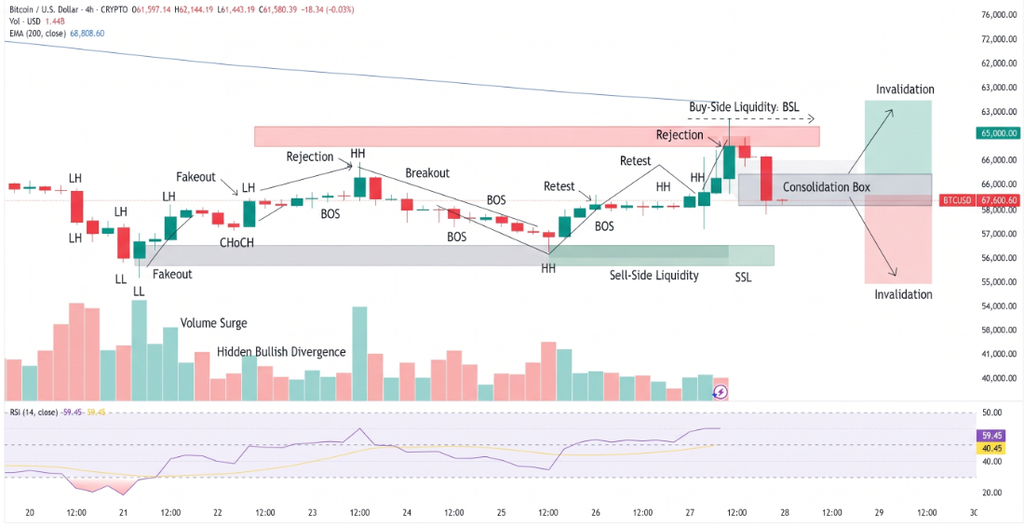
Bitcoin climbed toward $61,500 on Friday, extending its recovery from a two-year low as bargain hunters returned and improving sentiment across financial markets supported cryptocurrencies. The largest digital asset traded at $61,431.90, up 0.75% in the latest reported session. It was on course for a 2.2% weekly gain, potentially ending a seven-week losing streak. However, the rebound remains fragile, with higher US interest-rate expectations and regulatory uncertainty continuing to weigh on the market.
Bitcoin rebounds after seven-week slide
Bitcoin recovered after touching $57,325.70 earlier in the week, its lowest level in two years according to the supplied market snapshot. The move higher followed renewed buying in technology shares, particularly battered artificial-intelligence stocks, which helped improve appetite for risk-sensitive assets.
Trading activity was also relatively subdued during the US Thanksgiving holiday period. Reduced participation can amplify price movements, meaning Friday’s gains may not fully reflect a broad return of institutional demand.
Despite the rebound, Bitcoin remains substantially below its annual highs. Investors are assessing whether the recovery represents a durable change in market direction or a temporary pause in a prolonged correction.
The outlook remains sensitive to several factors:
- Interest rates: Persistent inflation has strengthened expectations of further Federal Reserve tightening.
- Market sentiment: Volatility in technology shares continues to influence demand for riskier investments.
- Regulation: Uncertainty surrounding US cryptocurrency policy remains a concern for investors.
These pressures could limit the recovery as markets approach 2027.
Binance restores withdrawals after $6.3B hack
Binance announced on November 26 that it had completed the recovery process for withdrawal services affected by October’s $6.3 billion security incident. The exchange said restrictions linked to the attack had been lifted across nearly all blockchain networks.
The incident, which occurred on October 29, was described as the largest cryptocurrency theft on record. US authorities and blockchain investigators have linked the attack to North Korean cyber actors. Approximately $2.85 billion of the stolen funds has been frozen, according to reporting by Reuters.
Binance had initially suspended withdrawals on affected networks as a security precaution. Although services returned in stages, the exchange only confirmed the full removal of incident-related restrictions on Thursday. A small number of networks remain temporarily unavailable for routine maintenance or planned upgrades.
The announcement helped ease concerns about access to customer funds, although the incident remains a reminder of the security risks facing cryptocurrency platforms. Binance’s BNB token gained 1.4% in Friday’s reported trading.
Ethereum and altcoins extend recovery
Alternative cryptocurrencies also advanced as Bitcoin stabilised. Ethereum gained nearly 3% to $1,744.92, supported partly by progress on its upcoming Glamsterdam upgrade. Developers scheduled the Hoodi testnet activation for December 15, although a mainnet launch date has not been confirmed.
Other major tokens recorded gains:
- XRP advanced 0.6%.
- Solana climbed 3.2%.
- Cardano increased 2%.
- Dogecoin gained 2.1%.
- Official Trump slipped 0.7%.
Conclusion
Bitcoin’s move toward $61,500 offers relief after seven consecutive weekly losses, but the market has not yet established a sustained recovery. Further gains will depend on improving risk appetite, easing monetary-policy concerns and stronger investor participation. Meanwhile, Binance’s withdrawal recovery and Ethereum’s development progress provide positive industry developments, but they do not remove the broader financial and regulatory risks facing digital assets.
Sources & Methodology
Primary-source standard: Market-moving facts should link to original data releases, regulator notices, company filings or official project announcements whenever available. Secondary reporting is used for additional context, not as a substitute for original evidence.
Page last reviewed: