
The Australian dollar weakened against its US counterpart on Friday, with AUD/USD slipping towards 0.6785 as expectations of further Federal Reserve tightening supported the greenback. Traders are weighing the possibility of a larger US rate increase in December, while persistent Australian inflation has complicated the Reserve Bank of Australia’s policy outlook. Attention is turning to US producer-price data and upcoming central bank minutes for clues about the interest-rate gap between the two economies.
Fed rate expectations strengthen the US dollar
The US dollar has gained support from rising Treasury yields and renewed speculation that the Federal Reserve could deliver a larger-than-usual rate increase next month. Fed Governor Christopher Waller said policymakers should consider a 50-basis-point increase if underlying inflation remains elevated.
According to the reported CME FedWatch figures, traders assigned an 85.5% probability to a December rate increase, including a 14.5% chance of a half-percentage-point move. These figures represent market pricing rather than a confirmed decision by the Federal Reserve.
Commonwealth Bank of Australia currency strategist Carol Kong said the dollar could maintain its near-term strength if further Fed commentary supports a larger increase. However, she also warned that a sharp selloff in equity markets could weaken the US currency by increasing concerns about economic and financial conditions.
Investors are also monitoring comments from Fed officials and the US October Producer Price Index (PPI), which measures changes in prices received by domestic producers. A stronger reading could reinforce concerns about persistent inflation and support expectations of tighter monetary policy.
Australian inflation complicates RBA outlook
Australia faces its own inflation challenge. Rabobank analysts reported that consumer inflation expectations remained at 5.3% in November, more than twice the midpoint of the Reserve Bank of Australia’s inflation target.
Elevated expectations matter because households and businesses may adjust wages and prices based on their assumptions about future inflation. If those expectations remain high, the RBA could face pressure to maintain restrictive interest rates for longer.
The upcoming release of the RBA meeting minutes should provide additional insight into policymakers’ assessment of inflation and economic growth. Investors will also examine the Federal Open Market Committee minutes for indications of how strongly US policymakers are considering further tightening.
The main events influencing AUD/USD include:
- US PPI: A key measure of producer-level inflation.
- RBA minutes: Further guidance on Australian inflation and interest rates.
- FOMC minutes: Details of the debate surrounding the Fed’s policy outlook.
AUD/USD technical outlook: 0.6668 support
AUD/USD remains under pressure below its 20-day and 100-day simple moving averages, according to the supplied daily-chart snapshot. The pair is also trading beneath the lower Bollinger Band, indicating strong selling pressure.
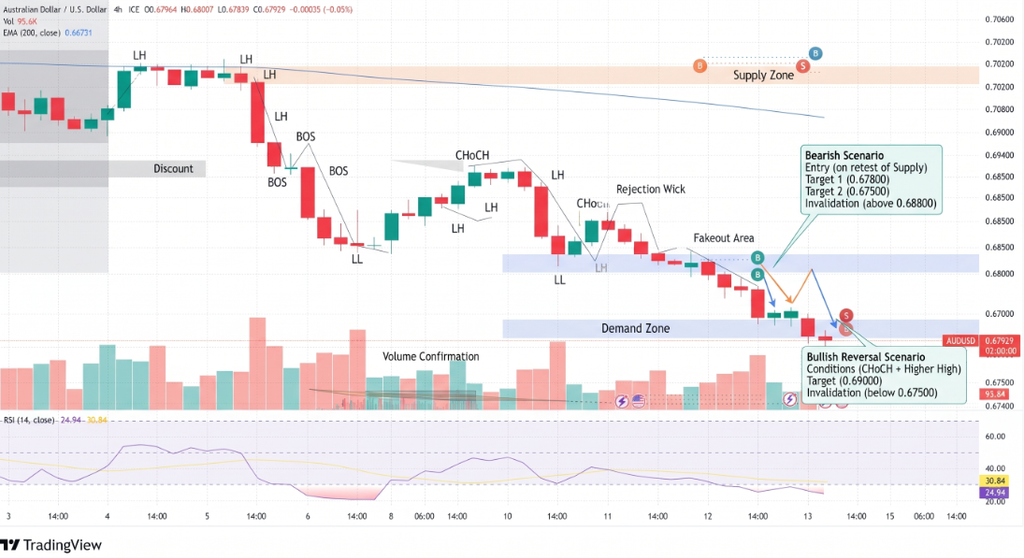
The 14-day Relative Strength Index (RSI) stands at 31.9, close to the conventional oversold threshold of 30. This suggests bearish momentum is stretched, although it does not confirm that a recovery is imminent.
Initial resistance is located around 0.6800, followed by the Bollinger midline near 0.6960 and the psychological 0.7000 level. The 100-day SMA at 0.7025 represents a further hurdle, while 0.7120 marks the upper Bollinger Band.
On the downside, support stands at 0.6668. A break below that level could expose 0.6592 and then 0.6458.
Conclusion
AUD/USD remains vulnerable as stronger US rate expectations support the dollar and Australian inflation expectations keep the RBA cautious. A sustained move below 0.6668 would increase downside risks, while a recovery above 0.6800 could provide the first indication that selling pressure is easing.
Sources & Methodology
Primary-source standard: Market-moving facts should link to original data releases, regulator notices, company filings or official project announcements whenever available. Secondary reporting is used for additional context, not as a substitute for original evidence.
Page last reviewed: