
EUR/USD edged higher towards 1.1060 during Friday’s early European session but remained vulnerable beneath key technical resistance. The euro faces competing pressures: the European Central Bank is weighing the inflationary effects of higher energy costs against uneven regional growth, while hawkish Federal Reserve signals have strengthened expectations of further US rate increases. With traders reassessing the policy outlook on both sides of the Atlantic, the currency pair’s recovery remains limited as investors monitor central bank commentary and important technical levels.
ECB caution limits euro recovery
European Central Bank policymaker Philip Lane said that falling energy prices would not automatically remove inflation concerns. The ECB must assess whether previous fuel-cost increases are spreading into wages, services and other consumer prices before determining its next policy steps.
Economists surveyed by Reuters have largely expected another ECB deposit-rate increase in December, although views differ over whether tightening will continue into 2027. More than one-third reportedly anticipate an additional increase early next year as inflation remains above the central bank’s 2% target.
However, higher interest rates do not necessarily guarantee a stronger euro. If tighter monetary policy weakens economic activity, investors may question whether the ECB can continue raising borrowing costs without damaging growth.
Analysts at NBC have described the euro as caught between persistent inflation and an uneven economic outlook. They argue that additional rate increases could provide limited currency support if growth expectations deteriorate. Their longer-term EUR/USD projections should be treated as forecasts rather than established outcomes, particularly where the supplied figures refer to an unclear forecast horizon.
Fed hawkishness keeps dollar supported
The US dollar has benefited from Federal Reserve officials’ warnings that inflation remains persistent. Some policymakers have indicated that a larger rate increase could remain an option if price pressures fail to moderate.
According to the CME FedWatch Tool, traders assigned approximately a 14.5% probability to a 50-basis-point December increase in the reported market snapshot, compared with no probability priced in the previous week. This represents changing market expectations, not a commitment by the Fed.
New York Fed President John Williams has also emphasised the resilience of the US economy and the need to bring inflation sustainably towards the central bank’s 2% objective. A restrictive policy outlook can support the dollar by keeping US yields attractive relative to those available elsewhere.
Key factors influencing the pair include:
- ECB policy: Energy-related inflation and regional growth.
- Fed expectations: The possibility of further US rate increases.
- Economic data: Inflation, employment and activity indicators.
EUR/USD technical outlook: 1.1000 support
EUR/USD trades below its 100-day simple moving average, maintaining a bearish near-term structure. The Relative Strength Index (RSI) stands at 35.19, indicating weak momentum but remaining above the conventional oversold threshold of 30.
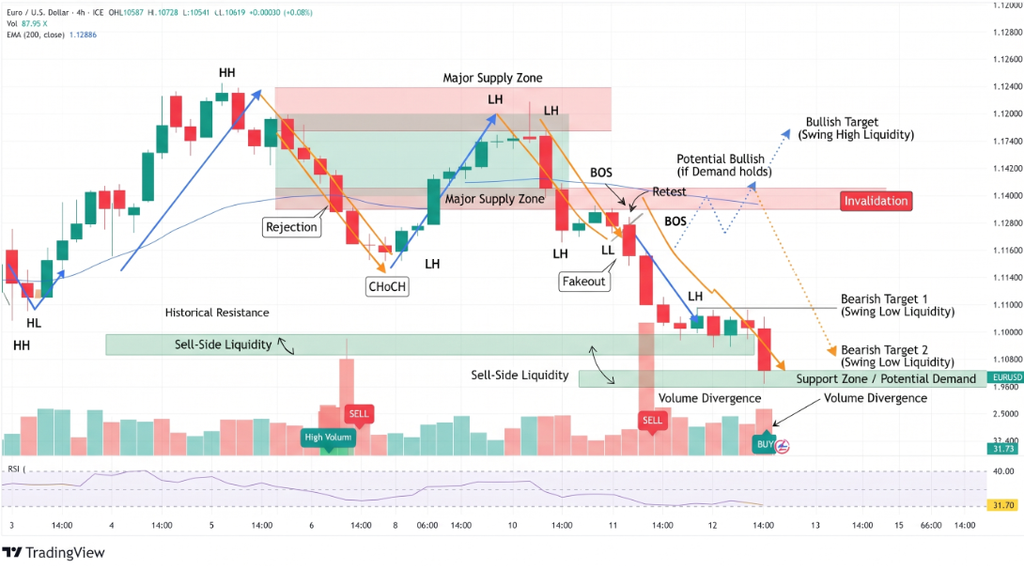
The pair is also pressing the lower Bollinger Band, suggesting sustained selling pressure. Initial resistance sits at 1.1100, followed by the middle Bollinger Band near 1.1175 and the upper band around 1.1280. The 100-day SMA near 1.1400 represents a more significant barrier.
On the downside, 1.1000 is the immediate psychological support. A decisive break could expose 1.0951, followed by 1.0733.
Conclusion
EUR/USD remains under pressure as hawkish Fed expectations support the dollar while cautious ECB policy signals restrict euro gains. A sustained move above 1.1100 could improve the near-term outlook, but a break below 1.1000 would increase the risk of deeper losses.
Sources & Methodology
Primary-source standard: Market-moving facts should link to original data releases, regulator notices, company filings or official project announcements whenever available. Secondary reporting is used for additional context, not as a substitute for original evidence.
Page last reviewed: