
The Australian dollar climbed 0.35% to around 0.6980 against the US dollar on Friday, supported by improving investor sentiment and a pullback in US Treasury yields. Strong demand at a recent US government bond auction has helped ease pressure across the Treasury market, encouraging investors to consider risk-sensitive currencies. Despite the recovery, AUD/USD remains below a key short-term technical indicator, leaving the pair vulnerable to renewed selling. Upcoming US inflation figures and Australian employment data could determine whether the rebound develops into a sustained recovery.
Falling US Yields Support the Aussie
The Australian dollar strengthened as improving market sentiment reduced demand for the US dollar. S&P 500 futures rose 0.33% to approximately 7,800, signaling a more constructive outlook among equity investors.
US Treasury yields retreated sharply on Thursday after the 30-year yield failed to extend its advance beyond a reported two-decade high of 5.36%. The pullback followed another well-received US Treasury bond auction, reinforcing demand for US debt despite elevated borrowing costs.
Analysts at Danske Bank described the latest auction as solid, noting that strong demand across Treasury maturities had supported a broader decline in yields. When Treasury yields fall, the dollar can lose some of its yield advantage over other currencies, although exchange rates also depend on expectations for central-bank policy and economic growth.
The Australian dollar is particularly sensitive to changes in global risk appetite because investors often use it as a proxy for expectations about international growth and commodity demand. A sustained improvement in equities and a further decline in US yields could therefore provide additional support.
AUD/USD Faces Resistance at 0.7020
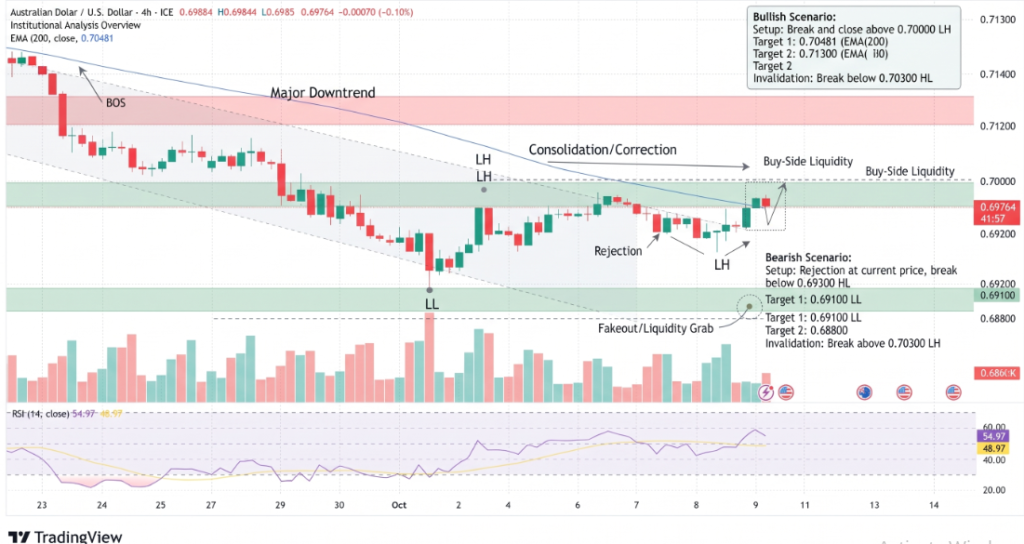
Despite Friday’s advance, the AUD/USD exchange rate retains a cautious near-term technical outlook. The pair is trading below its 20-day Exponential Moving Average (EMA) at 0.7020, indicating that recent selling pressure has not been fully reversed.
The daily Relative Strength Index (RSI) is near 39. This reading reflects weak momentum, although it suggests some stabilization after recent declines.
Traders are monitoring several important levels:
- 0.6990: The October 6 high and immediate resistance.
- 0.7020: The 20-day EMA, where a sustained break could improve the outlook.
- 0.6933: The October 8 low and initial support.
- 0.6903: The October low and a deeper downside reference.
A sustained move above 0.7020 would weaken the bearish technical bias. Failure to clear resistance, however, could leave the pair exposed to another test of support.
US CPI and Australian Jobs in Focus
The next major catalysts are September’s US Consumer Price Index (CPI) and Australian employment figures, both scheduled for release the following week in the supplied market outlook.
US inflation data could reshape expectations for Federal Reserve interest-rate policy and influence Treasury yields. Stronger-than-expected inflation could lift yields and support the dollar, while softer figures could reinforce the recent decline in borrowing costs.
Australian employment data will provide further evidence of domestic economic conditions and may influence expectations for Reserve Bank of Australia policy.
Conclusion
AUD/USD has gained support from improved risk sentiment and falling US Treasury yields, but the recovery remains technically unconfirmed. Resistance at 0.6990 and 0.7020 will be important tests for buyers, while 0.6933 and 0.6903 remain key downside levels. The next US inflation and Australian employment reports could determine whether the Australian dollar extends its rebound or returns to its recent downward path.
Sources & Methodology
Primary-source standard: Market-moving facts should link to original data releases, regulator notices, company filings or official project announcements whenever available. Secondary reporting is used for additional context, not as a substitute for original evidence.
Page last reviewed: