
Bitcoin fell on Thursday, extending its recent decline as expectations of further Federal Reserve (Fed) interest-rate increases weakened demand for speculative assets. The world’s largest cryptocurrency dropped 1.7% to $63,529.90 by 01:21 ET (06:21 GMT), after touching an intraday low of $62,399.50. Persistent weakness in technology and artificial intelligence stocks added to market pressure, while investors assessed the implications of Anthropic’s highly anticipated stock-market debut. With monetary policy uncertainty still elevated, cryptocurrency markets struggled to attract fresh buying interest.
Fed rate hike fears weigh on Bitcoin
Bitcoin’s losses accelerated after the release of the Fed’s October meeting minutes, which reinforced expectations that policymakers could raise interest rates again in December. Almost all participants considered additional increases likely to be appropriate as inflation remained above the central bank’s 2% target. Two policymakers also discussed the possibility of a larger, 50-basis-point increase if inflation data warranted stronger action.
Christopher Waller, a Fed governor, added to the hawkish message by arguing that officials should consider a half-percentage-point increase in December. He warned that inflation was moving in the wrong direction, strengthening concerns that borrowing costs could remain elevated.
Higher interest rates typically reduce demand for assets perceived as risky, including cryptocurrencies. Investors can become more selective when safer interest-bearing investments offer higher returns, leaving Bitcoin and other digital assets exposed to further selling.
The broader technology sell-off has compounded the pressure. Weakness in artificial intelligence-related shares has encouraged investors to reduce exposure to growth-oriented investments. Anthropic’s IPO pricing and anticipated trading debut also attracted attention as investors assessed opportunities outside cryptocurrencies.
Regulatory uncertainty adds to crypto pressure
Political developments have created another source of uncertainty for digital assets. The Democratic Party’s victories in both chambers of Congress during the US midterm elections raised concerns about the direction of cryptocurrency regulation.
Several Democratic lawmakers, including Senator Elizabeth Warren, have called for stronger oversight of the industry. Investors are watching whether a Democratic-controlled Congress will pursue tighter rules governing cryptocurrency exchanges, stablecoins and digital-asset markets.
The regulatory debate adds to existing concerns about market liquidity and institutional participation. Combined with expectations of higher interest rates, these risks have made traders more cautious about increasing their cryptocurrency exposure.
Bitcoin and altcoins extend declines
Selling pressure spread across major cryptocurrencies on Thursday, although losses varied between assets. Market prices in the supplied trading snapshot showed:
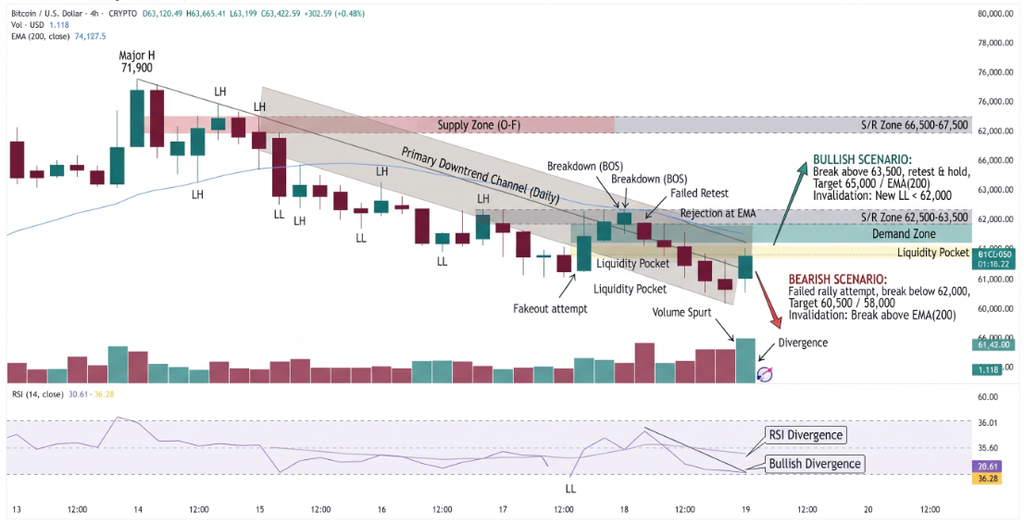
Bitcoin Price Chart – Source: Tradingview
- Bitcoin (BTC): Down 1.7% to $63,529.90.
- Ethereum (ETH): Fell 0.3% to $1,804.83.
- XRP: Declined 0.4%.
- BNB: Lost 0.6%.
- Solana (SOL) and Cardano (ADA): Traded broadly flat.
- Dogecoin (DOGE) and TRUMP: Recorded changes of less than 1%.
Bitcoin’s decline toward $62,400 places the market close to levels last seen several months earlier. A sustained recovery in risk appetite could help stabilize prices, but continued pressure from monetary policy expectations may limit buying interest.
Conclusion
Bitcoin remains under pressure as hawkish Fed signals, technology-sector weakness and regulatory uncertainty weigh on investor sentiment. Its move toward $62,400 highlights the fragility of the current market, while further interest-rate repricing could deepen losses. Traders will closely monitor upcoming US economic data and Federal Reserve commentary for evidence that monetary tightening expectations are easing.
Sources & Methodology
Primary-source standard: Market-moving facts should link to original data releases, regulator notices, company filings or official project announcements whenever available. Secondary reporting is used for additional context, not as a substitute for original evidence.
Page last reviewed: