
Key Points
- The Bank of Japan raised its policy rate by 25 basis points to 1.25%, the highest level in 31 years.
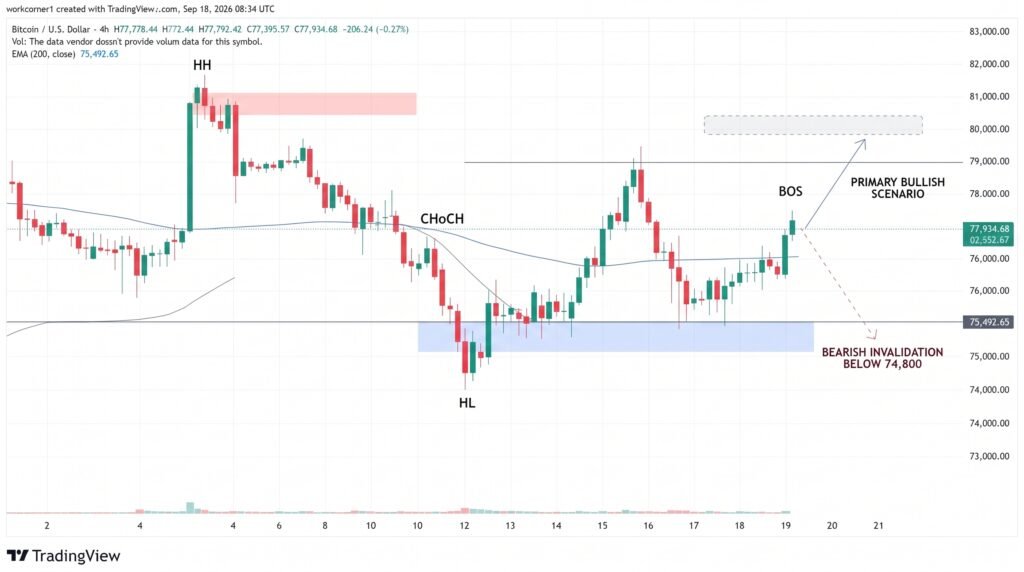
- Bitcoin climbed to about $77,400 after the decision, recovering from an overnight low near $76,200.
- The Japanese yen weakened despite the hike, with USD/JPY rising toward 156.70 as investors assessed the BOJ’s guidance.
Bitcoin moved above $77,000 on September 18 after the Bank of Japan raised interest rates for the second time in three months. The BOJ lifted its policy rate from 1.00% to 1.25%, its highest level since 1995, as policymakers responded to inflation risks and elevated energy costs. Bitcoin rose to roughly $77,400, while the yen weakened against the dollar. The market reaction indicated that investors had largely anticipated the rate increase and were more focused on how quickly the BOJ could tighten monetary policy again.
BOJ Raises Rate to 1.25%
The Bank of Japan approved the quarter-point increase by a 7–2 vote, continuing its gradual shift away from the exceptionally low interest-rate policy that characterized Japan for decades.
The central bank remains focused on inflation and its 2% price-stability target, particularly as higher energy and import costs create additional price pressure.
The BOJ also indicated that it could continue raising borrowing costs if economic activity and inflation develop in line with its projections. Even after the latest increase, Japanese monetary conditions remain relatively accommodative compared with the United States.
Because financial markets had widely anticipated the decision, the 25-basis-point increase itself produced a relatively limited immediate shock.
Bitcoin Rebounds to $77,400
Bitcoin responded positively following the BOJ announcement. BTC climbed to approximately $77,400, extending its recovery from an overnight low around $76,200. Bitcoin priced against the yen also strengthened, with BTC/JPY on Japanese cryptocurrency exchange bitFlyer reaching approximately 12.06 million yen.
The yen moved in the opposite direction. USD/JPY increased from around 156.20 to 156.70, meaning the Japanese currency weakened against the U.S. dollar despite the higher interest rate.
The reaction reflected market expectations rather than simply the direction of the policy decision. Investors had largely priced in the BOJ increase and focused instead on the central bank’s guidance about future tightening.
Yen Carry Trade Remains in Focus
BOJ policy has implications beyond Japan because the yen has historically been an important funding currency for global investors. Years of exceptionally low Japanese interest rates encouraged the yen carry trade, where investors borrow money at relatively low rates in yen and deploy that capital into assets or currencies offering higher expected returns.
Higher Japanese rates can reduce the attractiveness of these positions. A rapid appreciation of the yen can also force leveraged investors to close trades, potentially creating selling pressure across equities, bonds and cryptocurrencies.
That risk attracted significant attention during the global market volatility of August 2024, when changing Japanese rate expectations and a stronger yen contributed to a sharp reduction in leveraged positions. The current situation is different because Japan’s policy rate remains substantially below U.S. rates.
Fed-Japan Rate Gap Stays Wide
The Federal Reserve raised its federal funds target range by 25 basis points to 3.75%–4.00% on September 16, its first increase since 2023. Investors can follow changes in U.S. rate expectations through the CME FedWatch Tool.
The upper end of the U.S. policy range is now 2.75 percentage points above Japan’s 1.25% rate. That substantial differential helps explain why the yen did not strengthen sharply following the BOJ decision and why an immediate large-scale carry-trade unwind did not occur.
For Bitcoin, however, further tightening from either central bank remains important. Higher interest rates increase financing costs and can reduce liquidity available for higher-risk assets.
Changes in the U.S. Dollar Index, U.S. Treasury yields and USD/JPY could therefore influence Bitcoin’s next move alongside crypto-specific demand.
Conclusion
The BOJ’s move to 1.25% marks another significant step away from Japan’s long period of exceptionally low interest rates, but it did not trigger an immediate sell-off across global risk assets. Instead, Bitcoin recovered above $77,000, while the yen weakened as traders focused on the BOJ’s cautious approach to further tightening.
The next test for BTC will come from broader global liquidity conditions. With the Federal Reserve at 3.75%–4.00% and the Bank of Japan at 1.25%, investors will closely track future rate decisions, USD/JPY volatility, Treasury yields and any evidence of yen carry-trade deleveraging. For now, Bitcoin’s move above $77,000 indicates that markets absorbed the widely anticipated BOJ hike without a major risk-off reaction.
Sources & Methodology
Primary-source standard: Market-moving facts should link to original data releases, regulator notices, company filings or official project announcements whenever available. Secondary reporting is used for additional context, not as a substitute for original evidence.
Page last reviewed: