
Brent crude oil is approaching the $104.30 resistance level on the 5-hour chart as buying momentum improves, but the underlying trend remains relatively weak. The benchmark was recently trading around $103.94 in the supplied technical setup, leaving bulls within striking distance of a potential breakout.
The latest move comes as broader oil markets remain sensitive to geopolitical and supply risks. Brent recently climbed above $104 as renewed shipping disruptions in the Middle East and weather-related production losses in the U.S. Gulf of Mexico tightened the market’s near-term supply outlook.
Technically, the key question is whether buyers can produce a confirmed 5-hour close above $104.30. Without stronger volume and trend participation, a brief move above resistance could instead become a false breakout.
The MACD is improving, with the indicator rising from 0.18 to 0.42 in the supplied setup. That shift points to stronger short-term upside momentum, although it does not independently confirm a sustainable trend.
Weak Trend Keeps Breakout Risk High
The biggest warning comes from the Average Directional Index (ADX), which stands at only 11.02 in the supplied 5-hour chart. ADX measures trend strength rather than direction, so the low reading suggests that neither buyers nor sellers currently have enough momentum to establish a powerful trend.
This matters because Brent is testing a major resistance zone while trend conviction remains limited. Recent gains have also lacked convincing volume expansion, raising questions about whether enough buyers are positioned to push the market through $104.30.
The longer-term structure is more constructive. Brent remains above its 200-period SMA near $97.31, keeping the broader bullish bias intact. The price has also moved above the Ichimoku Cloud, with the supplied setup identifying $101.68 as an important structural level.
- Bullish trigger: 5-hour close above $104.30 with stronger volume.
- Key support: $101.50, followed by the psychological $100 level.
- Trend support: 200-period SMA near $97.31.
Current market pricing also confirms that Brent remains elevated. FT market data showed Brent around $102.59 on October 8 after closing at $100.20 on October 7.
Brent Oil Breakout or Bull Trap?
A sustained move above $104.30 would strengthen the bullish case and signal that buyers have absorbed the available selling pressure at resistance. It would also establish a new short-term higher high, an important confirmation for traders following price action.
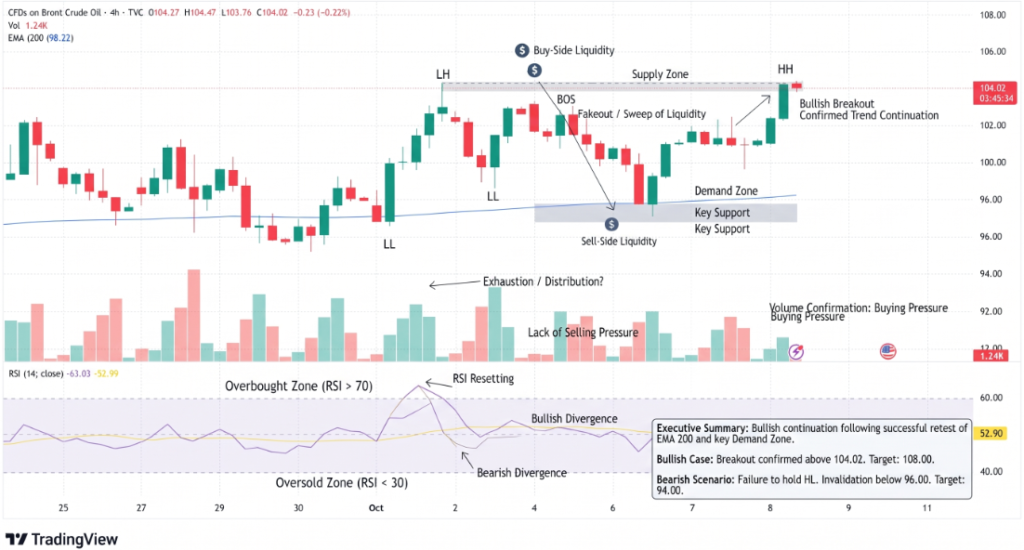
However, the breakout needs confirmation. A move above resistance followed by a rapid return below $104.30 would indicate that buyers failed to maintain control. In that scenario, $101.50 becomes the first important downside checkpoint, while a break below $100 would strengthen the bearish case.
The broader fundamental picture remains supportive of elevated oil prices. Reuters reported that attacks on tankers around the Gulf have intensified, while roughly one-fifth of global oil shipments normally pass through the Strait of Hormuz, leaving the market highly sensitive to further disruptions.
The Relative Strength Index (RSI) and other momentum tools should therefore be monitored alongside volume rather than treated as standalone signals. A confirmed breakout with expanding participation would carry considerably more weight than an isolated intraday spike.
Conclusion
Brent oil remains bullish above its major moving-average support, but the $104.30 resistance level represents a critical test. The low ADX reading warns that trend strength is still limited, making false breakouts a significant risk. A confirmed 5-hour close above $104.30 with stronger volume would improve the upside outlook, while a failure followed by a break below $101.50 or $100 would shift attention back toward sellers.
Sources & Methodology
Primary-source standard: Market-moving facts should link to original data releases, regulator notices, company filings or official project announcements whenever available. Secondary reporting is used for additional context, not as a substitute for original evidence.
Page last reviewed: