

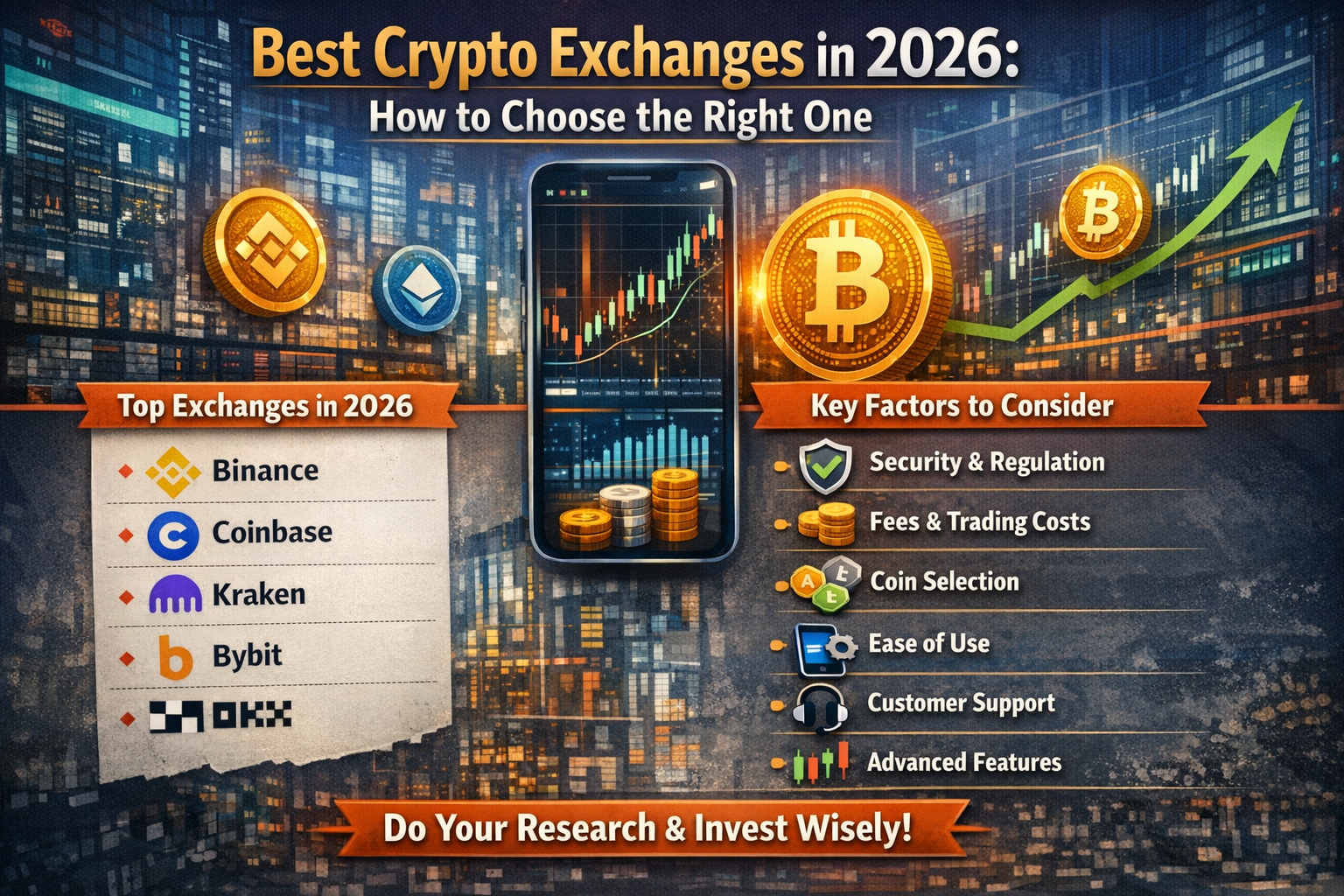
Looking for the safest and most reliable crypto exchange in 2026? This guide explains how cryptocurrency exchanges work, what’s changed in recent years, and how to choose the right platform based on fees, security, regulation, and trading features.
You’ll also find a detailed comparison of the top crypto exchanges used globally, including who each platform is best suited for and where it may fall short.
What Is Cryptocurrency? (Quick Explanation)
Cryptocurrency is a form of digital money that isn’t controlled by any government or bank. It’s built to be secure and works the same no matter where you are in the world. There are many types of cryptocurrencies, each with its own purpose and advantages. The most well-known ones are Bitcoin and Ethereum, which are often seen as the foundation of the crypto world.
All crypto transactions run on a system called blockchain. It’s like a digital ledger that keeps a permanent record of every trade or transfer. Each transaction is stored as a “block” and connected to the one before it, forming a secure chain of data.
This technology keeps everything transparent and safe. Many companies also use blockchain to create smart contracts that automatically execute once certain conditions are met.
Crypto Exchanges in 2026: What’s Changed?
By 2026, crypto exchanges have evolved into full financial platforms rather than simple trading venues. Today’s leading exchanges offer spot trading, futures, options, staking, passive income products, and proof-of-reserve transparency. Many are now licensed or registered in major jurisdictions, which has improved trust and regulatory oversight.
That said, there is no single “best” crypto exchange for everyone. The right choice depends on what matters most to you:
- Low trading fees
- Strong security and custody practices
- Regulatory compliance
- Access to altcoins or derivatives
- Beginner-friendly design or advanced tools
In this guide, I break down the top crypto exchanges used in 2026, highlighting their strengths, weaknesses, and ideal use cases so you can confidently choose the platform that fits your goals.
Now that we’ve covered how the crypto exchange landscape has matured, let’s look at the top crypto exchanges to use in 2026.
Top 10 Crypto Exchanges to Use in 2026
Binance:
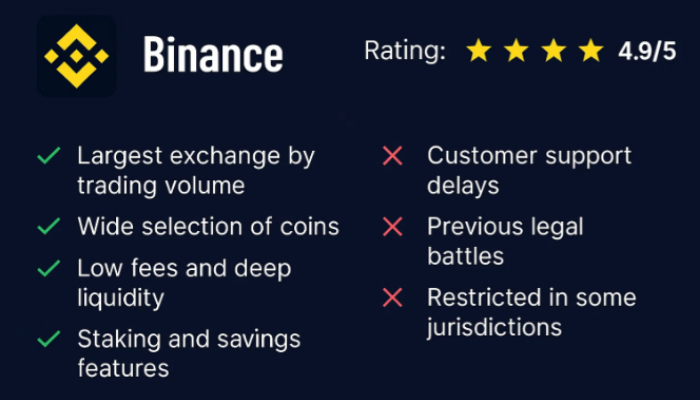
Binance is the largest cryptocurrency exchange in the world by trading volume and user base. It’s well-known for its wide range of supported coins and deep liquidity, allowing users to buy and sell with minimal slippage. The platform caters to both beginners and experienced traders, offering a mix of simplicity and advanced tools.
Binance remains one of the most competitive exchanges when it comes to trading fees, charging only 0.1% for both makers and takers. The platform also provides additional features such as staking, futures trading, savings products, and proof-of-reserve transparency, giving users more ways to manage and grow their assets.
Security is another strong point. Binance implements cold storage, two-factor authentication, and proof-of-reserve systems to keep funds safe. Although the platform experienced a hack in 2019 involving about $40 million, the company quickly reimbursed affected users and later created the SAFU fund to cover any future security issues.
Customer support has improved but still faces delays during high traffic periods. Binance has also faced regulatory challenges in several countries, leading to restrictions or modified services in some regions.
Choose Binance if:
- You want access to a large variety of cryptocurrencies.
- You prefer low trading fees and strong liquidity.
- You are interested in extra features like staking, savings, and futures.
- You need a powerful and user-friendly mobile app.
Don’t choose Binance if:
- You live in a region where Binance faces restrictions.
- You expect fast and responsive customer support.
- You’re concerned about ongoing regulatory issues.
Coinbase:
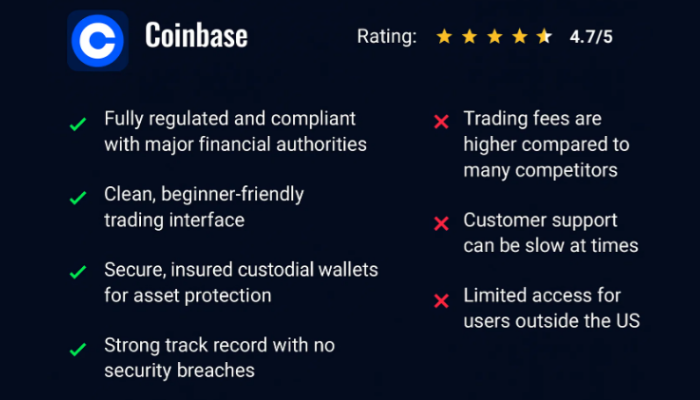
Coinbase is one of the most trusted and regulated crypto exchanges in the world. It is a publicly listed company in the United States, which means it must follow strict financial and security standards. This gives users confidence that their funds and data are handled safely. Coinbase is especially popular among beginners who want a simple way to buy major cryptocurrencies like Bitcoin and Ethereum.
The platform now supports a growing list of coins, along with features like staking and recurring purchases. It offers two main versions – a simple one for everyday users and an advanced version with more tools for traders. This makes it flexible for both casual investors and those who want more control over their trades.
Coinbase takes security seriously by storing most assets in cold wallets, using strong verification methods, and offering insurance on certain holdings. It has never faced a major hack, which adds to its strong reputation. However, its trading fees are slightly higher than some competitors, and customer support can be slow during busy periods.
Choose Coinbase if:
- You are new to crypto and want a safe, beginner-friendly platform.
- You prefer using a regulated and publicly listed exchange.
- You value strong security and insured wallets.
- You want an easy way to buy crypto using local currency in the US.
Don’t choose Coinbase if:
- You live in a region with limited access to its services.
- You trade often and want lower fees.
- You expect fast and responsive customer support.
Bybit:
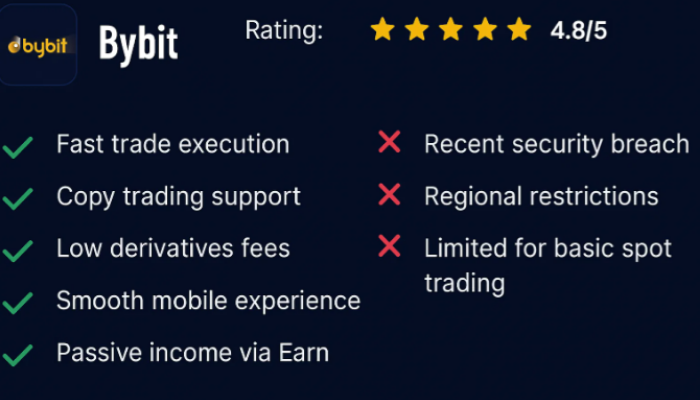
Bybit was founded in 2018 and has grown quickly to become one of the largest crypto derivatives platforms. Originally based in Singapore, it moved its main operations to Dubai in 2022. The exchange is known for its fast matching engine and clean, easy-to-use interface, making trading straightforward for both beginners and advanced users.
Bybit offers spot trading as well as futures and derivatives, attracting millions of users worldwide. Security is handled by the company since it’s a centralized exchange. In 2025, Bybit faced a major hack where about $1.5 billion in Ethereum tokens were stolen by the Lazarus group. The CEO, Ben Zhou, responded quickly and covered all user losses, so no one lost funds, which highlighted the company’s commitment to its users.
Customer support has had some issues, including slow response times and occasional KYC verification problems. Despite this, Bybit’s performance, intuitive mobile platform, and range of products make it a strong option for both casual and professional traders.
Choose Bybit if:
- You want to follow professional traders through copy trading.
- You are interested in passive income via Bybit Earn products.
- You prefer a smooth and easy-to-use mobile interface.
- You trade derivatives and futures and want low fees.
Don’t choose Bybit if:
- You are concerned about the recent major security breach.
- You are in a region with regulatory restrictions.
- You are looking only for simple spot trading with no extra features.
OKX:
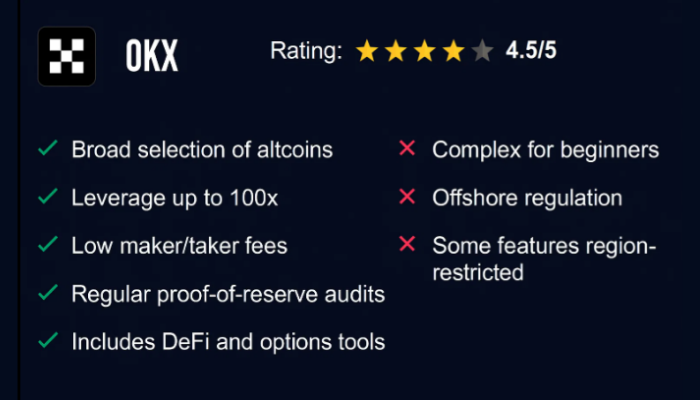
OKX was founded in 2017 as the international branch of OKEx, which itself grew out of OKCoin, established in 2013 by Minxing “Star” Xu. Today, OKX is headquartered in the Seychelles, with offices in the US, Dubai, Singapore, Turkey, Australia, Brazil, and several European countries. The exchange is centralized but has been expanding its Web3 offerings through the non-custodial OKX Wallet.
OKX is especially useful for trading smaller or emerging cryptocurrencies that may not be listed on larger exchanges. It offers a wide range of products, including spot trading, spot margin, futures, options with up to 100x leverage, peer-to-peer trading, and simple “convert” options for users who prefer to avoid complex order books. Fees are competitive, starting around 0.08%/0.1% for makers and takers on spot trades, with lower rates for high-volume or VIP users. Futures and options have separate fee structures.
Security is a strong point for OKX. It uses cold wallets for most funds, multi-signature controls, AI-based fraud detection, and has a dedicated cybersecurity team. Proof-of-Reserve audits are conducted regularly to maintain transparency.
The main downside is that the platform can feel overwhelming for beginners. Some advanced features carry more complexity and risk, and regional availability varies, meaning certain services like derivatives or fiat on/off-ramps may not be accessible everywhere.
Choose OKX if:
- You want access to a wide range of altcoins and trading pairs.
- You are interested in options trading, DeFi tools, or advanced features.
- You want to earn passive income through staking or Earn products.
- You are looking for lower trading fees.
Don’t choose OKX if:
- You are a complete beginner with no prior experience in crypto.
- You are concerned about its offshore regulatory status.
- You are in a region with restricted access to certain features.
Kraken:
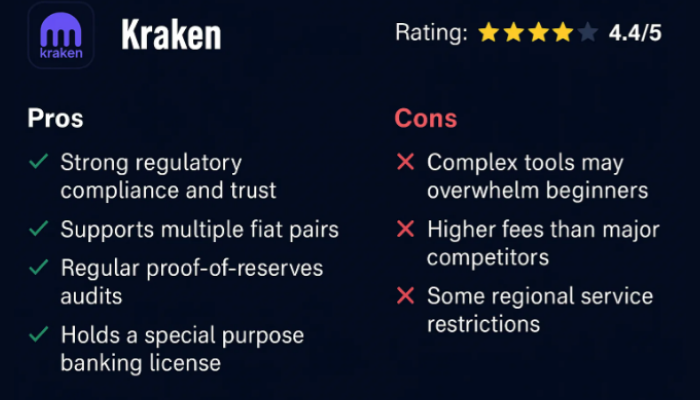
Kraken is one of the oldest crypto exchanges, founded in 2011 by Jesse Powell, who remains very active in the crypto community. The platform supports over 500 cryptocurrencies and allows trading in multiple fiat currencies, including USD, EUR, GBP, and JPY. Kraken offers both a Simple mode for beginners and a Pro mode for more advanced traders.
Security is a top priority at Kraken. Most funds are kept in cold storage, and the platform uses multi-factor authentication, third-party security testing, and regular Proof-of-Reserve audits. In terms of trading features, Kraken offers spot trading, margin, futures, OTC trading, staking, and more.
Kraken also provides convenient options like “Instant Buy” and stablecoin purchases, although these can come with higher fees of up to 1.5% plus conversion costs. The exchange is primarily focused on US users, so it’s particularly well-suited for American traders who want a regulated and reliable platform. Kraken even holds a special-purpose banking license, adding to its credibility.
Choose Kraken if:
- You value strong regulatory compliance and a trusted reputation.
- You want access to a wide range of fiat trading pairs.
- You’re looking to trade both spot and futures on one platform.
- You want helpful educational resources for learning crypto trading.
Don’t choose Kraken if:
- You are a complete beginner and may find the tools overwhelming.
- You want trading fees as low as Binance.
- You live in a region where Kraken has regulatory restrictions.
Crypto.com
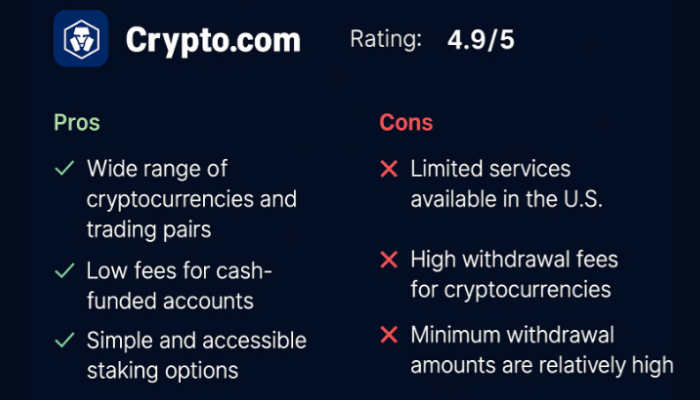
Crypto.com is a popular cryptocurrency exchange known for offering a wide variety of coins and trading pairs. It also has features like staking, allowing users to earn rewards on their holdings. Funding your account via bank transfers usually keeps fees low, which makes it appealing for regular traders.
The platform supports a large selection of digital assets, and holders of its native CRO token can get extra benefits, including lower fees and other perks. Crypto.com is easy to navigate and offers a straightforward experience for both new and experienced users.
On the downside, some services are not available in the U.S., and withdrawal fees can be relatively high. Additionally, minimum withdrawal amounts may be larger than other exchanges, which could be inconvenient for smaller traders.
Choose Crypto.com if:
- You want access to a large selection of cryptocurrencies.
- You are interested in earning rewards through staking.
- You prefer low fees when funding accounts via cash transfers.
- You want extra perks by holding CRO tokens.
Don’t choose Crypto.com if:
- You are in the U.S. and need all features available locally.
- You want low-cost crypto withdrawals.
- You plan to withdraw small amounts frequently.
Robinhood Crypto
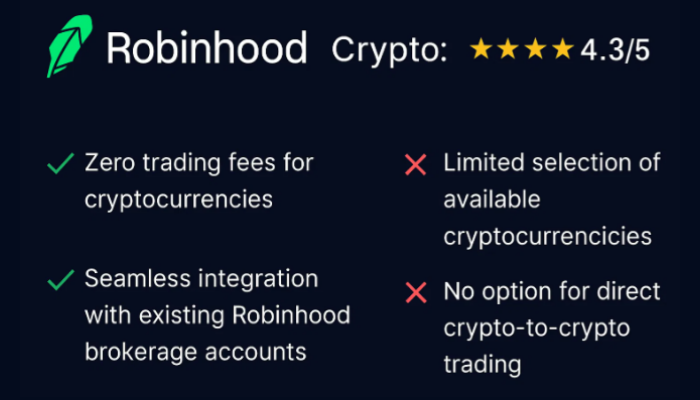
Robinhood Crypto is a cryptocurrency trading platform integrated into the popular Robinhood brokerage app. It is best known for offering commission-free trading, allowing users to buy and sell cryptocurrencies without paying traditional fees. This makes it an appealing choice for beginners and casual investors who are already familiar with Robinhood’s interface for stocks and ETFs.
The platform supports a limited selection of cryptocurrencies compared to dedicated crypto exchanges. Major coins like Bitcoin, Ethereum, and a few popular altcoins are available, but crypto-to-crypto trading is not supported. Users can only trade crypto for fiat currency, which may limit flexibility for those looking to diversify into smaller or emerging tokens.
Robinhood Crypto’s simplicity is one of its biggest strengths. The interface is clean and easy to navigate, making it ideal for users who want a straightforward way to invest in digital assets without getting overwhelmed by complex trading tools. For users already holding a Robinhood brokerage account, adding crypto trading is seamless, allowing for convenient portfolio management in one place.
On the security front, Robinhood Crypto follows standard practices for digital asset protection, including encryption and two-factor authentication. However, because it is a custodial platform, users do not hold private keys, which means crypto funds are stored within Robinhood’s system rather than in a personal wallet.
Choose Robinhood Crypto if:
- You want zero-fee trading for buying and selling major cryptocurrencies.
- You already use a Robinhood brokerage account and prefer to manage all investments in one place.
- You are a beginner looking for a simple, user-friendly interface.
- You are primarily interested in trading crypto for fiat rather than crypto-to-crypto pairs.
Don’t choose Robinhood Crypto if:
- You want access to a wide range of cryptocurrencies beyond the major coins.
- You need the ability to trade crypto-to-crypto.
- You prefer full control over your crypto private keys.
- You are an active trader looking for advanced tools and detailed charting features.
Robinhood Crypto is best suited for casual investors and beginners who want a low-cost, easy entry into the cryptocurrency market. Its integration with the broader Robinhood app makes it convenient for managing multiple asset types in a single place, though it lacks some of the flexibility and advanced features found on dedicated crypto exchanges.
Uphold
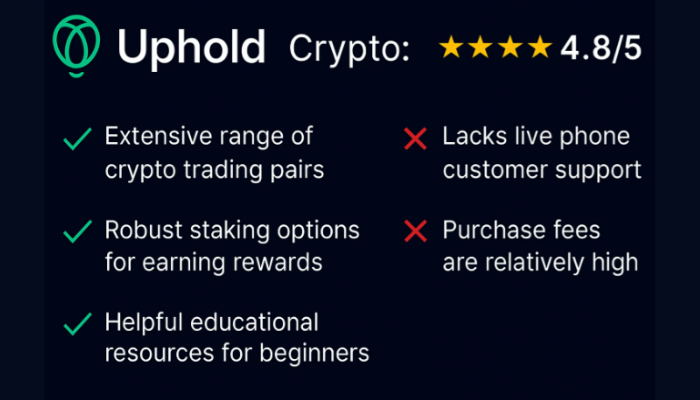
Uphold is a versatile cryptocurrency exchange that supports a large variety of crypto trading pairs, making it ideal for users who want access to a wide selection of digital assets. The platform also offers features like staking, allowing users to earn rewards on certain coins, as well as multiple wallet options for storing cryptocurrencies securely. Uphold provides helpful educational resources, making it suitable for beginners who want to learn more about crypto trading while actively investing.
One of Uphold’s advantages is the sheer number of trading pairs available, which gives users flexibility to trade major coins as well as smaller, less common tokens. The interface is user-friendly and works well for both desktop and mobile users. Staking opportunities and other earning features are straightforward, helping users generate passive income without complex setups.
On the downside, transaction fees can be on the higher side, ranging from 0.2% to 2.95% depending on the type of trade or purchase. Additionally, Uphold does not offer live phone support, which may make it harder to resolve urgent issues quickly. Despite this, the platform is considered reliable and secure, using standard security measures like encryption and multi-factor authentication to protect user funds.
Choose Uphold if:
- You want access to a wide range of cryptocurrencies and trading pairs.
- You are interested in staking and earning rewards on your holdings.
- You are a beginner looking for educational resources alongside trading tools.
- You want multiple wallet options for better flexibility and asset management.
Don’t choose Uphold if:
- You are looking for low transaction fees across all trades.
- You expect live phone support for immediate assistance.
- You only trade very small amounts where higher fees could impact profitability.
Uphold is a solid choice for both beginners and experienced traders who want a broad selection of cryptocurrencies, staking opportunities, and multiple wallet options, though users should be aware of its higher fees and limited customer support options.
Gemini:
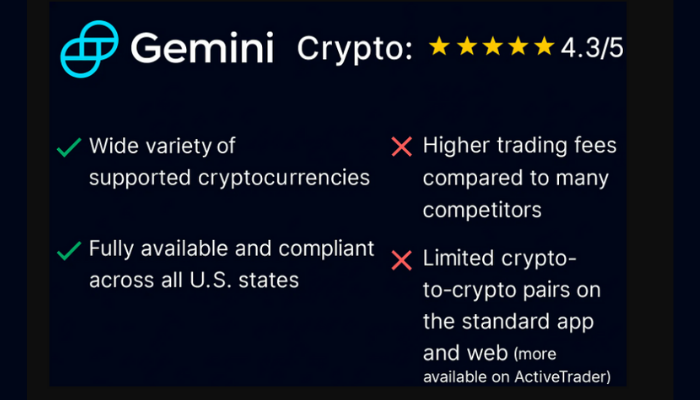
Gemini is a U.S.-based cryptocurrency exchange that is available in all 50 states, making it one of the most accessible platforms for American users. The exchange offers a solid selection of cryptocurrencies, including major coins like Bitcoin and Ethereum, as well as many popular altcoins. Gemini is designed to be beginner-friendly, with a clean interface that simplifies buying, selling, and managing crypto assets.
Gemini offers different platforms for trading. The standard interface is simple and easy to use, while the ActiveTrader platform provides more advanced features and over 100 crypto-to-crypto trading pairs. This allows users to choose between a straightforward experience and a more technical trading environment.
Fees on Gemini can be higher than other exchanges, ranging from 0.03% to 3.49% depending on the payment method and platform used. Despite the higher fees, the exchange emphasizes security and regulatory compliance, using cold storage for most funds, multi-factor authentication, and insurance coverage for certain assets.
Choose Gemini if:
- You want a secure and fully U.S.-regulated exchange.
- You are a beginner looking for an easy-to-use platform.
- You want access to a solid selection of cryptocurrencies.
- You prefer an exchange available in all U.S. states.
Don’t choose Gemini if:
- You want the lowest possible trading fees.
- You need extensive crypto-to-crypto trading on mobile or web.
- You are an active trader seeking advanced features without higher costs.
Gemini is a strong choice for casual investors and beginners who value regulatory compliance, security, and easy access across the U.S., though traders looking for lower fees or more advanced trading options may want to consider alternatives.
BitMEX
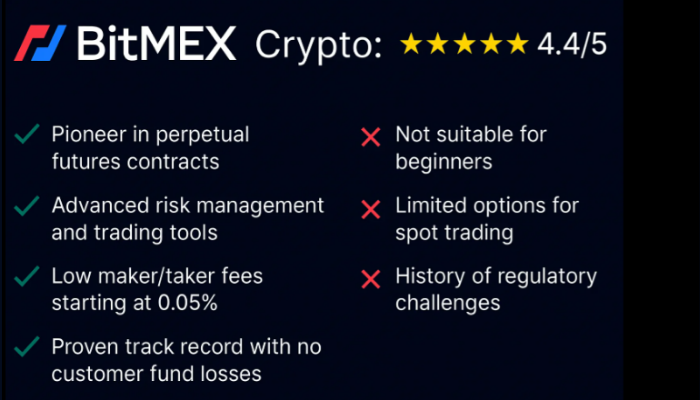
BitMEX is a cryptocurrency exchange founded in 2014 by Ben Delo, Samuel Reed, and Arthur Hayes. It is now operated by HDR Global Trading Limited, based in the Seychelles. The platform is best known for derivatives trading and was one of the first to popularize perpetual futures contracts, which remain its core offering today.
The platform has also expanded its spot trading options and places a strong emphasis on security. Most funds are kept in cold storage, and withdrawals and deposits use multi-signature systems to ensure safety. The exchange claims it has never lost user funds since its inception. Fees for futures trading start around 0.05% for makers and takers, with potential reductions for high-volume traders or those staking BitMEX’s native token, BMEX.
Despite its strengths, BitMEX is unavailable in the United States and a few other jurisdictions, limiting accessibility for some users. The variety of spot assets is smaller compared to other exchanges, although it offers hundreds of derivative contracts. The platform’s history includes legal challenges with the U.S. Commodities and Futures Trading Commission, which resulted in fines and guilty pleas from its founders, but the exchange has since overhauled its leadership and compliance practices.
Choose BitMEX if:
- You focus on derivatives and perpetual contracts.
- You are an experienced trader looking for advanced risk management tools.
- You value transparency in liquidation systems.
- You want a platform tailored to professional traders.
Don’t choose BitMEX if:
- You are a beginner or new to leverage trading.
- You are mainly interested in spot trading.
- You want access to a wide variety of altcoins.
- You are concerned about its regulatory history and legal challenges.
BitMEX remains a strong choice for professional traders who prioritize derivatives, advanced trading tools, and security, while beginners and casual investors may prefer exchanges with broader spot offerings and simpler interfaces.
How to Trade Cryptocurrency
Trading cryptocurrency can be exciting but also risky. To protect your investments and trade safely, follow these steps:
1. Choose a reputable cryptocurrency exchange
Start by selecting a trusted exchange. A reliable platform keeps your funds secure and reduces the risk of fraud. Top options include Coinbase, Gemini, Kraken, and eToro. Consider trading volume, track record, security features, and how your assets are stored.
2. Create an account and verify your identity
After choosing an exchange, set up your account. You will need to provide personal information such as your email, identification, and in some countries, a Social Security Number. Verification links your account to you and helps prevent fraud.
3. Deposit fiat currency
Connect your bank account to deposit fiat currency, such as USD, into your exchange wallet. This allows you to purchase your first cryptocurrency.
4. Buy, sell, and swap cryptocurrencies
Select the cryptocurrency you want to buy using its ticker symbol, for example, BTC for Bitcoin or ETH for Ethereum. You can buy full coins or fractions depending on the price. When selling, choose the coin, enter the amount, and either convert it to another cryptocurrency or back into fiat. Monitoring the market helps you take advantage of price changes.
5. Monitor your account and trade history
Track price movements and review your trading history to identify trends and patterns. Understanding market cycles like accumulation, markup, distribution, and decline can help you decide when to buy, sell, or hold.
6. Withdraw your cryptocurrency into a wallet
For extra security, transfer your crypto from the exchange to a private wallet. Use the platform’s transfer or withdraw feature to move your funds safely to a hardware or software wallet. This keeps you in full control of your assets.
Conclusion
Choosing the right crypto exchange and practicing safe trading habits are essential for success in 2026. Always research platforms carefully, start with small investments, and use private wallets to protect your assets. With the crypto market constantly evolving, staying informed and making thoughtful decisions will help you trade confidently and grow your digital portfolio safely.

