
Cardano (ADA) traded near $0.176 on Monday after declining more than 9% last week, extending its losing streak to five consecutive weeks since early October. Persistent selling by large holders, weakening on-chain indicators and a deteriorating technical structure are weighing on the cryptocurrency’s recovery prospects. Although some smaller whale groups have increased their holdings, distribution among the largest investors suggests that market confidence remains fragile. With ADA trading below its major moving averages, investors are monitoring $0.156 as a critical support level that could determine the token’s next directional move.
Cardano Whales Reduce ADA Holdings
Data from Santiment indicates that selling pressure among Cardano’s largest holders has intensified. Wallets containing between 10 million and 100 million ADA collectively reduced their holdings by approximately 50 million tokens between November 4 and November 9.
The distribution trend presents a mixed picture across other large-wallet categories. Addresses holding between 100,000 and 1 million ADA and those holding between 1 million and 10 million ADA accumulated approximately 20 million tokens combined during the same period.
This divergence suggests that smaller large-holder groups are absorbing some of the supply released by the biggest investors. However, their accumulation has not been sufficient to offset the reduction in holdings among wallets containing 10 million to 100 million ADA.
Changes in whale activity matter because large investors can influence market liquidity and short-term price direction. Continued distribution by major holders could increase available supply and make it more difficult for buyers to establish a sustained recovery.
On-Chain Indicators Signal Selling Pressure
Cardano’s on-chain metrics and derivatives indicators also point toward cautious market sentiment. According to the latest CryptoQuant market assessment, both spot and futures markets are showing significant whale activity alongside overheating conditions and stronger selling pressure.
Spot trading involves the direct purchase and sale of ADA, whereas futures trading allows investors to speculate on price movements through contracts. When selling pressure appears across both markets, it can indicate that bearish sentiment extends beyond short-term spot transactions.
The combination of declining whale exposure, weak price performance and cautious derivatives positioning creates an unfavorable environment for a sustained bullish reversal.
Investors are also monitoring Cardano’s network activity and broader market liquidity for signs that demand is improving. A recovery in buying activity could help stabilize prices, but continued selling from large wallets would increase downside risks.
ADA Price Forecast: $0.156 in Focus
Cardano traded around $0.176 on Monday, remaining below its 50-day Exponential Moving Average (EMA) at $0.209, 100-day EMA at $0.211 and 200-day EMA at $0.232. These indicators track average prices over different periods and help traders assess the broader market trend.
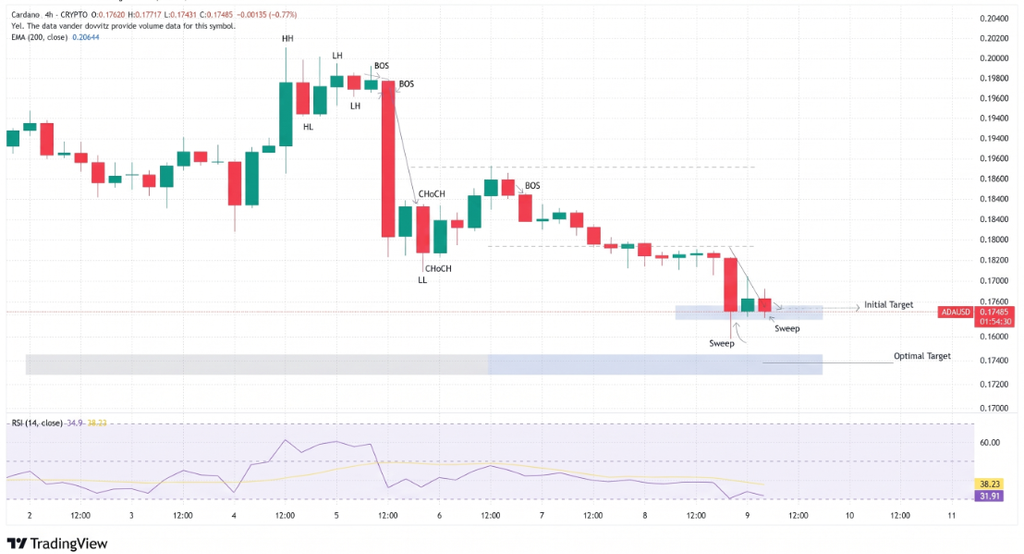
The positioning of all three moving averages above the current price reinforces the bearish technical structure. Meanwhile, the Relative Strength Index (RSI) near 32 indicates weak momentum and approaches oversold territory without confirming a reversal. The Moving Average Convergence Divergence (MACD) remains slightly negative, adding to the cautious outlook.
Important technical levels include:
- $0.183: Initial resistance.
- $0.209–$0.211: Immediate EMA resistance zone.
- $0.232–$0.245: Broader resistance region.
- $0.296: More distant upside barrier.
- $0.156: Critical downside support.
Conclusion
Cardano remains under pressure as large-holder distribution and bearish technical indicators reinforce selling risks. A sustained recovery above $0.183 would provide an initial positive signal, but reclaiming the $0.209–$0.211 EMA zone is necessary to improve the short-term outlook. Conversely, a decisive break below $0.156 could expose ADA to another round of losses. Until buying activity strengthens and whale distribution eases, Cardano’s broader price outlook remains bearish.
Sources & Methodology
Primary-source standard: Market-moving facts should link to original data releases, regulator notices, company filings or official project announcements whenever available. Secondary reporting is used for additional context, not as a substitute for original evidence.
Page last reviewed: