
Dogecoin (DOGE) is struggling to recover after last week’s sell-off pushed the meme coin to a new yearly low near $0.055. The token trades around $0.059 on Wednesday, with weak derivatives positioning and negative funding adding to concerns about demand. Technical indicators also show that sellers retain control, despite the possibility of short-term rebounds from oversold levels. Traders are now watching whether DOGE can defend its recent low or risks extending its decline.
Derivatives data signals bearish positioning
Dogecoin’s derivatives market reflects continued caution among traders. The long-to-short ratio cited in the supplied market snapshot stood at 0.90, a reading below one that indicates short positions outweighed long positions across the accounts measured. However, this ratio can vary by exchange and measurement method, so it should not be treated as a universal market-wide reading.
The funding rate also turned negative in the supplied data, reaching −0.0011% on Wednesday. Negative funding means short-position holders pay long-position holders to maintain their contracts. It can signal bearish positioning, although it does not guarantee that prices will fall.
More recent CoinGlass data showed funding near −0.0008%, confirming that the rate remained negative, while its other derivatives indicators showed sellers still active. These figures suggest that traders have yet to establish strong conviction in a sustained recovery.
On-chain activity points to selling pressure
On-chain and exchange-flow indicators add to the cautious outlook. The CryptoQuant data cited in the original market analysis showed sell-side dominance in both spot and futures markets, alongside large whale orders.
Large orders can influence short-term liquidity and price movements, particularly when market depth is limited. However, whale activity alone does not establish whether large holders are accumulating or distributing tokens. The broader selling imbalance is therefore a more relevant signal than the size of individual orders.
Dogecoin is also exposed to shifts in overall cryptocurrency sentiment. As a meme coin, DOGE can be particularly sensitive to speculative demand and changes in investor risk appetite. If Bitcoin and the wider market remain weak, a recovery in DOGE could struggle to attract sustained buying.
DOGE forecast: $0.055 support in focus
DOGE remains below its 50-day, 100-day and 200-day Exponential Moving Averages, positioned near $0.074, $0.078 and $0.086, respectively. The averages slope above the current price, reinforcing the bearish structure.
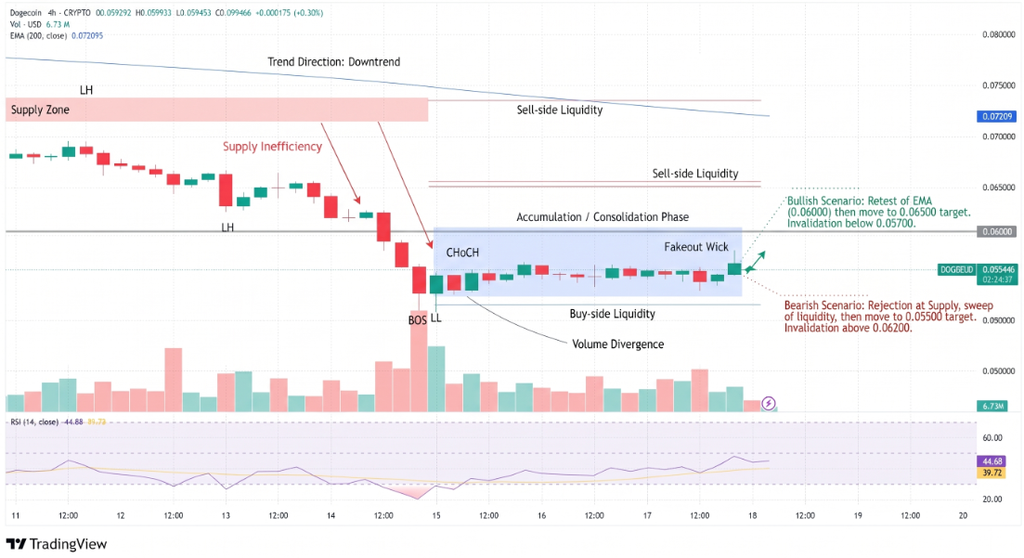
The Relative Strength Index near 28 indicates oversold conditions, while the negative MACD suggests downside momentum remains dominant. Oversold readings can precede corrective rebounds, but they do not independently confirm a trend reversal.
Key technical levels include:
- $0.055: Recent yearly low and immediate downside reference.
- $0.068–$0.069: Initial resistance and former trendline support.
- $0.074–$0.078: 50-day and 100-day EMA resistance.
- $0.086–$0.088: Higher resistance around the 200-day EMA.
Conclusion
Dogecoin remains vulnerable while it trades below its major moving averages and faces negative derivatives signals. A break beneath the recent $0.055 low could expose the token to further losses, while a sustained recovery above $0.068–$0.069 would be an early sign that selling pressure is easing. Until buyers reclaim those resistance levels, the broader technical outlook remains bearish.
Sources & Methodology
Primary-source standard: Market-moving facts should link to original data releases, regulator notices, company filings or official project announcements whenever available. Secondary reporting is used for additional context, not as a substitute for original evidence.
Page last reviewed: