The euro traded almost unchanged against the British pound on Wednesday, with EUR/GBP hovering around 0.8367 as recovering crude prices limited buying interest. The pair remained above former resistance at 0.8360 but struggled to establish a foothold above 0.8370. Investors weighed improving market sentiment against renewed concerns about Middle East tensions, while softer German inflation and expectations for the UK’s third-quarter growth report added to the cautious trading environment.
Oil Rebound Limits Euro Recovery
Oil prices recovered on Wednesday after falling to two-month lows in the previous session. Brent crude advanced approximately 1.4% to $92.77 a barrel, while West Texas Intermediate (WTI) gained 0.9% to $86.80.
The rebound followed renewed uncertainty surrounding diplomatic efforts to resolve the Middle East conflict. Iran’s position on its nuclear programme raised doubts about an imminent agreement with Washington, while continued shipping risks around the Strait of Hormuz kept concerns about energy supplies in focus.
The recovery in crude prices can influence European currency trading because higher energy costs may increase the region’s import bill and complicate the inflation outlook. This can weigh on the euro, particularly when investors are assessing the economic consequences of prolonged energy-market volatility.
However, the broader improvement in risk appetite has offered some support to European currencies. The competing effects have left EUR/GBP struggling to establish a clear direction.
German Inflation and UK GDP in Focus
Germany’s final October Harmonised Index of Consumer Prices (HICP) confirmed that inflation increased 2.8% annually, slowing from 3.3% in September. Prices also declined 0.1% month over month, following September’s 0.6% increase.
The figures matched preliminary estimates and indicated that inflationary pressures had eased. Softer price growth could influence expectations for the European Central Bank (ECB), particularly if the moderation continues across the wider euro area.
In the United Kingdom, attention is shifting toward the Office for National Statistics’ third-quarter GDP report, scheduled for November 12. The previous quarterly estimate showed that the British economy expanded 0.5% in the second quarter.
Markets are watching whether stronger economic activity will support the Bank of England (BoE)‘s policy outlook. A stronger-than-expected GDP reading could provide support for sterling, although interest-rate expectations will also depend on inflation and wage developments.
EUR/GBP Forecast: 0.8360 Support Matters
EUR/GBP traded near 0.8367 on the technical snapshot, maintaining a mildly bullish short-term bias above 0.8360. The Relative Strength Index (RSI) remained in positive territory, while the Moving Average Convergence Divergence (MACD) indicator stayed slightly above zero, suggesting buyers retained some control.
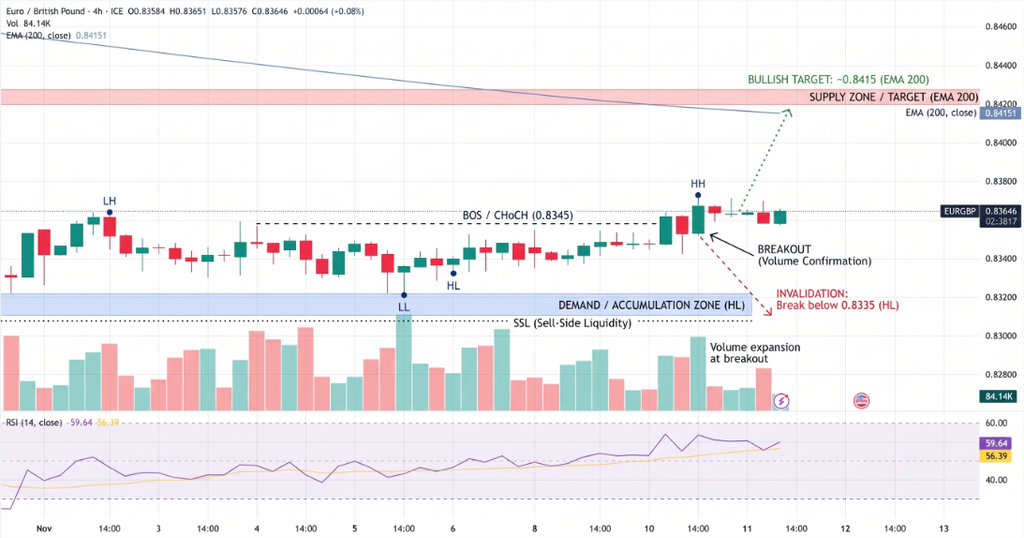
Important levels include:
- Immediate resistance: 0.8370.
- Higher resistance: 0.8380 and 0.8400.
- Initial support: 0.8360.
- Lower support: 0.8335 and 0.8320.
Conclusion
EUR/GBP remains supported above 0.8360, but the inability to break 0.8370 is limiting its recovery. A sustained move above that barrier could open the way toward 0.8380 and 0.8400. Conversely, a break below 0.8360 would expose 0.8335, followed by the year-to-date low near 0.8320. German inflation, Thursday’s UK GDP release and developments in crude oil markets are likely to determine the pair’s next directional move.
Sources & Methodology
Primary-source standard: Market-moving facts should link to original data releases, regulator notices, company filings or official project announcements whenever available. Secondary reporting is used for additional context, not as a substitute for original evidence.
Page last reviewed: