USD/CAD extended its advance on Wednesday, reaching approximately 1.4213, its highest level in more than three weeks. The Canadian dollar faces pressure from falling crude prices and renewed expectations of Federal Reserve tightening after stronger US inflation data. The US Dollar Index (DXY) also advanced to around 102.37, reflecting increased demand for the greenback. With markets debating whether the Fed will raise rates by 25 or 50 basis points in December, the currency pair’s near-term outlook remains tilted toward further gains.
Oil Decline Adds Pressure on Canadian Dollar
The Canadian dollar, commonly called the loonie, is sensitive to movements in crude oil because Canada is a major energy exporter. When oil prices decline, expectations for export revenues and energy-sector activity can weaken, reducing support for the currency.
West Texas Intermediate (WTI) crude fell nearly 18% from its recent high of $104.03 to around $85.35 in the market snapshot provided. Hopes of progress toward a US-Iran agreement had reduced concerns about potential supply disruptions, encouraging traders to reassess the geopolitical premium in oil prices.
The relationship is not automatic, however. Lower crude prices do not always translate into an immediate decline in the Canadian dollar, as interest-rate expectations and broader market sentiment also influence exchange rates.
Recent developments underline that uncertainty. Oil rebounded on Wednesday after Iran rejected key elements of a proposed diplomatic arrangement, with WTI recovering toward $86.80, according to Reuters. This suggests that geopolitical developments could quickly change the oil-market outlook.
Fed Rate Expectations Lift US Dollar
The US dollar gained support after October inflation exceeded economists’ expectations. The US Consumer Price Index (CPI) increased 0.4% month over month, compared with the 0.3% forecast. Core CPI, which excludes food and energy, rose 0.3%, above the expected 0.2%.
The report strengthened expectations of another Federal Reserve rate increase in December. Attention has shifted toward the size of the move following comments from Fed Governor Christopher Waller.
Waller indicated that a 25-basis-point increase would be appropriate even if inflation eased, while a core CPI reading of at least 0.3% could justify considering a 50-basis-point move.
TD Securities continues to favor a quarter-point increase but sees growing risks of a larger move or another increase in January. Higher expected US interest rates can attract investment toward dollar-denominated assets, supporting USD/CAD.
USD/CAD Forecast: 1.4210 Support in Focus
The daily technical picture remains constructive for buyers. USD/CAD trades above its 20-day Exponential Moving Average (EMA) at 1.4085, indicating that the short-term trend has strengthened.
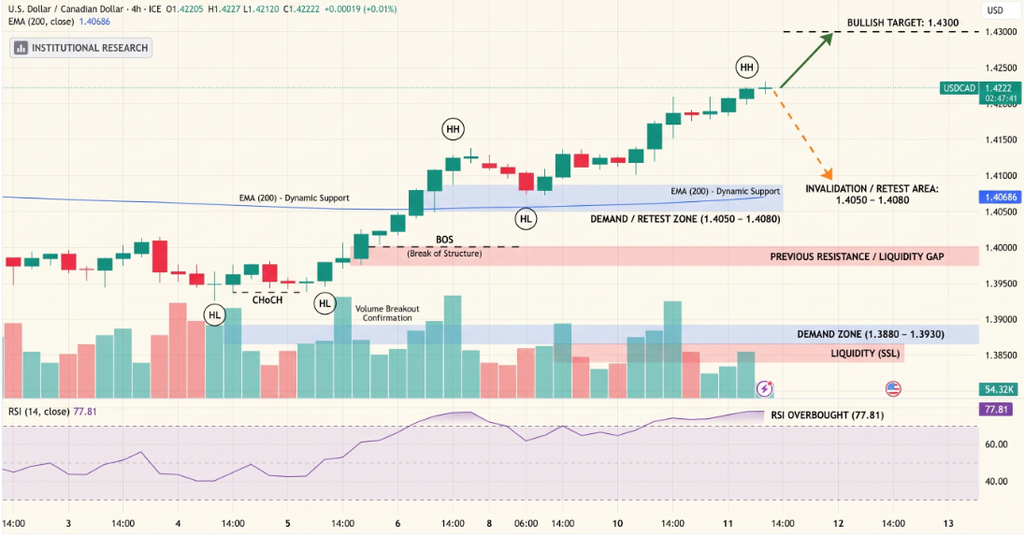
The Relative Strength Index (RSI) stands at 63.9, showing positive momentum without yet reaching the commonly used overbought threshold of 70.
Key levels to monitor include:
- Immediate pivot: 1.4210, near the current trading price.
- Next support: 1.4085, the 20-day EMA.
- Current resistance focus: The recent high near 1.4213.
Conclusion
USD/CAD retains a bullish near-term bias as stronger US inflation and expectations of further Fed tightening support the dollar, while weaker oil prices weigh on the Canadian currency. A sustained move above the recent 1.4213 high could extend the advance, although traders should watch crude-market developments closely. A pullback toward 1.4085 would test whether buyers can defend the pair’s improving technical structure. The balance between Fed policy expectations, oil prices and geopolitical developments will remain central to the next move.
Sources & Methodology
Primary-source standard: Market-moving facts should link to original data releases, regulator notices, company filings or official project announcements whenever available. Secondary reporting is used for additional context, not as a substitute for original evidence.
Page last reviewed: