EUR/GBP remained under pressure on Tuesday, trading around 0.8375 after sellers rejected the pair near 0.8400. The euro faces headwinds from elevated energy prices and concerns about France’s public finances, while expectations of higher UK interest rates have helped support sterling. With the exchange rate approaching its reported year-to-date low of 0.8361, investors are watching whether buyers can defend nearby support or whether another decline will expose lower levels.
French Risks Keep the Euro Under Pressure
The euro’s weakness reflects a combination of fiscal uncertainty and rising energy costs. Higher oil and gas prices threaten to lift inflation while weighing on household spending and economic growth across the eurozone. France’s budget challenges add another source of uncertainty, as investors assess whether the government can contain its deficit and maintain market confidence.
MUFG Research said on October 26 that the euro had been the weakest-performing Group of 10 currency during October, citing energy costs and French political and fiscal risks. The bank also noted that eurozone business activity had softened, with the October composite Purchasing Managers’ Index falling to 51.9 and France’s measure dropping to 48.4.
The European Central Bank meets on October 29, with markets focused on whether policymakers will signal further tightening. The ECB raised its key rates by 25 basis points in September, taking its deposit rate to 2.50%, and warned that energy-related inflation could remain elevated. A cautious policy message could limit support for the euro even if rates remain unchanged.
Sterling Gains as BoE Hike Bets Rise
Sterling has benefited from expectations that the Bank of England could raise its benchmark rate from 3.75% to 4.00% at its November 5 meeting. UK inflation reached 3.5% in September, up from 3.1% in August, strengthening market expectations for tighter monetary policy.
However, the UK’s October 28 budget is another potential catalyst. Fiscal measures that disappoint investors could undermine sterling, particularly after the pound’s recent strength against the euro. For now, the relative outlook for interest rates favors sterling, but the budget and central-bank guidance could change that balance.
EUR/GBP Levels Signal Further Downside Risk
The four-hour technical picture shows bearish pressure easing without a clear bullish reversal. The Relative Strength Index (RSI) near 40 indicates weak momentum, while the Moving Average Convergence Divergence (MACD) has moved into positive territory, suggesting selling pressure may be fading.
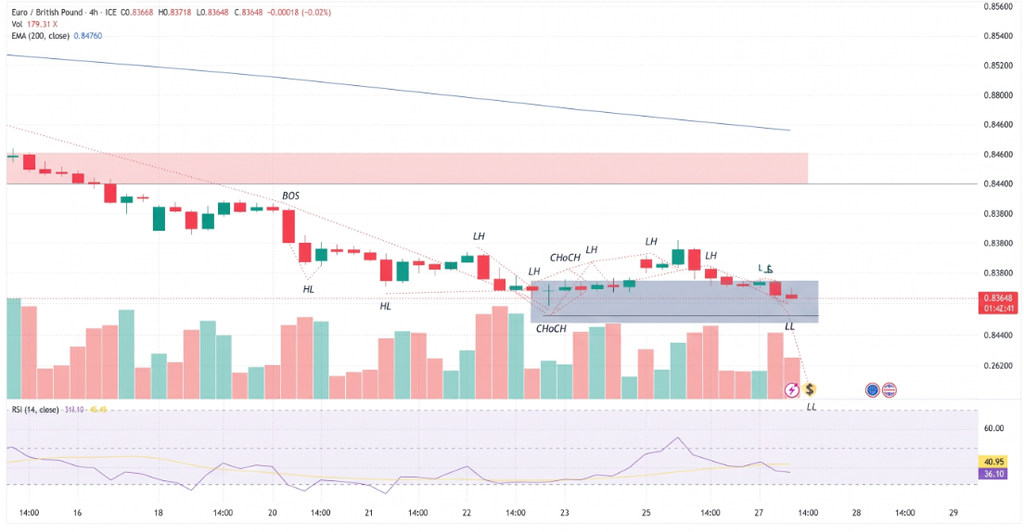
Key levels to monitor are:
- Resistance: 0.8400, followed by 0.8430 and 0.8480–0.8490.
- Immediate support: The reported year-to-date low near 0.8361.
- Lower support: 0.8355, followed by 0.8315 if selling accelerates.
A sustained break above 0.8400 would strengthen the case for a recovery toward 0.8430. Conversely, a move below 0.8355 could expose 0.8315.
Conclusion
EUR/GBP remains vulnerable while rallies fail below 0.8400. French fiscal concerns and stronger UK rate expectations favor sterling, although the ECB meeting and UK budget could trigger sharp moves. A decisive break of support or resistance should provide a clearer directional signal than the current mixed momentum indicators.
Sources & Methodology
Primary-source standard: Market-moving facts should link to original data releases, regulator notices, company filings or official project announcements whenever available. Secondary reporting is used for additional context, not as a substitute for original evidence.
Page last reviewed: