
The US dollar strengthened against the Japanese yen on Tuesday, with USD/JPY trading around 157.86 as investors prepared for two major central-bank decisions. The Federal Reserve is scheduled to announce its policy decision on Wednesday, October 28, followed by the Bank of Japan on Friday, October 30. The pair’s short-term technical picture remains mildly bullish, but expectations for future Japanese rate increases and warnings about possible currency intervention could limit further gains.
Fed and BoJ Decisions Drive USD/JPY
The dollar’s advance reflects a combination of interest-rate expectations and demand for the US currency. Reuters reported on October 27 that the dollar rose to around 157.73 yen as markets prepared for a busy week of central-bank meetings. A steadier equity market and expectations for a firm Federal Reserve outlook also supported the greenback.
The Federal Reserve is widely expected to leave its benchmark rate unchanged at 3.75%–4.00%. Investors will focus on policymakers’ assessment of inflation, economic growth and the outlook for future rate moves. A cautious message about easing policy could support the dollar, while signals that borrowing costs may eventually fall could weigh on the currency.
The Bank of Japan is also expected to hold its short-term policy rate near 1.25% at its October 29–30 meeting. However, markets are assessing the possibility of further tightening later in the year. Stronger Japanese inflation could strengthen the case for higher rates, potentially supporting the yen and putting downward pressure on USD/JPY. Japanese officials have also warned that authorities could intervene to counter excessive yen weakness.
USD/JPY Technical Levels to Watch
On the supplied daily chart, USD/JPY trades near 157.86, above the nine-period exponential moving average (EMA) at 157.69. The Relative Strength Index (RSI) stands around 51, indicating broadly neutral momentum with a slight positive bias. The pair has room to rise if buyers maintain control, although the indicators do not establish a confirmed breakout.
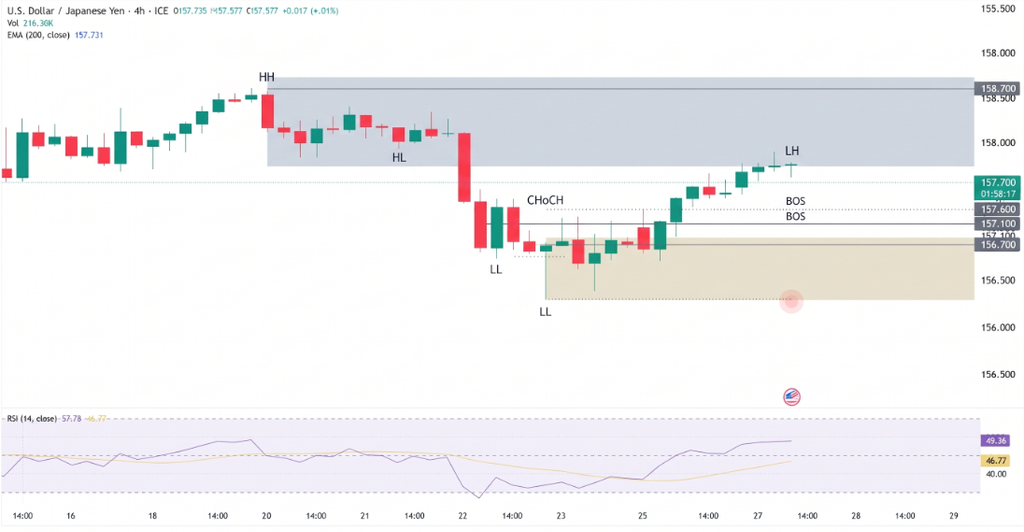
The immediate technical reference is the moving average at 157.69. A sustained move below it would weaken the near-term bullish setup, while continued trading above it would keep buyers in control.
Key points for traders include:
- Immediate support: 157.69 at the nine-period EMA.
- Bullish signal: Sustained buying above 157.86, followed by confirmation from price momentum.
- Downside risk: A break below the EMA could invite further selling.
- Fundamental risk: A hawkish BoJ message or intervention warning could strengthen the yen.
The RSI indicator measures the speed and strength of recent price movements; a reading near 51 is close to neutral rather than overbought.
Conclusion
USD/JPY retains a modest bullish bias while holding above 157.69, but central-bank guidance could quickly change that outlook. A firm Fed message and cautious BoJ stance could support another advance. Conversely, a more hawkish BoJ outlook or intervention concerns could trigger a yen recovery.
Traders should watch the moving-average support alongside both policy announcements before assuming the pair’s next direction. The technical setup supplied here identifies the nine-period EMA, not the 20-day EMA, so that distinction should be verified against the chart before publication.
Sources & Methodology
Primary-source standard: Market-moving facts should link to original data releases, regulator notices, company filings or official project announcements whenever available. Secondary reporting is used for additional context, not as a substitute for original evidence.
Page last reviewed: