
EUR/USD extended its decline on Wednesday, falling 0.3% toward 1.0960 and reaching its weakest level in 19 months. The Euro remains under pressure as expectations of consecutive Federal Reserve (Fed) interest rate increases strengthen the US Dollar. Traders are now awaiting the release of the October Federal Open Market Committee (FOMC) minutes for clues about the central bank’s next policy decisions. With the pair approaching the 1.0900 support area, the balance of risks continues to favour sellers.
Fed rate expectations strengthen Dollar
The US Dollar has gained support from a combination of resilient economic data and increasingly hawkish signals from Federal Reserve officials. Strategists at MUFG say markets have moved toward pricing in consecutive rate increases in December and January, with another increase in March also under consideration.
According to the CME FedWatch tool, traders see further tightening at the December and January meetings as highly likely. The probability of another increase in March stands at 47.7%, indicating that expectations extend beyond the end of this year.
Recent US data have reinforced the case for tighter monetary policy. October retail sales increased 0.2% month over month, while import prices rose more than expected. Federal Reserve officials have also warned that persistent inflation could require additional action.
The FOMC minutes, scheduled for release at 19:00 GMT on Wednesday, cover the October 27–28 policy meeting. Investors will examine the discussion for evidence of how strongly policymakers favour further increases. The minutes will provide historical context, however, rather than reflect developments since that meeting.
Euro faces pressure against the Greenback
The Euro’s weakness also reflects concerns about its own economic and monetary-policy outlook. Strategists at OCBC argue that resilient US growth, persistent inflation and rising Fed rate expectations could support further moderate Dollar gains, particularly against the Euro.
The divergence between the two central banks is important for EUR/USD. If the Fed continues raising rates while expectations for additional European Central Bank (ECB) tightening remain limited, the relative yield advantage could shift further toward the Dollar.
A stronger US currency also makes each Euro worth less in dollar terms, placing additional downward pressure on the exchange rate. Investors will therefore monitor both US policy signals and incoming eurozone economic data for signs that this divergence is changing.
EUR/USD technical outlook points lower
On the weekly chart, EUR/USD trades near 1.0966, well below its 10-period Exponential Moving Average (EMA) at 1.1190. This positioning indicates that sellers retain control of the broader trend.
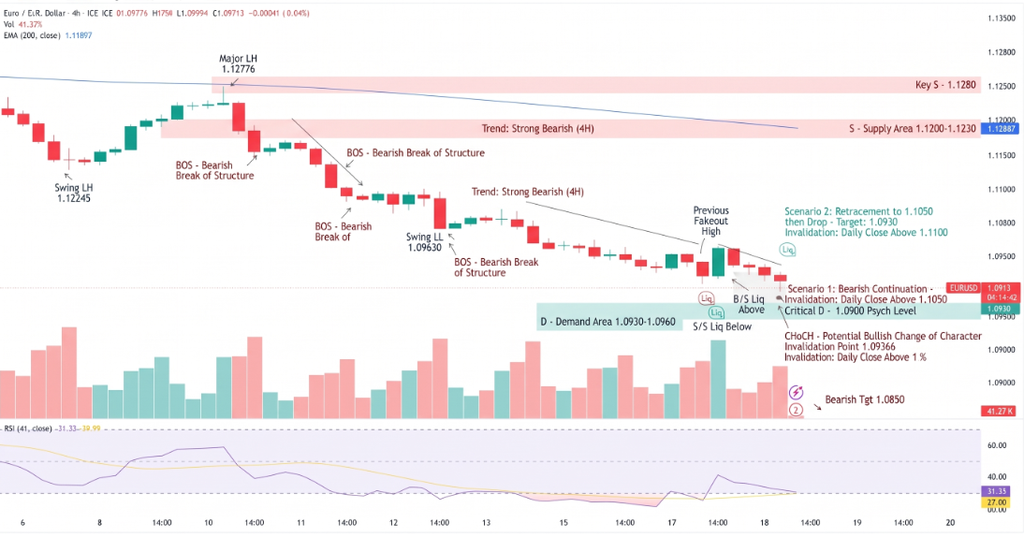
The Relative Strength Index (RSI) stands near 27, placing the pair firmly in oversold territory. Although this signals strong selling pressure, it also raises the possibility of a temporary rebound or consolidation.
Key technical levels include:
- Immediate support: 1.0960, followed by 1.0900.
- Major resistance: 1.1190, the weekly 10-period EMA.
- Momentum: RSI near 27, indicating oversold conditions.
Conclusion
EUR/USD remains vulnerable to further losses as hawkish Fed expectations support the US Dollar and the Euro struggles to attract demand. A sustained break below 1.0960 could expose 1.0900. However, the oversold RSI leaves room for a corrective bounce. A sustained recovery above 1.1190 would be needed to materially weaken the prevailing bearish outlook.
Sources & Methodology
Primary-source standard: Market-moving facts should link to original data releases, regulator notices, company filings or official project announcements whenever available. Secondary reporting is used for additional context, not as a substitute for original evidence.
Page last reviewed: