
EUR/USD extended its decline on Monday, falling 0.28% to around 1.1565 during European trading and reaching its lowest level in four weeks. The euro has weakened as markets increasingly favor a Federal Reserve rate increase this week, giving the U.S. dollar a stronger interest-rate advantage.
The move follows August U.S. inflation data that kept price pressures above the Fed’s 2% target. Headline US CPI increased 0.4% month over month, compared with 0.1% in July, while annual inflation held at 3.4%. Core CPI, which excludes food and energy, rose 0.3% monthly after 0.2% in July, although its annual rate eased to 2.4% from 2.5%.
The monthly figures were particularly important for markets because they showed that disinflation has not been uniform. Gasoline prices also jumped 3.9% in August, accounting for more than one-third of the monthly headline increase.
- Headline CPI: 3.4% YoY
- Core CPI: 2.4% YoY
- Monthly headline CPI: +0.4%
- Monthly core CPI: +0.3%
Fed Outlook Favors the Dollar
The inflation report significantly strengthened expectations for the Federal Reserve to raise rates at its September 15–16 meeting. Market-based pricing put the probability of a 25-basis-point increase around 86%–87% after the CPI release, up sharply from roughly 69% before the report.
The August US PPI report added to the pressure. Producer prices rose 0.4% in August, while the annual increase accelerated to 5.4%. Final-demand goods prices climbed 1.1%, and energy prices increased 4.2%.
That combination gives the dollar a stronger policy backdrop. Higher U.S. interest rates can attract capital toward dollar assets, increasing downside pressure on EUR/USD.
The euro has also lost some support after the European Central Bank raised its three key rates by 25 basis points on September 10. The deposit rate now stands at 2.50%, while the main refinancing rate is 2.65%. The ECB’s latest projections see headline eurozone inflation averaging 3.0% in 2026, reflecting persistent energy-related pressure.
1.1560 Support Holds Key
The technical structure has turned mildly bearish. EUR/USD is trading below its 20-period exponential moving average at 1.1602, indicating that short-term rallies are losing strength. The Relative Strength Index sits around 45, showing weaker momentum without entering oversold territory.
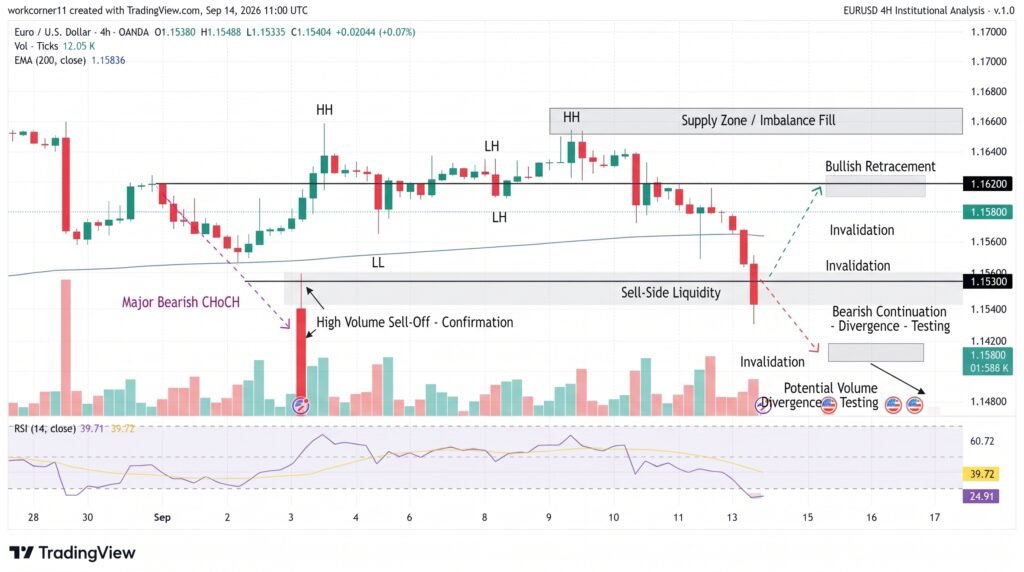
The immediate technical levels are:
- Resistance: 1.1602, the 20-period EMA
- Immediate support: 1.1560
- Major psychological support: 1.1500
A sustained daily close above 1.1602 would weaken the bearish setup and signal that buyers are regaining control. Conversely, a decisive break below 1.1560 would expose the 1.1500 psychological level.
The broader backdrop remains dollar-supportive while markets prepare for the Fed decision. At the same time, rising oil prices are creating another inflation risk for both economies, limiting the scope for either central bank to ease policy quickly. Brent crude recently climbed above $107 a barrel amid continuing Middle East supply disruptions.
Conclusion
EUR/USD is under pressure as stronger monthly U.S. inflation readings and elevated producer prices push Fed hike expectations toward 87%. The decline to 1.1565 puts 1.1560 in immediate focus, while 1.1602 is the key level bulls must reclaim to stabilize the trend. A break below 1.1560 would expose 1.1500, while a recovery above the 20-period EMA could ease the bearish bias. For now, the policy divergence and higher U.S. yields favor the dollar.
Sources & Methodology
Primary-source standard: Market-moving facts should link to original data releases, regulator notices, company filings or official project announcements whenever available. Secondary reporting is used for additional context, not as a substitute for original evidence.
Page last reviewed: