
Hyperliquid strengthened its position in the cryptocurrency derivatives market during the third quarter, with open interest reaching a record $18.1 billion in September and its share of combined positions across nine trading venues rising to 11.7%. The decentralized exchange attracted more traders and recorded higher outstanding positions, challenging established centralized platforms. Its expansion was driven increasingly by native cryptocurrency derivatives, even as markets linked to traditional assets continued to generate substantial volume. However, HYPE’s technical outlook remains weak, with the token trading below major moving averages and facing resistance near $75.
Hyperliquid Expands Derivatives Market Share
According to Hyperliquid’s Q3 2026 report, open interest peaked at $18.1 billion on September 22. By the end of the quarter, it stood at $16.7 billion, representing a 79.9% increase from $9.31 billion at the end of June. Average open interest also climbed 46.4% quarter over quarter to $12.7 billion.
Open interest measures the value of outstanding derivatives contracts that have not been settled or closed. Its increase indicates that traders are maintaining larger positions, although it does not necessarily mean that buying activity or bullish sentiment is rising.
Hyperliquid’s share of combined open interest across itself and eight major centralized exchanges increased to 11.7% from 9.6% in June. The platform moved ahead of Kraken and Bybit on August 12 before surpassing OKX on September 17. Nevertheless, its quarter-end open interest remained considerably smaller than Binance’s, representing approximately 27% of that exchange’s total.
Native Crypto Markets Drive Growth
The composition of Hyperliquid’s derivatives activity changed significantly during Q3 as traders returned to its core cryptocurrency markets.
Its HIP-3 framework allows third-party developers to introduce perpetual futures linked to traditional assets, including equities, commodities and market indices. These contracts generated $262 billion in quarterly trading volume, an increase of 23% from Q2.
However, HIP-3’s share of Hyperliquid’s perpetual futures activity declined from 51.1% in July to 24.5% in September. The shift reflected a 72% recovery in native market volume from its July low.
Equity-linked contracts remained the largest HIP-3 category, producing $153.8 billion in quarterly volume, up 160.8%. Commodity trading moved in the opposite direction, declining 47.7% to $45.6 billion.
Broader participation also improved:
- Average daily traders increased 20% to 65,161.
- New traders climbed 14.5% to 362,611.
- Matched trading volume rose 9.3% to $730.6 billion.
- Net bridge outflows reached $953 million during the quarter.
Despite the increase in trading volume, activity remained 30.5% below the same period a year earlier. Bridge outflows also indicate that capital left the platform through its cross-chain infrastructure, but do not independently establish that trading demand weakened.
HYPE Price Forecast: $75 Resistance
HYPE traded around $72.13 in the supplied daily-chart snapshot, remaining below its 20-day, 50-day and 100-day Exponential Moving Averages (EMAs), clustered between $77.44 and $80.26.
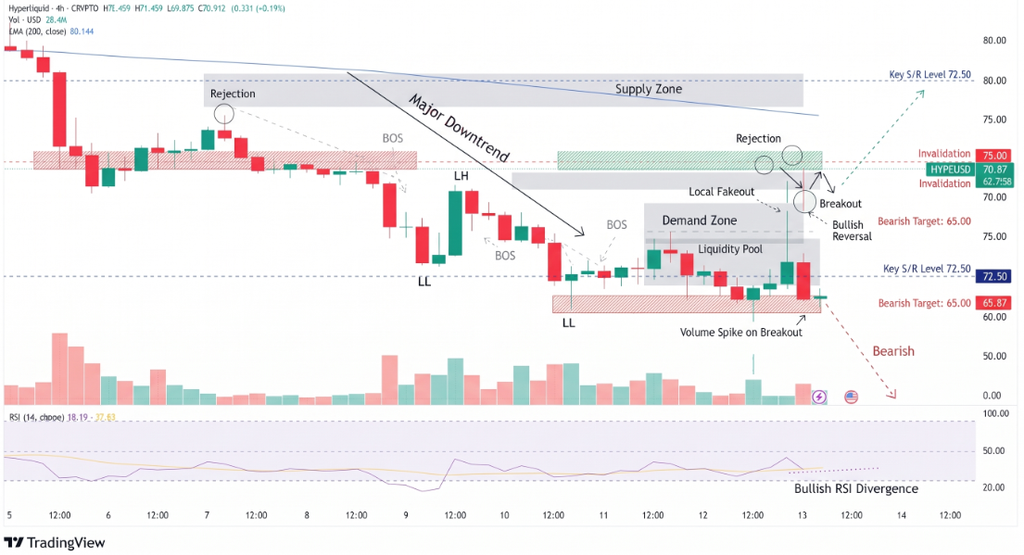
The descending trendline near $75.12 continues to restrict recovery attempts. The Relative Strength Index (RSI) near 35 indicates weak momentum, while the Stochastic Oscillator around 9 signals deeply oversold conditions. Neither indicator independently confirms a reversal.
Key price levels include:
- Immediate support: $67.63.
- Lower support: $61.16 and $51.57.
- Initial resistance: $75.12–$75.69.
- Higher resistance: $85.04 and $97.84.
Conclusion
Hyperliquid’s record open interest and growing market share demonstrate its expanding role in cryptocurrency derivatives trading. However, the increase in platform activity has not yet translated into a stronger HYPE price structure. A sustained move above $75 could improve the technical outlook, while a break below $67.63 would expose lower support levels. Continued growth in native-market participation will remain important to the platform’s competitive position.
Sources & Methodology
Primary-source standard: Market-moving facts should link to original data releases, regulator notices, company filings or official project announcements whenever available. Secondary reporting is used for additional context, not as a substitute for original evidence.
Page last reviewed: