

Forex trading can seem compsxlex at first, but with the right guidance, anyone can learn the basics and start trading confidently.
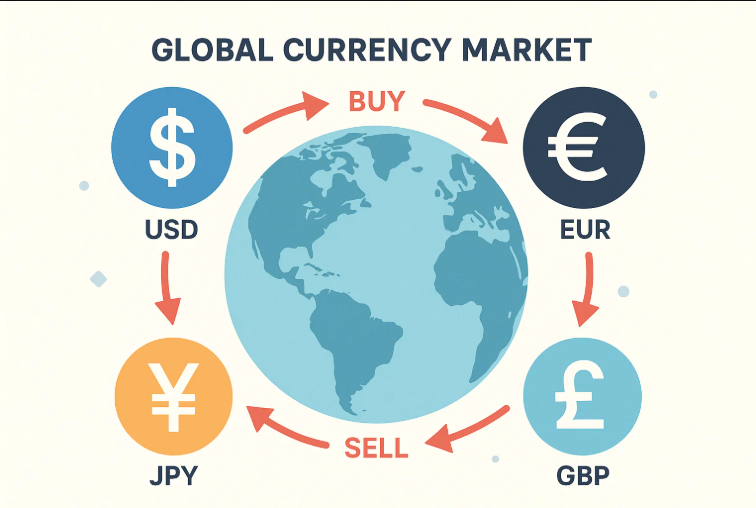
If you’ve ever wanted to learn how currency trading works, this guide will walk you through it step by step. You’ll find out what Forex is, where it began, and why it’s such a big part of the world economy.
By the end, you’ll understand the basics and feel ready to start learning how to trade with confidence. The primary way traders make money in forex is by correctly predicting currency price movements.
Importance of Understanding Forex Trading Before Starting
Forex is more than buying and selling currencies. You need to know market trends, economic factors, and risk management to make smart decisions and avoid beginner mistakes.
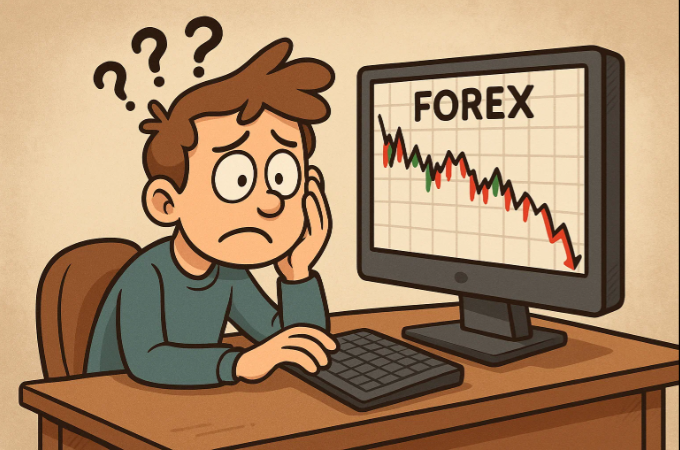
Example: Imagine buying a currency right before bad economic news comes out. The price could suddenly drop, and you’d lose money simply because you didn’t know what was happening in the market.
Objectives of the Guide
This guide explains Forex in a simple way. It covers what Forex is, its history, its role in the world economy, and how beginners can start trading safely and effectively.
What is Forex Trading?
Forex trading is the act of exchanging one currency for another to make a profit from changes in their value.
Definition of Forex
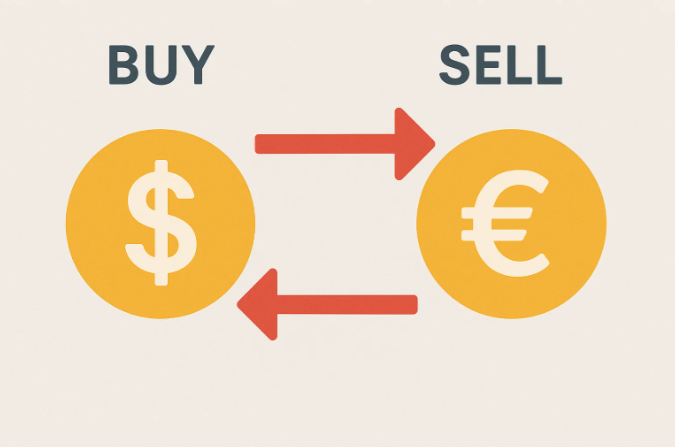
Forex (foreign exchange) is the world’s largest financial market, where currencies are bought and sold. Traders aim to profit from changes in exchange rates by buying one currency and selling another.
Example: Suppose you think the euro will become stronger than the US dollar. You buy the EUR/USD pair. If the euro’s value goes up, you can sell it later for a profit.
Brief History of the Forex Market
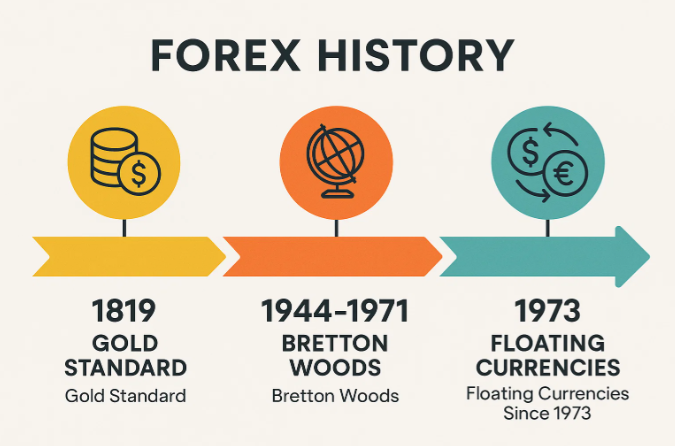
Currency trading has been around for hundreds of years.
In 1819, the gold standard was introduced, linking money to the value of gold.
From 1944 to 1971, the Bretton Woods system tied most currencies to the US dollar.
Since 1973, most major currencies have been allowed to move freely, with prices decided by supply and demand.
Importance of Forex in the Global Economy
Forex plays a key role in global finance. It makes international trade possible, helps investors diversify their portfolios, and shows how strong or weak a country’s economy is.
Central banks also use the Forex market to keep their currencies stable and support economic growth.
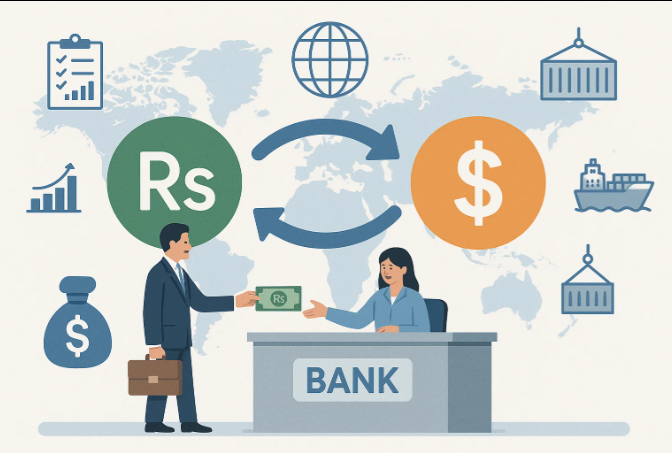
Example: A company in Japan buying products from Europe needs to exchange yen for euros. The Forex market makes this currency conversion possible.
2. Understanding Forex Trading
Before you start trading, it’s important to understand how the Forex market works and what makes it unique.
What is Forex Trading?
Forex, or foreign exchange trading, means buying one currency while selling another at the same time. Traders try to earn money when exchange rates change.
Unlike the stock market, Forex is open 24 hours a day, five days a week, so people around the world can trade at any time. Because of its massive daily trading volume, it’s the largest financial market in the world.
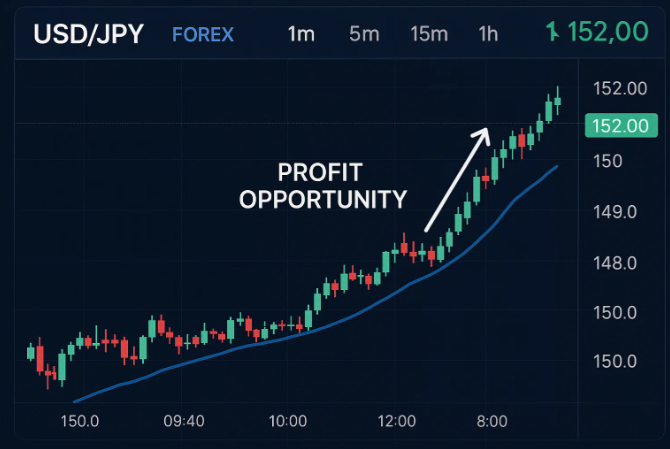
Example: Suppose you buy USD/JPY when the price is 150. Later, it goes up to 152. If you sell at that point, you earn a profit because the value of the US dollar increased against the Japanese yen.
Basic Concepts and Terminology
Before trading, it helps to know a few basic terms you’ll see often:
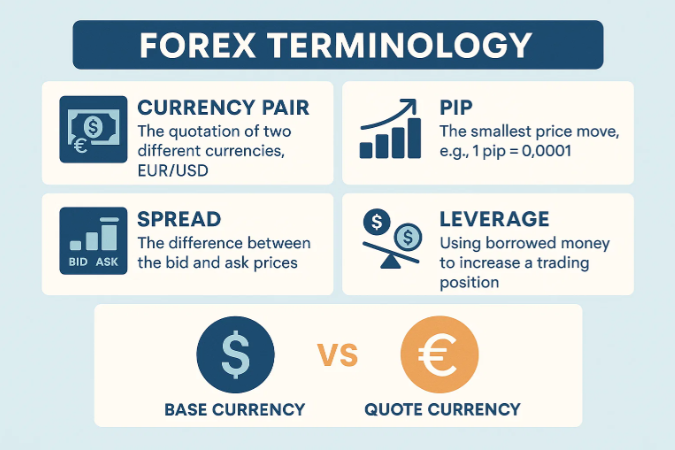
- Currency Pair: The two currencies you’re trading, such as EUR/USD.
- Base and Quote Currency: In EUR/USD, EUR is the base currency (the one you buy or sell), and USD is the quote currency (it shows how much one euro is worth).
- Pip: The smallest change in the price of a currency pair.
- Spread: The difference between the buying price and the selling price.
- Leverage: Borrowed money that lets you trade larger amounts, increasing both potential profits and losses.
Example: If you use 10:1 leverage, a $100 trade lets you control $1,000 in the market. But remember, this also means your losses can grow just as quickly.
History and Evolution of the Forex Market
Forex trading has come a long way over time. In ancient days, people simply traded goods and coins to do business across regions.
In the 1800s, the gold standard was introduced to keep currency values steady. Then, in the mid-1900s, the Bretton Woods system tied many currencies to the US dollar.
That system eventually ended in the 1970s, and since then, most major currencies have floated freely, with their prices set by supply and demand.
Today, with fast internet and digital platforms, anyone can trade currencies instantly. This growth has turned Forex into one of the most active and important markets in the world.
3. Getting Started with Forex Trading
Before you begin trading, it’s important to understand the basics and build a strong foundation.
What You Need to Know Before You Start
Forex isn’t a quick way to get rich. Real success takes patience, discipline, and learning. Before you trade with real money, make sure you understand how the market works and what risks are involved.
A smart first step is to open a demo account. It lets you practice trading with virtual money, so you can gain experience safely.
Setting Realistic Expectations
In Forex, profits and losses are both part of the journey. Instead of chasing big wins, focus on learning consistently and growing your account slowly. Managing risk and setting achievable goals are what lead to long-term success.
Example: Aiming for 2–3% growth each month is much more realistic than expecting to double your account in a few weeks.
Importance of Education and Research
Learning is the foundation of successful trading. Understanding both technical and fundamental analysis helps you make better decisions.
It’s also important to stay updated on currency news, global events, and economic reports, as these factors often influence market movements. The more you learn, the more confident and prepared you become as a trader.
How Forex Markets Work
To trade confidently, it helps to understand how the Forex market is structured and who takes part in it.
Market Structure
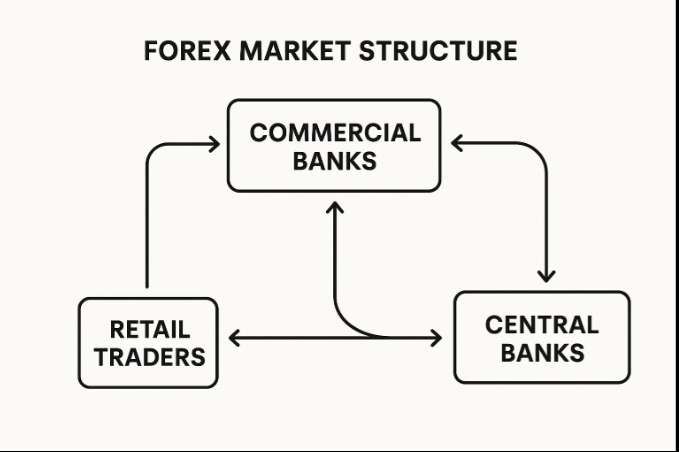
The Forex market doesn’t have a central exchange like the stock market. Instead, it’s decentralized, meaning trades happen directly between buyers and sellers through a system called over-the-counter (OTC) trading. Because of this setup, Forex runs 24 hours a day as different financial centers around the world open and close in different time zones.
Key Players
The main participants in the Forex market include:
- Retail traders: Individual people trading through online platforms
- Commercial banks and institutions: Handle large transactions and liquidity
- Central banks: Influence currency values by changing interest rates or policies
Example: When the U.S. Federal Reserve raises interest rates, the U.S. dollar often becomes stronger in the Forex market.
Currency Pairs
Before trading, it’s important to know how currencies are grouped and priced.
Explanation of Currency Pairs
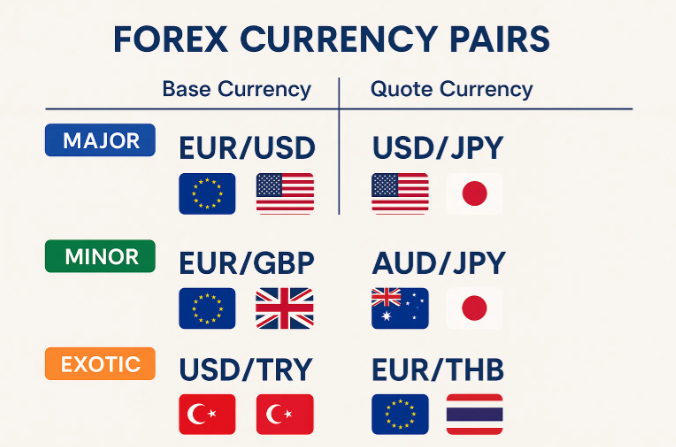
In Forex, currencies are always traded in pairs, for example, EUR/USD.
The first currency is called the base currency, and the second is the quote currency.
The price of the pair tells you how much of the quote currency is needed to buy one unit of the base currency.
Example: If EUR/USD = 1.10, it means one euro equals 1.10 U.S. dollars.
Major, Minor, and Exotic Pairs
- Major pairs: Most traded, like EUR/USD or USD/JPY.
- Minor pairs: Less common, like EUR/GBP.
- Exotic pairs: Mix major currencies with smaller ones, like USD/TRY.
How to Read Forex Quotes
Each pair has two prices:
- Bid: Price you sell at.
- Ask: Price you buy at.
- Spread: Difference between bid and ask (your trading cost).
Example: If EUR/USD is 1.1050/1.1052, the spread is 2 pips.
5. Forex Market Operating Hours
Knowing when different markets are open helps traders find the best times to trade.
Overview of the Major Trading Sessions
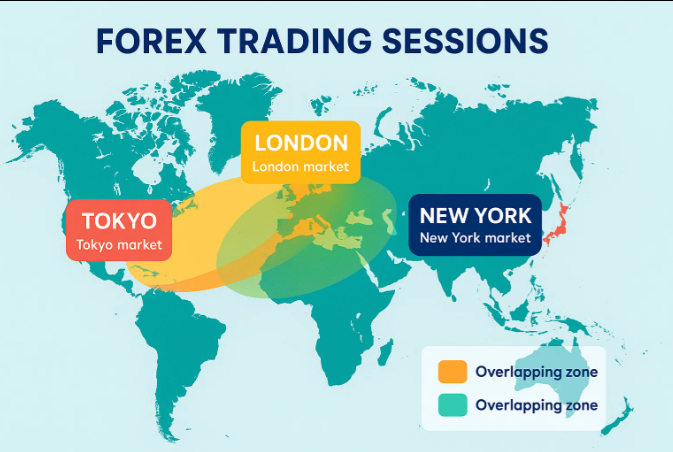
Forex runs 24 hours a day, five days a week, across different global time zones. The main sessions are:
- Tokyo (Asian session)
- London (European session)
- New York (US session)
When sessions overlap, trading activity and liquidity increase significantly.
Characteristics and Market Activity in Each Session
- Tokyo Session: Opens around midnight GMT. Activity is moderate, with focus on JPY, AUD, and NZD pairs.
- London Session: Starts in the morning GMT. It is the most active session, especially for EUR/USD and GBP/USD.
- New York Session: Begins in the afternoon GMT and overlaps with London, creating high liquidity and volatility, especially in USD pairs.
Best Times to Trade Forex
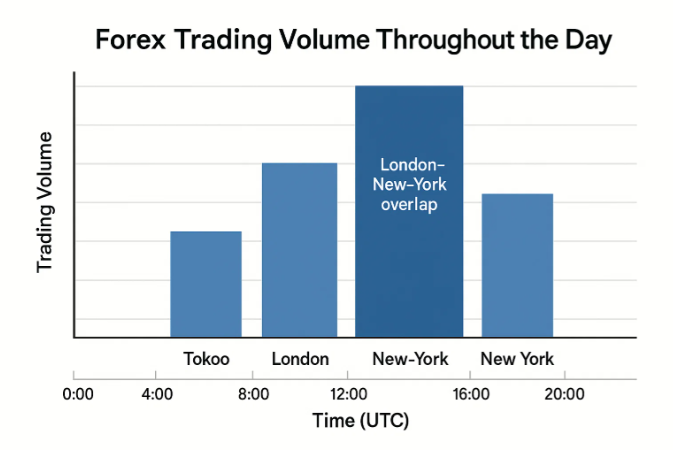
The best time to trade Forex is when two major sessions are open at the same time. During these overlaps, trading activity increases, and prices move more strongly.
The London–New York overlap is the busiest period of the day, offering the most trading opportunities.
Example: The EUR/USD pair often shows larger price swings during this overlap, giving traders more chances to profit from market movement.
6. Must-Have Forex Trading Software
Before you start trading, it’s important to choose the right platform that fits your needs and skill level.
Overview of Popular Trading Platforms
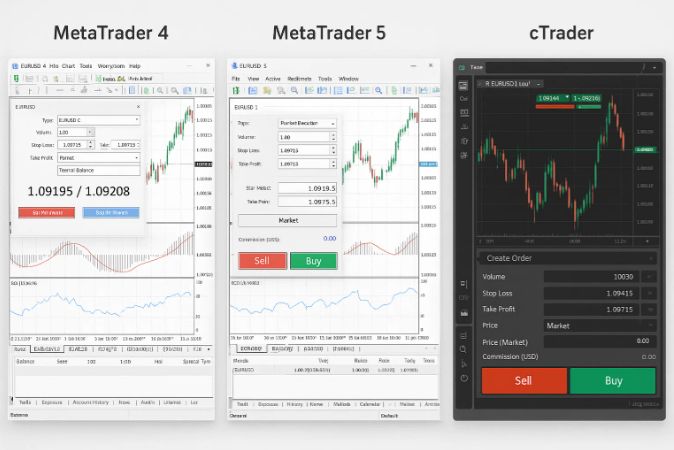
Choosing a reliable platform is one of the most important steps in Forex trading. The most widely used options are:
- MetaTrader (MT4 & MT5): Easy for beginners and packed with strong charting tools, technical indicators, and automated trading features called Expert Advisors (EAs).
- cTrader: Known for its fast trade execution, advanced charting options, and modern, user-friendly design. Many experienced traders prefer it for speed and detail.
Example: A beginner might start with MT4 for its simplicity, while an advanced trader may choose cTrader for its detailed analysis tools and faster performance.
Importance of a Reliable Trading Platform
Your trading platform is your main workspace. It provides real-time price data, charts, and order execution. If it’s unreliable, you might face delays or errors that can cause losses. Choosing a trusted, broker-supported platform ensures smoother, safer, and more efficient trading.
Additional Tools That Help Traders
Along with a trading platform, a few extra tools can make a big difference:
- Economic Calendar: Shows upcoming events like interest rate announcements and GDP releases.
- News Feeds: Keep you updated on global financial and political news that can affect currency prices.
- Trading Calculators: Help you manage risk by calculating pip values, position sizes, and margin requirements.
When used together, these tools make trading more informed, accurate, and efficient.
7. Introduction to Forex Analysis
Forex analysis is the key to making better trading decisions. By studying price movements, economic conditions, and overall trader behavior, traders can understand the market more clearly and plan their moves wisely.
Technical Analysis
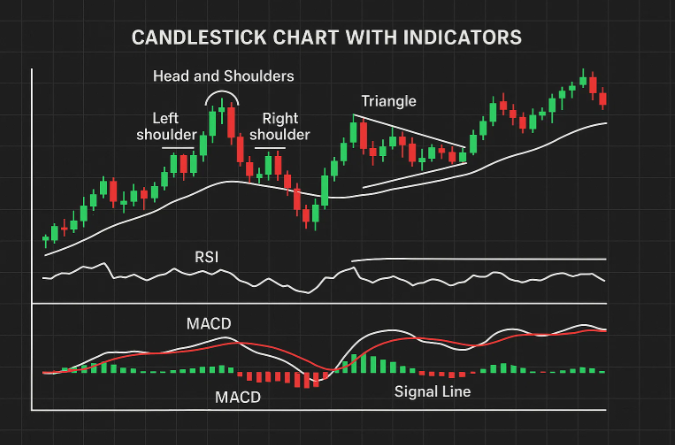
Technical analysis is the study of price charts and patterns to predict where the market might move next. The idea is simple: prices often repeat certain behaviors over time.
Traders use different types of charts:
- Line charts show basic trends.
- Bar charts display detailed price ranges.
- Candlestick charts make it easy to spot patterns and changes in market mood.
In addition to charts, traders use tools like Moving Averages, RSI (Relative Strength Index), and MACD to find signs of momentum, strength, and potential buy or sell points. Recognizing chart patterns, such as head and shoulders or triangles, can also help forecast price direction.
Example: If the RSI shows that a currency is overbought, it might mean prices could drop soon as traders start selling to take profits.
Fundamental Analysis
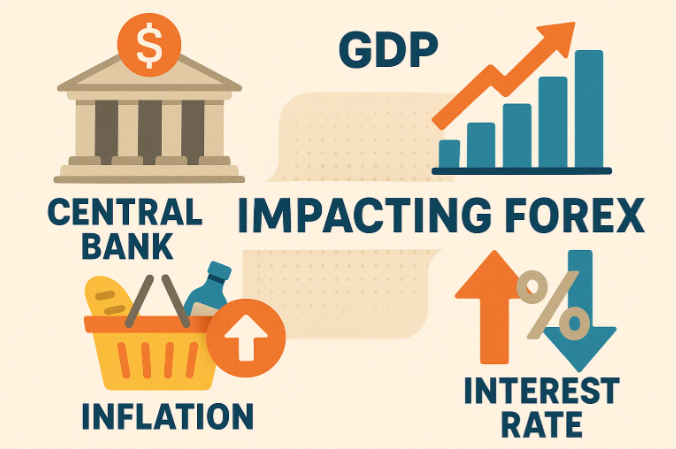
Fundamental analysis focuses on the overall economic health of a country to understand what might move its currency.
Key factors include interest rates, GDP growth, employment data, and inflation, all of which can strongly affect currency values.
Other elements such as political stability, central bank policies, and global trade events also play an important role in price movements.
Example: If the U.S. Federal Reserve raises interest rates, investors often buy more U.S. dollars because higher rates make the currency more attractive, which usually strengthens its value.
Sentiment Analysis
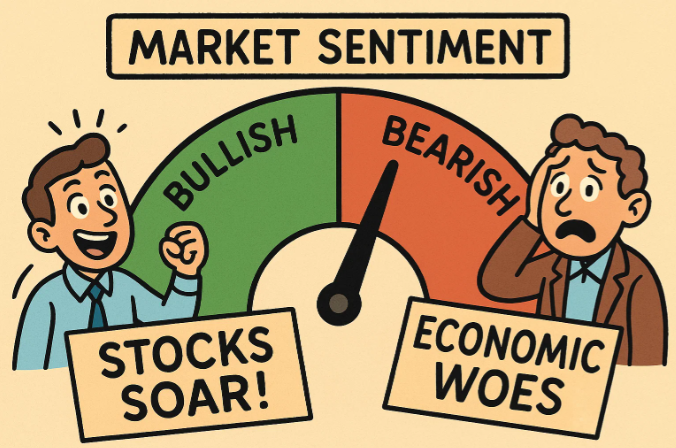
Sentiment analysis looks at the overall mood of the market, whether most traders are buying (bullish) or selling (bearish).
Sometimes, even when technical and fundamental analysis point in one direction, market sentiment can move prices the other way in the short term.
Traders use tools like the Commitment of Traders (COT) report, sentiment indexes, and news sentiment trackers to gauge how the crowd feels about a particular currency.
Example: Even if charts show a downtrend for the euro, positive or hopeful news might encourage traders to buy, which can push the price higher.
By combining technical, fundamental, and sentiment analysis, traders can form a clearer and more reliable view of the Forex market.
Developing a Trading Plan
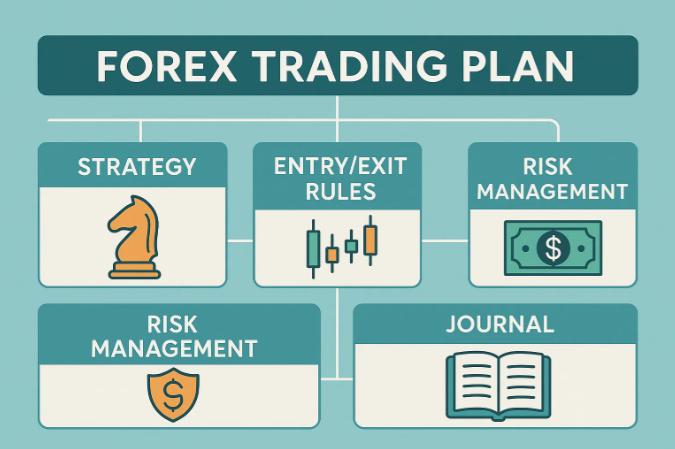
A trading plan is your personal rulebook for Forex trading. It explains when to enter and exit trades, how much risk to take, and how to react to different market situations.
Without a plan, many traders let emotions take over, chasing profits when prices rise or panicking when they fall.
A solid plan keeps you disciplined, removes guesswork, and helps you stay consistent over time.
Why It Matters
Most beginners lose money not because they don’t understand Forex, but because they lack discipline. A trading plan helps you stick to a clear strategy instead of making random, emotional decisions. It also allows you to review your past trades, learn from mistakes, and keep improving over time.
What a Trading Plan Should Include
Your plan should clearly define:
- Trading strategy – Decide if you prefer day trading, swing trading, or long-term investing.
- Entry and exit rules – Set conditions for opening and closing trades.
- Risk management – Limit how much of your account you will risk per trade.
- Money management – Choose lot sizes and how to use leverage wisely.
- Record keeping – Maintain a journal to track wins, losses, and lessons learned.
For example, you might decide never to risk more than 2% of your account on a single trade. This rule protects your capital even if you face multiple losses in a row.
Setting Goals
Clear goals give you direction and purpose.
Short-term goals can include practicing on a demo account, managing emotions, or earning small but steady profits.
Long-term goals might involve doubling your capital over a realistic period or becoming a consistently profitable trader.
The key is to make your goals specific and measurable, so you can track your progress without feeling pressured.
Risk Management
No trading plan is complete without proper risk control. Even experienced traders lose trades sometimes, but good risk management keeps one loss from wiping out your account.
Simple techniques include using stop-loss orders, setting a risk-to-reward ratio (for example, risking $1 to make $2), and keeping leverage under control.
Smart traders always focus on protecting their capital first. When you stay disciplined, profits tend to follow naturally.
8. Starting with a Forex Demo Account
Before using real money, every beginner should start with a demo account. Most brokers offer one, allowing you to trade with virtual funds in real market conditions. It’s the safest way to learn Forex without risking your savings.
Why Use a Demo Account
Trading with a demo account has many benefits:
- It carries no financial risk, so you can make mistakes and learn safely.
- It offers hands-on experience, helping you get comfortable with platforms like MetaTrader or cTrader.
- It lets you test different strategies to find what works best for you.
- Most importantly, it helps you build confidence before moving to live trading.
Practicing in a demo account is one of the smartest ways to prepare for the real Forex market.
How to Practice Effectively
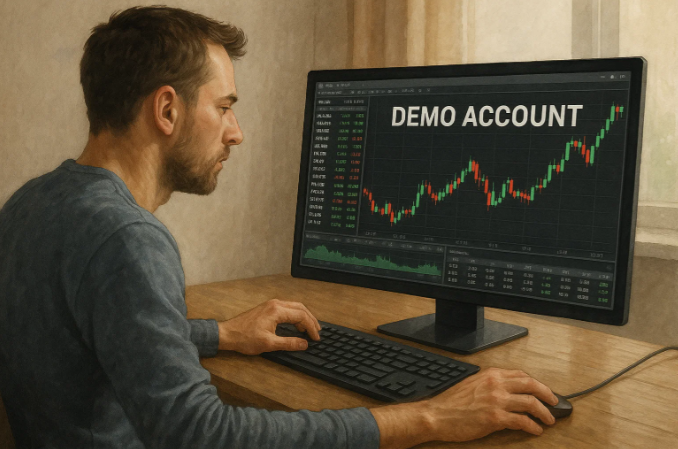
When using a demo account, treat it like a real one. Set a trading budget, follow your plan, and manage risk as if the money were your own.
Example: If you plan to risk only 2% of your capital per trade in a live account, use the same rule while practicing.
This approach helps you build good habits, stay disciplined, and avoid common mistakes like overtrading or ignoring stop-loss orders.
Moving from Demo to Live Trading
When you’re consistently profitable and confident in your strategy on a demo account, you’re ready to move to live trading. Start small, using only a little capital and low leverage.
The main difference between demo and live trading is emotion. When real money is involved, fear and greed can affect your decisions. That’s why discipline and sticking to your trading plan are so important.
Think of a demo account like training wheels on a bicycle. You won’t use them forever, but they help you find balance and confidence before starting the real ride.
9. Guide to Forex Currency Pairs
In Forex trading, currencies are always traded in pairs because buying one currency means selling another.
Understanding how these pairs work is essential for reading and predicting market movements.
Types of Currency Pairs
Currency pairs fall into three main categories:
- Major Pairs:
- These are the most actively traded pairs and always include the U.S. dollar. Examples include EUR/USD, GBP/USD, and USD/JPY. Major pairs have high liquidity and usually lower trading costs.
- Minor Pairs:
These pairs don’t include the U.S. dollar but involve other strong global currencies, such as EUR/GBP or AUD/JPY. They typically have slightly higher spreads and less liquidity than the majors.
- Exotic Pairs:
Exotic pairs combine a major currency with one from a smaller or emerging economy, such as USD/TRY (Turkish Lira) or EUR/THB (Thai Baht). They can be more volatile and riskier due to lower trading activity.
How to Read Forex Quotes
In Forex, every currency pair is written as Base Currency/Quote Currency.
For example, in EUR/USD, the euro (EUR) is the base currency, and the U.S. dollar (USD) is the quote currency.
If EUR/USD = 1.0800, it means one euro equals 1.08 U.S. dollars.
Each quote shows two prices:
- Bid: The price at which you can sell the base currency.
- Ask: The price at which you can buy the base currency.
The small gap between these two prices is called the spread, which represents the broker’s fee or profit.
Currency Correlations
Some currency pairs move in similar or opposite directions because they share common currencies.
For example, EUR/USD and GBP/USD often move in the same direction since both involve the U.S. dollar.
On the other hand, USD/JPY and EUR/USD often move in opposite directions.
Understanding these correlations helps traders manage their positions better and avoid taking multiple trades that react the same way to market changes.
10. Forex Bid, Ask, and Spread Explained
When you open a Forex trading platform, you’ll always see two prices for every currency pair: the bid and the ask.
The difference between these two prices is called the spread, which represents the small cost you pay to place a trade. It’s often considered the hidden cost of trading, since it’s built into the price rather than charged as a separate fee.
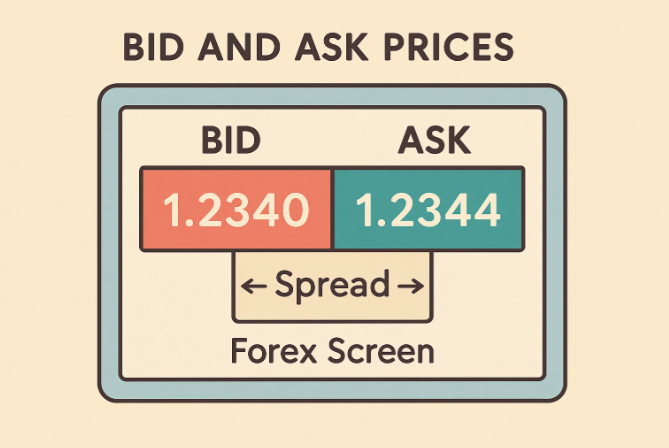
Bid, Ask, and Spread Explained
- Bid Price → The rate at which you can sell the base currency. Example: If EUR/USD bid is 1.0800, you can sell 1 Euro for 1.0800 US Dollars.
- Ask Price → The rate at which you can buy the base currency. Example: If the ask is 1.0802, you can buy 1 Euro for 1.0802 US Dollars.
- Spread → The gap between the bid and ask price. In this case, 1.0802 – 1.0800 = 0.0002 (2 pips).
How to Calculate the Spread
Spreads are measured in pips, the smallest price movement in Forex.
- EUR/USD at 1.0800 / 1.0802 → Spread = 2 pips
- USD/JPY at 145.10 / 145.13 → Spread = 3 pips
Impact on Trading Costs
- High Liquidity Pairs (e.g., EUR/USD) → Lower spreads, cheaper trades
- Exotic Pairs (e.g., USD/TRY) → Wider spreads, higher costs
- Scalpers/Day Traders → Very sensitive to spreads, as they trade often
- Swing Traders → Less affected, since they hold trades longer
In short, spreads may look tiny, but they can add up quickly. That’s why choosing pairs and brokers with tight spreads is crucial, especially if you trade frequently.
11. Different Forex Trading Orders
In Forex trading, you don’t just click “buy” or “sell.” There are different types of orders that let you control how and when your trades are executed.
Understanding these orders helps you manage risk, plan ahead, and avoid emotional decisions.
Types of Orders
1. Market Order
- Executes immediately at the current market price.
- Example: EUR/USD is at 1.0850. You click “buy,” and your trade opens right away at or near that price.
- Best for: Entering or exiting a trade quickly.
2. Limit Order
- An order to buy below the current price or sell above it.
- Example: EUR/USD is 1.0850. You set a buy limit at 1.0800. If the price drops to 1.0800, the order triggers automatically.
- Best for: Entering at better prices.
3. Stop Order (Stop-Loss Order)
- An order to buy above the current price or sell below it.
- Example: EUR/USD is 1.0850. You set a buy stop at 1.0900. If the price rises to 1.0900, the trade activates.
- Best for: Catching breakouts or limiting losses.
4. Trailing Stop Order
- A stop-loss that moves automatically as the market moves in your favor.
- Example: You buy EUR/USD at 1.0850 and set a trailing stop of 30 pips. If the price rises to 1.0900, your stop moves to 1.0870 to lock in profit.
- Best for: Protecting profits while letting trades run.
5. Stop-Limit Order
- A mix of a stop and a limit order. The stop triggers first, then a limit order executes at your chosen price.
- Example: You set a buy stop at 1.0900 with a limit at 1.0910. If the price jumps above 1.0910, the trade won’t execute.
- Best for: Traders who want more control over their entry price.
How to Use Orders Effectively
- Market Orders: Use when speed matters more than price.
- Limit Orders: Great for buying dips or selling rallies.
- Stop Orders: Useful for breakout strategies and managing risk.
- Trailing Stops: Ideal for trending markets to secure profits.
- Stop-Limit Orders: Best when you want precise control over entry.
Practical Example
Imagine EUR/USD is trading at 1.0850:
- You expect the price to drop before rising, so you place a buy limit at 1.0800.
- To protect yourself, you set a stop-loss at 1.0780.
- If the trade moves in your favor, you add a trailing stop to secure profits as the price climbs.
With the right mix of orders, you can automate your trades, save time, and keep emotions out of your decisions.
12. Forex Lots, Points, and Leverage
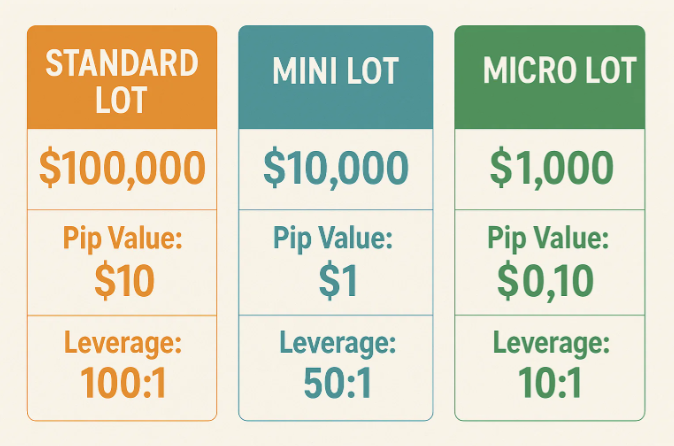
Before placing any trades, it’s important to understand three key ideas: lot size, pips, and leverage. Together, these determine how much you can gain or lose on each trade.
A lot is the standard size of a trade in Forex. The pip, short for “point in percentage,” is the smallest change in a currency pair’s price, usually at the fourth decimal place (0.0001). For example, if EUR/USD moves from 1.1000 to 1.1005, that’s a movement of five pips.
Lot size affects how much money you gain or lose with each pip. A standard lot equals 100,000 units of currency, where one pip is roughly worth ten dollars. A mini lot equals 10,000 units, making one pip worth about one dollar. A micro lot equals 1,000 units, where one pip is worth about ten cents. Most beginners start with mini or micro lots to reduce risk while they learn.
Leverage allows traders to control large positions with a small deposit, called margin. For instance, with 1:100 leverage, a deposit of $100 can control a $10,000 trade. If EUR/USD moves fifty pips in your favor on a mini lot, you could earn about $50 with only $100 invested.
However, leverage can work both for and against you. It gives small traders access to bigger opportunities and increases profit potential, but it also amplifies losses just as quickly. A single losing trade with high leverage can wipe out your account.
The safest approach is to start with lower leverage and smaller lot sizes until you gain experience and confidence in your trading strategy.
13. Profit Calculation in Forex
In Forex, your profit or loss depends on three things: pips gained or lost, lot size, and leverage. Once you understand how they connect, working out results becomes straightforward.
How to Calculate Profits and Losses
The process can be broken down into three steps:
- Find the pip movement of the trade.
- Multiply the pip movement by the pip value (depends on lot size).
- Adjust the result based on the number of lots traded.
Examples of Profit Calculation
Example 1 – Standard Lot (100,000 units):
You buy EUR/USD at 1.1000 and close at 1.1050 → a 50-pip gain.
Since 1 pip ≈ $10, your profit = 50 × $10 = $500.
Example 2 – Mini Lot (10,000 units):
Buy at 1.1000, close at 1.1050 → also a 50-pip gain.
Here, 1 pip ≈ $1, so profit = 50 × $1 = $50.
Example 3 – Micro Lot (1,000 units):
Buy at 1.1000, close at 1.1050 → same 50-pip gain.
With 1 pip ≈ $0.10, profit = 50 × $0.10 = $5.
The Role of Leverage
Leverage doesn’t change pip value—it changes how much capital you need to open a trade. For instance, with 1:100 leverage, you only need $1,000 to control a standard lot (instead of $100,000). This allows smaller accounts to access big trades.
However, leverage also magnifies losses. If the same 50-pip move above went against you with one standard lot, you would lose $500 instead of gaining it.
14. Determining Position Size in Forex
Position sizing means deciding how big or small your trade should be. Even the best trading strategy can fail if you risk too much on a single trade, which is why sizing matters just as much as your entry and exit strategy.
Why Position Sizing Matters
- Protects your account from large losses.
- Promotes consistency instead of risky “all-in” trades.
- Helps you survive losing streaks and stay in the game long term.
How to Calculate the Right Size
The calculation has three steps:
- Decide how much of your account you’re willing to risk per trade (usually 1–2%).
- Determine your stop-loss distance in pips.
- Apply the formula:
\text{Position Size} = \frac{\text{Account Balance} \times \text{Risk %}}{\text{Stop-Loss (pips)} \times \text{Pip Value}}
Example Calculation
- Account Balance = $5,000
- Risk = 2% → $100
- Stop-Loss = 50 pips
- Pip Value (mini lot) = $1
Position Size=10050×1=2 mini lots (20,000 units)\text{Position Size} = \frac{100}{50 \times 1} = 2 \text{ mini lots (20,000 units)}Position Size=50×1100=2 mini lots (20,000 units)
So, to stay within your risk limit, you should trade 2 mini lots.
Helpful Tools for Position Sizing
- Manual Calculation – Using the formula above.
- Position Size Calculators – Available on most broker websites.
- Trading Platforms – MetaTrader and cTrader allow custom scripts to auto-calculate size.
Correct position sizing is the backbone of risk management. By controlling your trade size, you ensure no single trade can wipe out your account.
15. Initial Investment for Forex Trading
Starting Forex trading doesn’t require a fortune, but the right amount depends on your goals and risk tolerance. Some brokers allow accounts with as little as $50–$100, which is fine for practice but not very practical for real growth. A more realistic range is $500–$1,000, as this gives enough flexibility to trade smaller positions while managing risk. Serious traders often begin with $5,000 or more if they want meaningful and consistent returns.
When deciding how much to start with, consider a few factors: your trading goals (learning, side income, or full-time trading), your personal risk tolerance, broker deposit requirements, and the type of account you want to open. Micro accounts need less capital, while standard accounts naturally require more.
Most importantly, your initial capital should be treated as your most valuable asset. Good risk management means never risking more than 1–2% on a single trade and avoiding high leverage just to chase quick profits.
👉 Example: With a $1,000 account, a 2% risk limit means your maximum loss per trade is $20. This discipline protects your account during losing streaks and allows steady growth over time.
16. Leverage and Margin in Forex Explained
Leverage and margin are the engines of Forex trading. They let you control large positions with only a small amount of money. While this power creates big opportunities, misusing it can quickly drain your account.
Leverage means controlling a bigger trade size with less capital. For instance, with 1:100 leverage, just $100 allows you to trade $10,000 worth of currency. Margin is the portion of your account set aside as a security deposit for that trade.
Example: To open a $10,000 position with 1:100 leverage, you only need $100 in margin.
Using leverage effectively requires discipline. Beginners should stick to lower ratios, such as 1:10 or 1:30, and always protect trades with stop-loss orders. Avoid stacking multiple large trades that eat up most of your margin, because leverage magnifies both profits and losses.
Margin requirements vary depending on the broker and leverage ratio. For example:
- 1:50 leverage → margin = 2% of trade size
- 1:100 leverage → margin = 1% of trade size
If your account balance drops below the required margin, the broker may issue a margin call or automatically close your trades (called a stop-out).
17. Opening and Closing Trades in MetaTrader
MetaTrader (MT4 and MT5) is one of the most popular platforms for Forex trading. Before trading live, every beginner should know how to correctly open and close trades.
Opening a Trade in MetaTrader
After logging into your account, choose a currency pair from the “Market Watch” window (e.g., EUR/USD). Right-click and select New Order or press F9 to open the order window. You’ll then need to:
Select the order type:
- Market Execution → trade opens instantly at the current price.
- Pending Order → trade opens later at your chosen price.
- Set the lot size (micro, mini, or standard).
Adding Stop-Loss and Take-Profit
In the same order window, you can set levels to manage risk automatically. For example, if you buy EUR/USD at 1.1000:
- Stop-Loss at 1.0980 (limits loss to 20 pips).
- Take-Profit at 1.1050 (locks in 50 pips profit).
Closing a Trade
To exit a trade, go to the “Terminal” window, right-click your open position, and select Close Order. The trade will close at the current market price. You can also partially close by selecting a smaller volume before confirming.
18. Understanding Forex Rollover and Swap
When you hold a Forex trade overnight, you may be charged or credited a rollover fee, also called a swap. This happens because every trade involves borrowing one currency to buy another, and different currencies have different interest rates.
Rollover is simply the process of extending an open trade to the next trading day. The swap is the fee or credit applied for holding the position overnight. For example, if you buy a currency with a higher interest rate against one with a lower rate, you may earn a positive swap. Conversely, selling that currency pair often results in a negative swap.
Swap rates are calculated based on the interest rate difference between the two currencies, with brokers adding a small service fee. For instance, buying AUD/USD when Australia’s rate is higher than the US rate could earn you a positive swap, while selling it may cost you.
The impact of swaps depends on your trading style:
- Short-term traders (scalpers or day traders) are usually unaffected, as they close trades within the same day.
- Swing or position traders may see swaps accumulate over days or weeks, either increasing costs or adding extra income.
- Carry trade strategy involves holding positions with positive swaps to collect interest over time.
19. Using the Economic Calendar for Forex
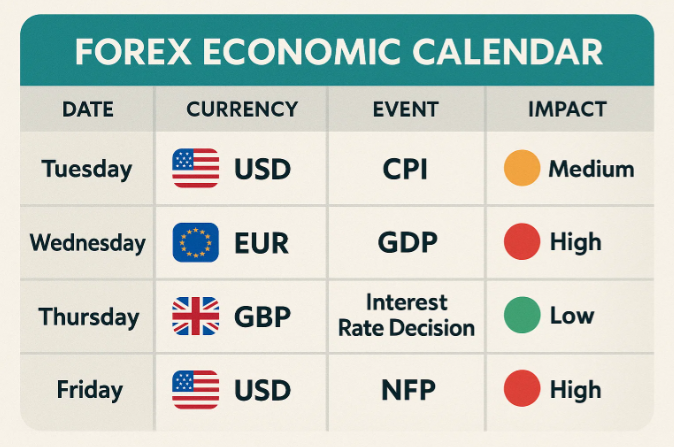
An economic calendar is a vital tool for Forex traders. It tracks major economic events and data releases that can influence currency prices. Using it effectively helps you anticipate market movements and make informed trading decisions.
Forex markets react strongly to indicators like interest rates, GDP, employment figures, and inflation. Traders who monitor these events can prepare for volatility spikes, while ignoring them may lead to unexpected losses—especially for short-term traders.
How to Read an Economic Calendar
- Date and Time: Note when events will occur and adjust for your time zone.
- Currency Impact: Identify which currency might be affected (e.g., USD, EUR).
- Event Type: Examples include Non-Farm Payrolls (NFP), CPI, or central bank decisions.
- Forecast vs. Actual: Compare analysts’ expectations with actual results; surprises often trigger sharp moves.
- Volatility Indicator: Calendars often color-code expected market impact as low, medium, or high.
Using Economic Events in Your Trading
- Before the Event: Consider reducing position size or closing trades to avoid sudden volatility.
- After the Event: Observe market reaction; strong deviations from forecasts can create trends.
- Example: If US CPI is higher than expected, the USD may strengthen. Traders can plan buy or sell positions accordingly, combining this insight with technical analysis for better precision.
20. Conclusion
Forex trading offers exciting opportunities, but real success comes from knowledge, discipline, and consistent practice.
In this guide, you learned what Forex trading is, how the global market works, and why understanding currency pairs, market analysis, and trading platforms is so important. You also discovered how to manage risk through position sizing, leverage, and stop-loss orders, along with practical steps like using a demo account, placing different types of orders, and staying updated on economic events.
Starting with a demo account is the safest way to practice your strategy, test your trading plan, and build confidence without risking real money. Always remember that Forex trading is a journey, not a race. Begin small, stay patient and disciplined, and never stop learning.
With steady effort and the right mindset, you can grow into a confident and consistent Forex trader ready to face the real market.

