


Bitcoin rebounds 5% from $57,735 as traders focus on the critical $62K resistance. Explore key technical signals, support zones, and market outlook.
Bitcoin Recovery Gains Momentum
Bitcoin regained momentum on Thursday after bouncing sharply from a recent low of $57,735, climbing more than 5% to trade near $61,211. The recovery has renewed optimism among traders, although technical indicators continue to present a mixed outlook. While short-term momentum has shifted in favor of buyers, longer-term trend signals still suggest that caution remains warranted.
The world’s largest cryptocurrency has recovered steadily rather than through an explosive rally, indicating that buyers have consistently absorbed selling pressure at lower price levels. Over the past 24 hours, Bitcoin recorded approximately $44.05 billion in trading volume, while its market capitalization climbed to roughly $1.23 trillion, reflecting continued investor participation despite recent volatility.
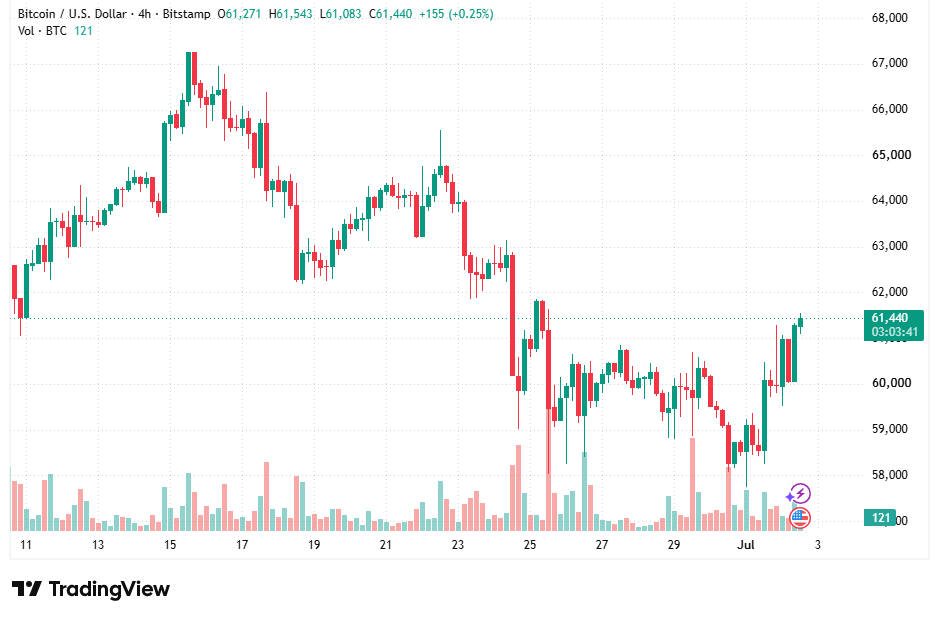
Market participants are now closely watching whether Bitcoin can overcome the important $61,500–$62,000 resistance zone. A successful move above this range could strengthen bullish sentiment and pave the way for another advance during the coming sessions.
Key Market Highlights
- Current Price: Around $61,211
- 24-Hour Recovery: More than 5% from $57,735
- Trading Volume: Approximately $44.05 billion
- Market Capitalization: Nearly $1.23 trillion
- Major Resistance: $61,300–$62,000
- Primary Support: $60,000, followed by $57,700
Technical Charts Signal Cautious Optimism
Bitcoin’s daily chart suggests buyers have regained some control after forming a higher low near the $57,700 support area. This technical pattern often signals strengthening demand and may represent the beginning of a broader recovery if buying pressure continues.
The cryptocurrency now faces immediate resistance between $61,300 and $62,000. A decisive daily close above this zone would improve the probability of a move toward $63,500 and potentially $64,000. Until that breakout occurs, however, Bitcoin remains within a broader corrective trend that has dominated recent weeks.
Shorter timeframes present a more constructive picture. The 4-hour chart shows a consistent sequence of higher highs and higher lows since the rebound began, indicating improving short-term market structure.
Meanwhile, the 1-hour chart continues to reflect bullish momentum, although shrinking candlestick sizes near resistance suggest that traders may experience brief consolidation before the next significant move.
If Bitcoin falls below the $60,000 support level, recent gains could quickly come under pressure, increasing the likelihood of another test of $59,000 or even the previous $57,735 low.
Indicators Keep Bulls and Bears Balanced
Technical indicators continue to deliver mixed signals. The Moving Average Convergence Divergence (MACD) has shifted into bullish territory, while the Momentum indicator also supports further upside. These developments indicate that buying pressure has improved considerably during the recent rebound.
Other oscillators remain largely neutral. The Relative Strength Index (RSI) stands at 43, suggesting Bitcoin is neither overbought nor oversold. Similarly, the Stochastic Oscillator, Commodity Channel Index (CCI), Average Directional Index (ADX), and Awesome Oscillator all point to a market waiting for stronger directional confirmation.
Moving averages tell a different story. Bitcoin currently trades above both its 10-period Exponential Moving Average (EMA) and 10-period Simple Moving Average (SMA), providing short-term buy signals. However, the 20-, 30-, 50-, 100-, and 200-period moving averages continue to indicate bearish conditions, highlighting that the broader trend has yet to reverse.
The coming sessions are likely to determine Bitcoin’s next major move. A sustained breakout above $62,000 would strengthen the bullish case and could attract additional buying interest. Conversely, failure to clear resistance combined with a break below $60,000 would likely shift momentum back toward sellers, placing the recent recovery at risk.
