

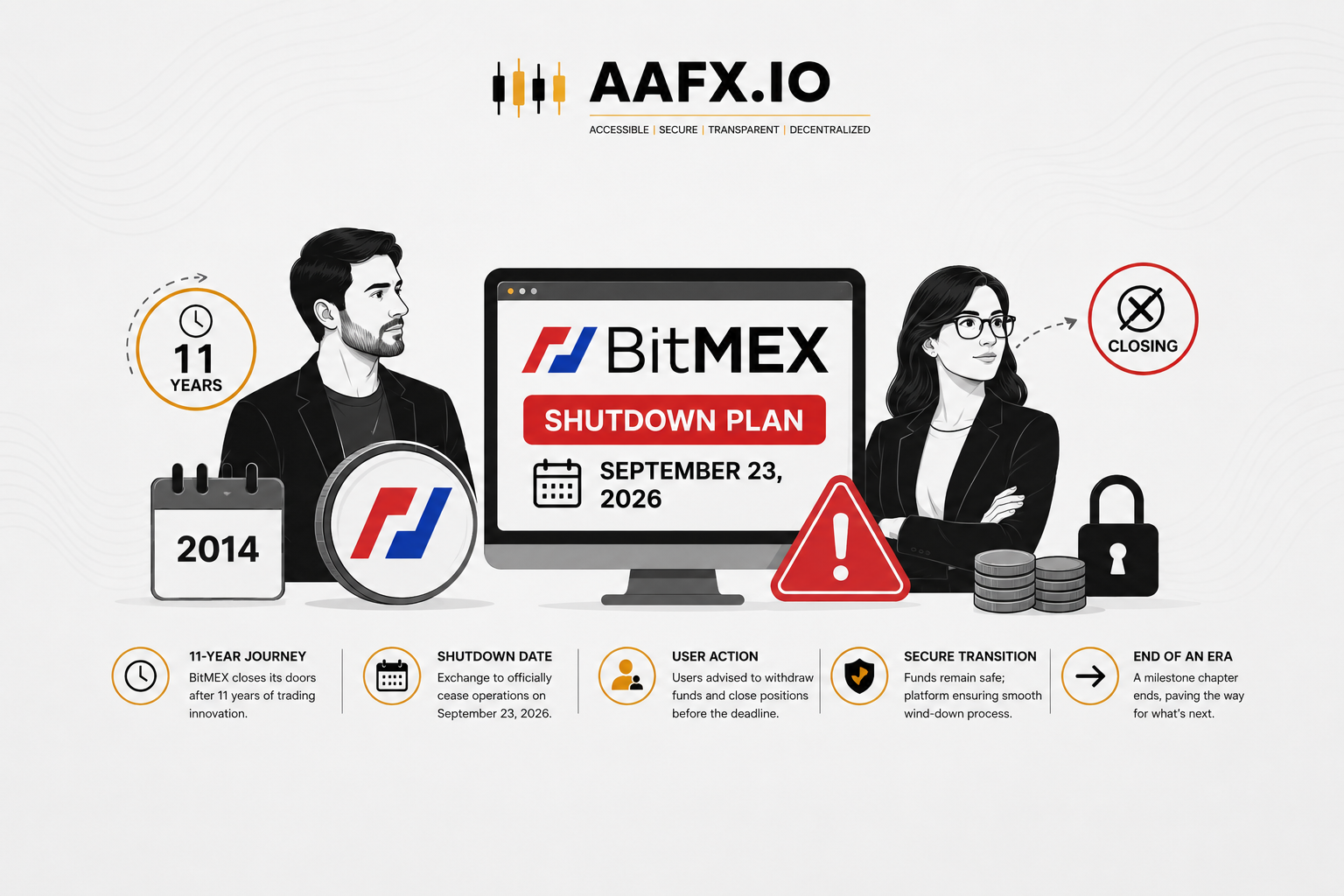
BitMEX will shut down after 11 years, ending its pioneering crypto derivatives journey. Learn the closure timeline, withdrawal rules, and market impact.
BitMEX Ends Operations After 11 Years
BitMEX, one of the most influential names in cryptocurrency derivatives trading, has confirmed it will permanently cease operations on September 23, 2026, at 04:00 UTC. The decision marks the conclusion of an 11-year journey for the exchange that introduced the 100x leveraged perpetual swap, a product that reshaped digital asset trading worldwide.
The exchange said the shutdown follows a comprehensive strategic review conducted by its parent company, HDR Global Trading Limited, rather than financial instability or regulatory intervention. New user registrations have already been suspended, signaling the beginning of a carefully managed exit from the crypto market.
Founded in 2014, BitMEX transformed derivatives trading by introducing perpetual futures contracts without expiration dates. The innovation quickly became the industry’s preferred trading instrument and was later adopted by nearly every major cryptocurrency exchange. Throughout its operational history, the company also highlighted that it had never suffered a successful hack resulting in customer fund losses, reinforcing its reputation for platform security.
Legacy, Innovation, and Challenges
BitMEX’s influence extends far beyond its trading volumes. The exchange helped popularize leveraged cryptocurrency trading, attracting both institutional participants and experienced retail traders. Its perpetual swap model fundamentally changed how digital assets are traded, making leveraged exposure more accessible across global markets.
Despite its technological achievements, the company also faced significant legal scrutiny. In 2022, founders Arthur Hayes, Ben Delo, and Samuel Reed pleaded guilty to violations of the U.S. Bank Secrecy Act related to shortcomings in the platform’s anti-money laundering compliance program. The founders later received presidential pardons, allowing the company to continue operating despite its legal history.
Unlike several crypto firms that collapsed due to insolvency or regulatory enforcement, BitMEX emphasized that its closure represents a business decision rather than a forced shutdown. The announcement positions the exchange as voluntarily concluding operations after completing an internal assessment of future market opportunities.
Key milestones include:
- Founded in 2014 as a crypto derivatives exchange.
- Introduced the industry’s first 100x perpetual swap.
- Permanent closure scheduled for September 23, 2026.
- New account registrations have already been discontinued.
Closure Timeline and User Guidance
BitMEX has outlined a structured wind-down process designed to minimize disruption for traders. The platform will continue operating normally until August 26, 2026, when new position openings will no longer be permitted. From that date forward, traders may only reduce or close existing positions.
As the shutdown date approaches, BitMEX will gradually liquidate remaining open positions to ensure an orderly market exit. Contracts with limited liquidity may be settled earlier under the exchange’s established procedures. Additionally, all staked BMEX tokens have already been unstaked and returned to their respective holders.
Following the official closure, customers will retain access to their accounts for balance reviews and asset withdrawals. However, verified users who leave funds on the platform after operations end may incur a monthly account maintenance fee of $50 or 1% annually, whichever is greater. The exchange also warned customers to remain alert for phishing scams exploiting the shutdown announcement and stressed that no legitimate service offers priority withdrawals.
BitMEX further reassured users by pointing to its proof-of-reserves data, stating that customer assets currently exceed platform liabilities. While the exchange’s operations are ending, its influence on cryptocurrency derivatives is expected to remain evident for years, as perpetual futures continue to dominate digital asset trading across global markets.
