

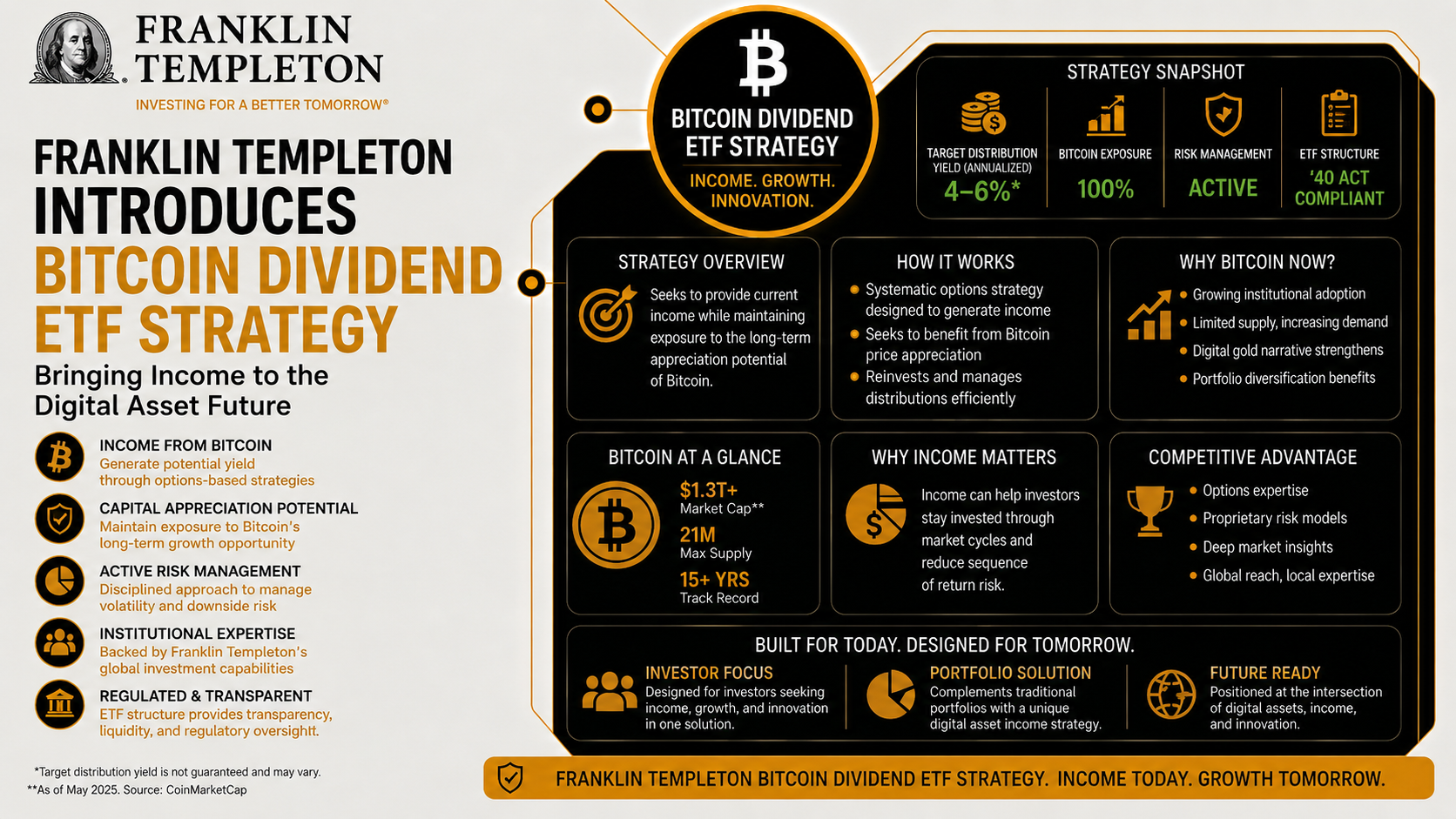
New ETFs Blend Stocks and Bitcoin
Franklin Templeton has taken another step into the digital asset market by filing for two innovative exchange-traded funds (ETFs) that combine traditional stock investing with automatic Bitcoin accumulation.
The proposed funds, named the Franklin US Equity Bitcoin DRIP Index ETF and the Franklin US Innovation Bitcoin DRIP Index ETF, aim to transform how investors gain exposure to cryptocurrency while maintaining ownership of large-cap U.S. equities.
According to regulatory filings submitted last week, the products could become effective as early as September 1, 2026. Unlike conventional dividend-focused funds, these ETFs would not distribute cash dividends directly to shareholders.
Instead, dividend income generated by portfolio companies would be systematically redirected into Bitcoin-related investments.
The strategy introduces a new hybrid investment model that merges the stability of established equity markets with the growth potential of digital assets. As institutional adoption of cryptocurrency accelerates, major asset managers are increasingly exploring ways to integrate blockchain-based investments into mainstream portfolios.
How the Bitcoin DRIP Model Works
The proposed ETFs would initially allocate approximately 95% of assets to large-cap U.S. stocks and 5% to Bitcoin-linked investments. Portfolio managers would monitor allocations through quarterly rebalancing to ensure exposure remains within predefined limits.
Key features of the structure include:
- 95% allocation to U.S. large-cap equities.
- 5% initial exposure to Bitcoin-related assets.
- 20% maximum Bitcoin cap between rebalancing periods.
- Quarterly portfolio adjustments to maintain target allocations.
- Exposure through regulated products rather than direct Bitcoin ownership.
If Bitcoin’s value rises sharply and exceeds target thresholds, the funds would automatically reduce exposure during scheduled rebalancing. For example, Bitcoin allocations above 5% would generally be adjusted back toward 4.5%, helping maintain the fund’s intended risk profile.
Rather than holding Bitcoin directly, the ETFs would gain exposure through regulated instruments such as spot Bitcoin ETFs, futures contracts, options, and other approved investment vehicles. This structure is designed to provide investors with cryptocurrency exposure while operating within established regulatory frameworks.
The equity portion of the portfolio would track an index containing roughly 498 publicly traded companies. These firms range from businesses valued at approximately $7.5 billion to some of the world’s largest corporations with market capitalizations approaching $5 trillion.
Digital Assets Enter a New Phase
Franklin Templeton’s latest filing reflects a broader shift occurring across the asset management industry. Since the approval of spot Bitcoin ETFs in the United States, financial institutions have moved beyond simple cryptocurrency tracking products and begun developing more sophisticated investment solutions.
Supporters of the DRIP strategy believe it could appeal to long-term investors seeking gradual Bitcoin accumulation without sacrificing diversification. Instead of making separate cryptocurrency purchases, investors gain exposure through an automated process tied directly to portfolio income.
The filing also underscores Franklin Templeton’s expanding commitment to blockchain technology. The firm’s spot Bitcoin ETF, trading under the EZBC ticker, has attracted substantial investor interest since launch. Beyond ETFs, the company has invested heavily in tokenized financial products, blockchain infrastructure, and digital asset partnerships.
Several trends are driving this evolution:
- Growing institutional demand for crypto exposure.
- Expansion of tokenized financial products.
- Increased adoption of blockchain settlement systems.
- Demand for diversified digital asset strategies.
If approved, these Bitcoin dividend ETFs could establish an entirely new category of investment products. More importantly, they highlight how digital assets are increasingly being integrated into traditional portfolio construction rather than treated as a separate speculative investment class.
As the line between conventional finance and blockchain technology continues to blur, Franklin Templeton’s proposal may offer a glimpse into the next generation of institutional investing.
