

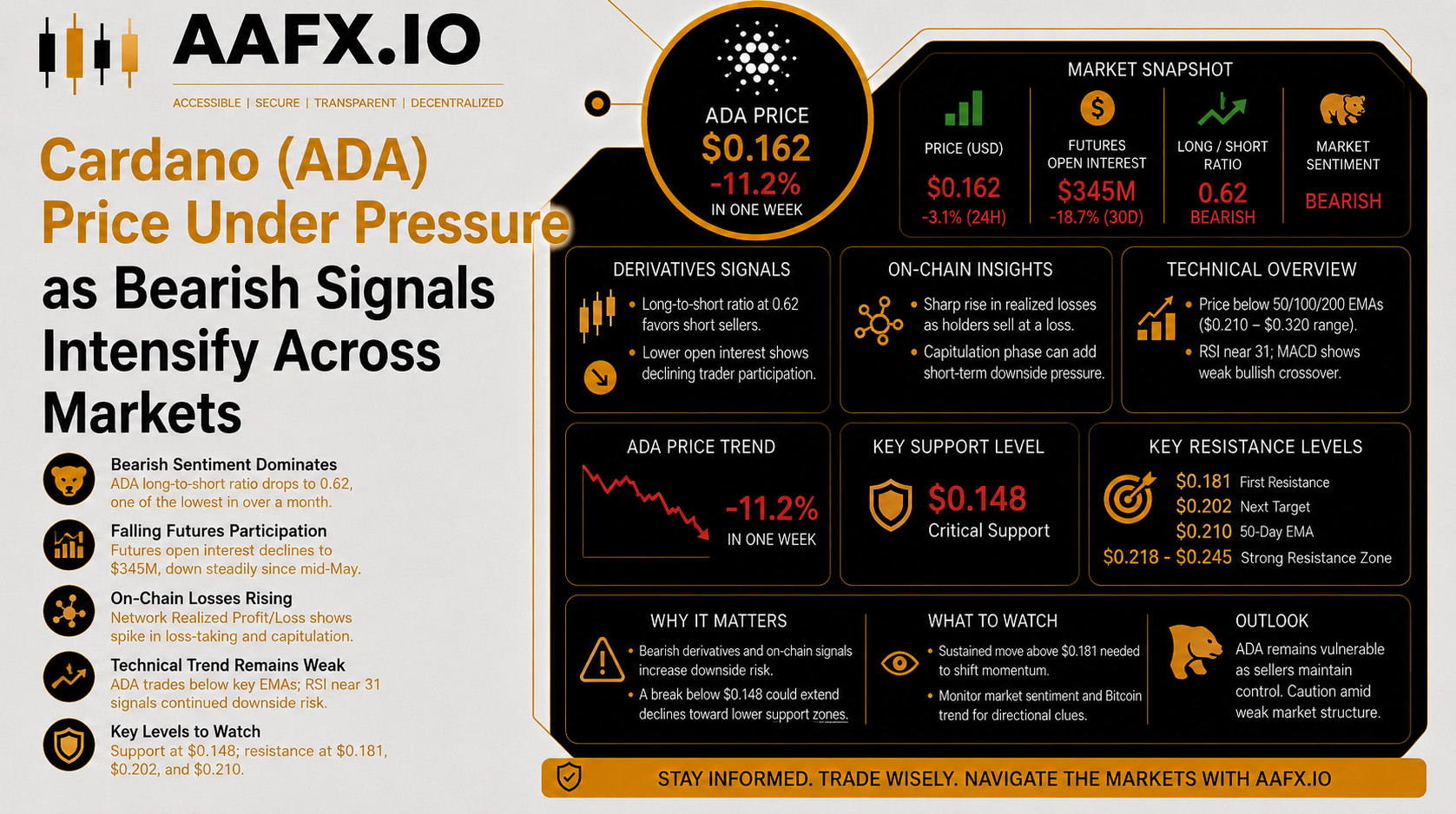
Cardano (ADA) remains under significant pressure as broader cryptocurrency markets struggle to regain momentum. The digital asset traded near $0.162 on Friday, extending its weekly losses beyond 11% and reinforcing concerns that sellers continue to dominate market activity.
Recent derivatives data, declining investor participation, and weak on-chain metrics suggest that ADA could face additional downside risks unless buying interest strengthens in the coming sessions.
Derivatives Market Signals Growing Caution
One of the clearest signs of weakening sentiment comes from Cardano’s derivatives market. Recent trading data shows ADA’s long-to-short ratio hovering around 0.62, one of its lowest readings in more than a month. A ratio below 1 indicates that bearish positions outweigh bullish bets, highlighting the growing influence of traders expecting further price declines.
Investor engagement is also showing signs of deterioration. ADA futures open interest has fallen to approximately $345 million, continuing a downward trend that began in mid-May. Open interest measures the total value of active futures contracts and is often used to gauge market participation.
Several factors currently point to cautious sentiment:
- ADA futures open interest has declined steadily since mid-May.
- The long-to-short ratio remains well below 1, favoring bearish positions.
- Lower participation often reflects reduced confidence in short-term recovery prospects.
- Weak derivatives activity can amplify price volatility during market selloffs.
Together, these indicators suggest traders are becoming increasingly defensive as uncertainty persists across the cryptocurrency sector.
On-Chain Activity Reveals Market Stress
Blockchain data presents a similarly challenging picture. Recent readings from Cardano’s Network Realized Profit/Loss metric show a sharp increase in loss-taking activity among holders. This occurs when investors sell tokens at prices below their purchase cost, often signaling heightened fear or market capitulation.
Historically, heavy loss realization has accompanied periods of significant market stress. While such conditions can create additional downward pressure in the short term, they may also indicate that weaker hands are exiting the market.
Similar behavior emerged during Cardano’s decline in mid-April before the asset experienced a modest rebound.
This dynamic creates a mixed outlook. Current data reflects persistent selling pressure, but prolonged capitulation can occasionally lay the groundwork for future stabilization once selling activity begins to fade.
Key ADA Levels Traders Are Monitoring
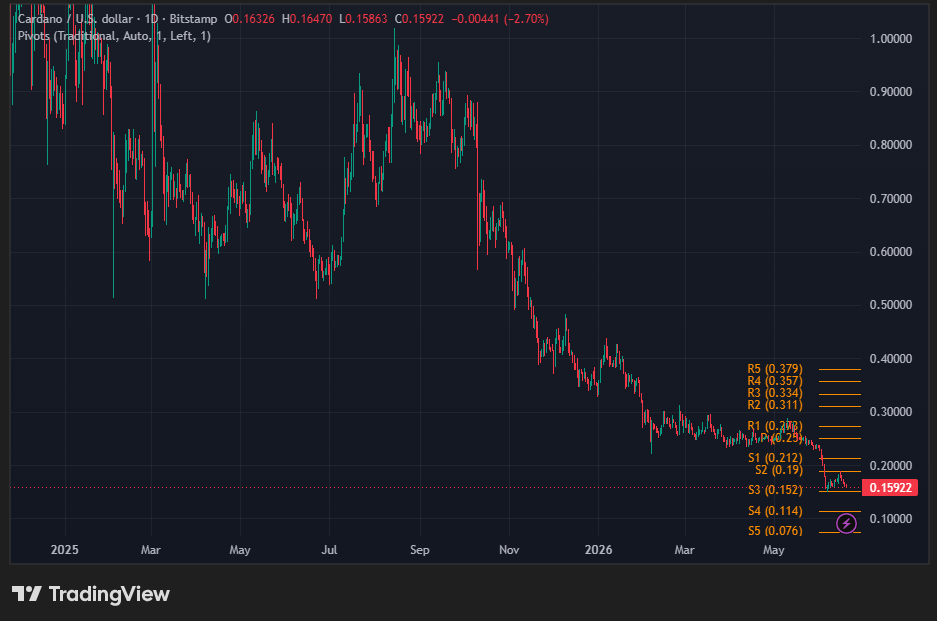
From a technical perspective, Cardano continues to trade below its major trend indicators. The token remains under the 50-day, 100-day, and 200-day Exponential Moving Averages, which range between approximately $0.210 and $0.320. This positioning confirms that the broader trend remains firmly bearish.
The Relative Strength Index (RSI) is hovering near 31, slightly above oversold territory. Although this suggests downside momentum may be becoming stretched, it does not yet confirm a meaningful reversal. Meanwhile, the MACD indicator has turned marginally positive, hinting that bearish momentum may be easing, though bullish confirmation remains absent.
Important levels to watch include:
- Immediate support near $0.148.
- First resistance at $0.181.
- Secondary upside targets around $0.202 and $0.210.
- Strong resistance zone between $0.218 and $0.245.
If ADA breaks below the $0.148 support area, sellers could gain additional control and extend the current downtrend. Conversely, a move above key resistance levels would be required to improve sentiment and signal a more sustainable recovery.
Until then, Cardano remains in a vulnerable position as traders closely monitor signs of either renewed demand or deeper market weakness.
