
Solana leads all blockchains with 286,000 RWA holders, signaling rapid growth in tokenized assets, stablecoins, and institutional adoption.
Solana Takes the Lead in RWA Adoption
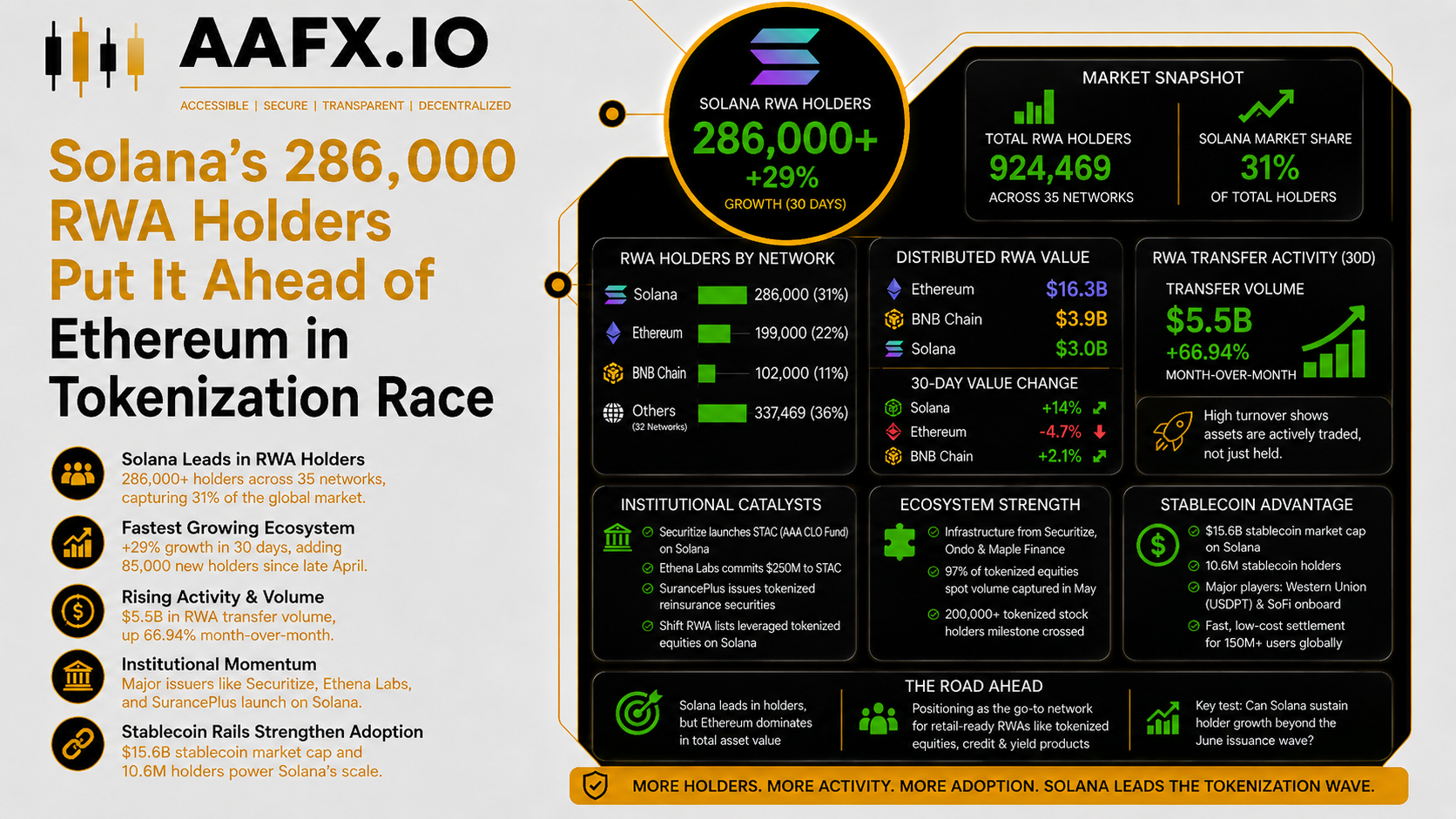
Solana has emerged as the leading blockchain by real-world asset (RWA) holders, marking a significant shift in the rapidly expanding tokenization market. According to data from RWA.xyz, the global tokenized asset ecosystem now includes more than 924,000 holders across 35 blockchain networks.
Solana accounts for approximately 286,000 of those users, representing nearly 31% of the total market and placing it ahead of Ethereum’s 199,000 holders and BNB Chain’s 102,000.
The milestone highlights an important trend within digital finance: investor participation is increasingly concentrating on networks that offer speed, accessibility, and lower transaction costs. While total asset value remains a critical measure, the number of holders provides insight into where user adoption is accelerating most rapidly.
Solana’s growth has been particularly striking. Over the past 30 days, its RWA holder base expanded by nearly 29%, adding roughly 85,000 new participants since late April. This rapid increase suggests that tokenized investment products are gaining traction among both retail investors and smaller institutions seeking blockchain-based exposure to traditional assets.
Transfer Activity Signals Momentum
Despite Solana’s leadership in holder count, Ethereum continues to dominate by total tokenized asset value. Ethereum currently supports approximately $16.3 billion in distributed RWA value, compared with Solana’s $3.0 billion and BNB Chain’s $3.9 billion.
However, recent growth trends indicate that Solana is closing the gap faster than its competitors. During the past month:
- Solana’s distributed RWA value increased by 14%.
- Ethereum’s RWA value declined by 4.7%.
- Solana generated $5.5 billion in RWA transfer volume.
- Monthly transfer activity surged nearly 67%.
Strong transaction turnover suggests that tokenized assets on Solana are actively traded rather than simply held. High levels of movement across the network point to increasing liquidity and deeper market participation, both of which are essential for long-term tokenization growth.
Institutions and Stablecoins Fuel Growth
Several factors are driving Solana’s rapid expansion in the tokenized asset sector.
Institutional issuers have increasingly chosen Solana as a platform for launching investment products. Major tokenization provider Securitize recently introduced its Tokenized AAA CLO Fund (STAC) on the network, while Ethena Labs committed $250 million to the fund.
Additional offerings, including tokenized reinsurance products and leveraged tokenized equities, have broadened investor access to traditionally restricted financial instruments.
The ecosystem has also benefited from established infrastructure providers such as Securitize, Ondo, and Maple Finance, which enable new issuers to access secondary markets more efficiently. In May 2026, Solana captured 97% of cumulative on-chain tokenized equities spot trading volume, demonstrating growing dominance in this emerging category.
Stablecoins have further strengthened Solana’s position. The network’s stablecoin ecosystem now exceeds $15.6 billion in market capitalization and supports more than 10.6 million holders. Large financial firms are increasingly leveraging Solana’s payment infrastructure, attracted by its speed and cost efficiency.
Looking ahead, the key question is whether Solana can maintain its lead once the current wave of tokenized asset issuance matures. Ethereum retains deeper liquidity, stronger institutional familiarity, and backing from large-scale products such as BlackRock’s multi-billion-dollar tokenized funds.
Nevertheless, Solana’s growing user base suggests it is becoming the preferred distribution network for retail-focused tokenized equities, credit products, and yield-generating assets.
If current adoption trends persist, Solana may play a defining role in bringing tokenized finance to a broader global audience, reshaping the competitive landscape of blockchain-based investing in the process.
