

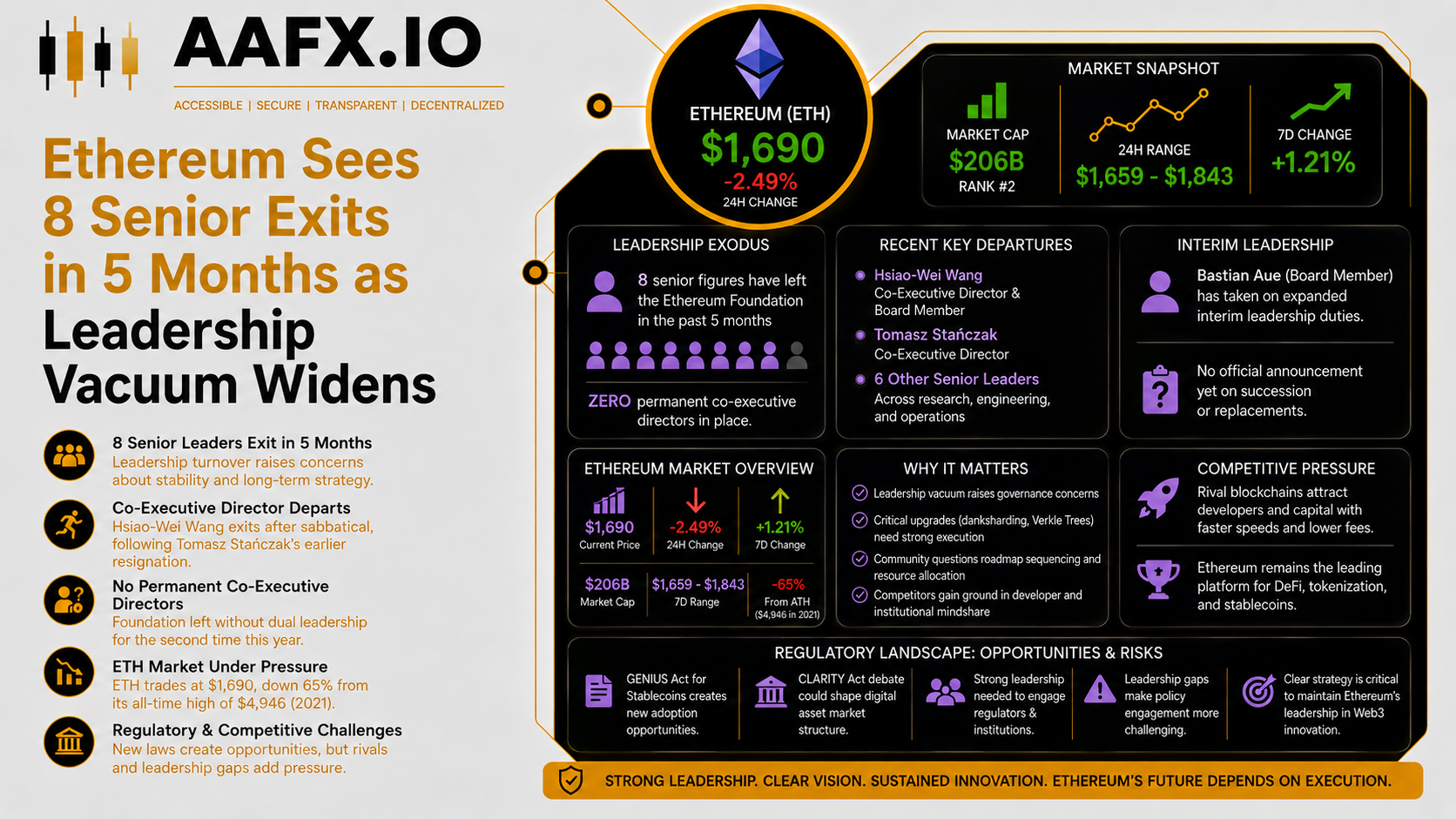
Ethereum Foundation faces leadership uncertainty after 8 senior departures in five months, raising questions about governance, strategy, and growth.
Leadership Shake-Up Hits Ethereum
The Ethereum Foundation is facing a period of heightened uncertainty following the resignation of co-executive director and board member Hsiao-Wei Wang. Her departure, announced effective immediately after a sabbatical, marks the latest leadership change at the organization responsible for supporting the development of the world’s second-largest blockchain network.
Wang’s exit leaves the Ethereum Foundation without a permanent co-executive director for the second time in 2026. Earlier this year, fellow co-executive director Tomasz Stańczak also stepped down, creating a leadership gap at a time when Ethereum is navigating increased competition, regulatory developments, and major technical upgrades.
Having spent nearly a decade within the organization, Wang played a key role in guiding Ethereum’s research and ecosystem initiatives. In her public statement, she cited personal reflection and evolving priorities as reasons for her decision to move on from the foundation.
The departure has intensified discussions throughout the Ethereum community regarding governance, succession planning, and long-term strategic direction.
Eight Senior Departures Raise Questions
Wang’s resignation is part of a broader trend that has seen at least eight senior figures leave the Ethereum Foundation over the past five months. The pace of departures has drawn attention from developers, investors, and industry observers who are closely watching how the organization adapts.
Currently, no permanent replacements have been announced for either co-executive leadership position. In the meantime, board member Bastian Aue has assumed a larger interim role as the foundation manages the transition.
Key developments shaping the leadership debate include:
- Eight senior departures recorded within five months.
- No permanent co-executive directors currently in place.
- Increased community scrutiny of governance structures.
- Ongoing concerns around roadmap execution and resource allocation.
The leadership turnover comes at a critical moment for Ethereum’s ecosystem. The network continues to support thousands of decentralized applications and remains the dominant blockchain for decentralized finance, tokenized assets, and stablecoins.
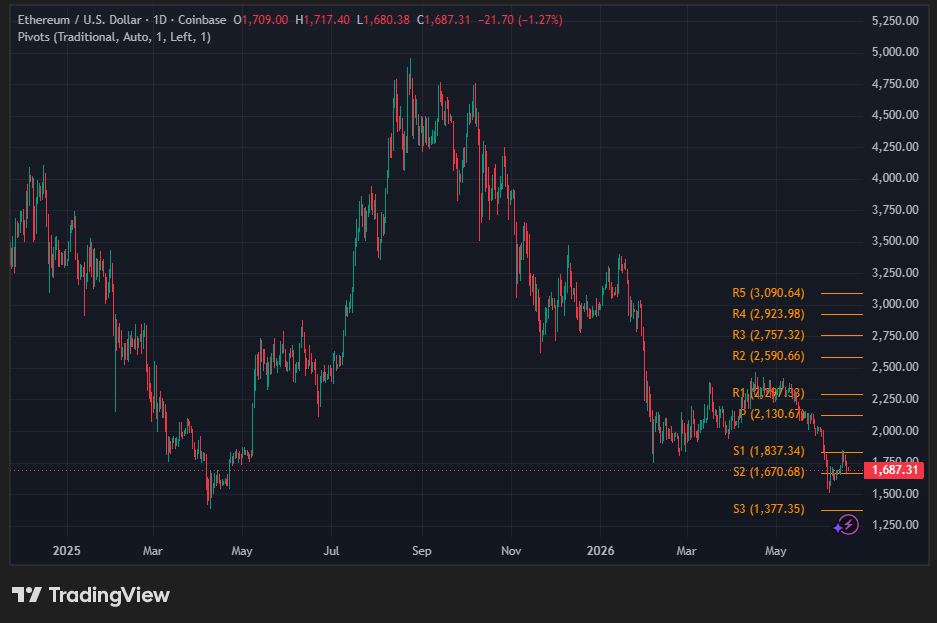
However, investors are increasingly focused on how organizational stability could affect future innovation and competitiveness.
Competition and Roadmap Pressures
Ethereum’s leadership challenges coincide with mounting pressure from rival blockchain ecosystems that have gained momentum among developers and institutional participants. Competing networks are attracting attention through faster transaction speeds, lower fees, and growing adoption across tokenization and payments markets.
At the same time, Ethereum continues to advance several ambitious technical initiatives, including danksharding and the transition to Verkle Trees. These upgrades are designed to improve scalability, reduce costs, and strengthen network performance.
However, executing such a complex roadmap requires clear leadership and coordinated decision-making.
Market performance has also reflected broader uncertainty. Ethereum recently traded near $1,690, giving the network a market capitalization of approximately $206 billion. While ETH remains one of the largest digital assets globally, it is still roughly 65% below its 2021 all-time high of $4,946.
Regulatory developments may further increase the importance of leadership stability. Proposed frameworks such as the GENIUS Act and ongoing discussions surrounding the CLARITY Act could create new opportunities for blockchain adoption and institutional engagement.
Successfully navigating those opportunities will likely depend on Ethereum presenting a cohesive vision to regulators, enterprises, and investors.
The coming months will determine whether the Ethereum Foundation can rebuild leadership continuity while maintaining momentum on the technological and policy initiatives that shape the network’s future.
