
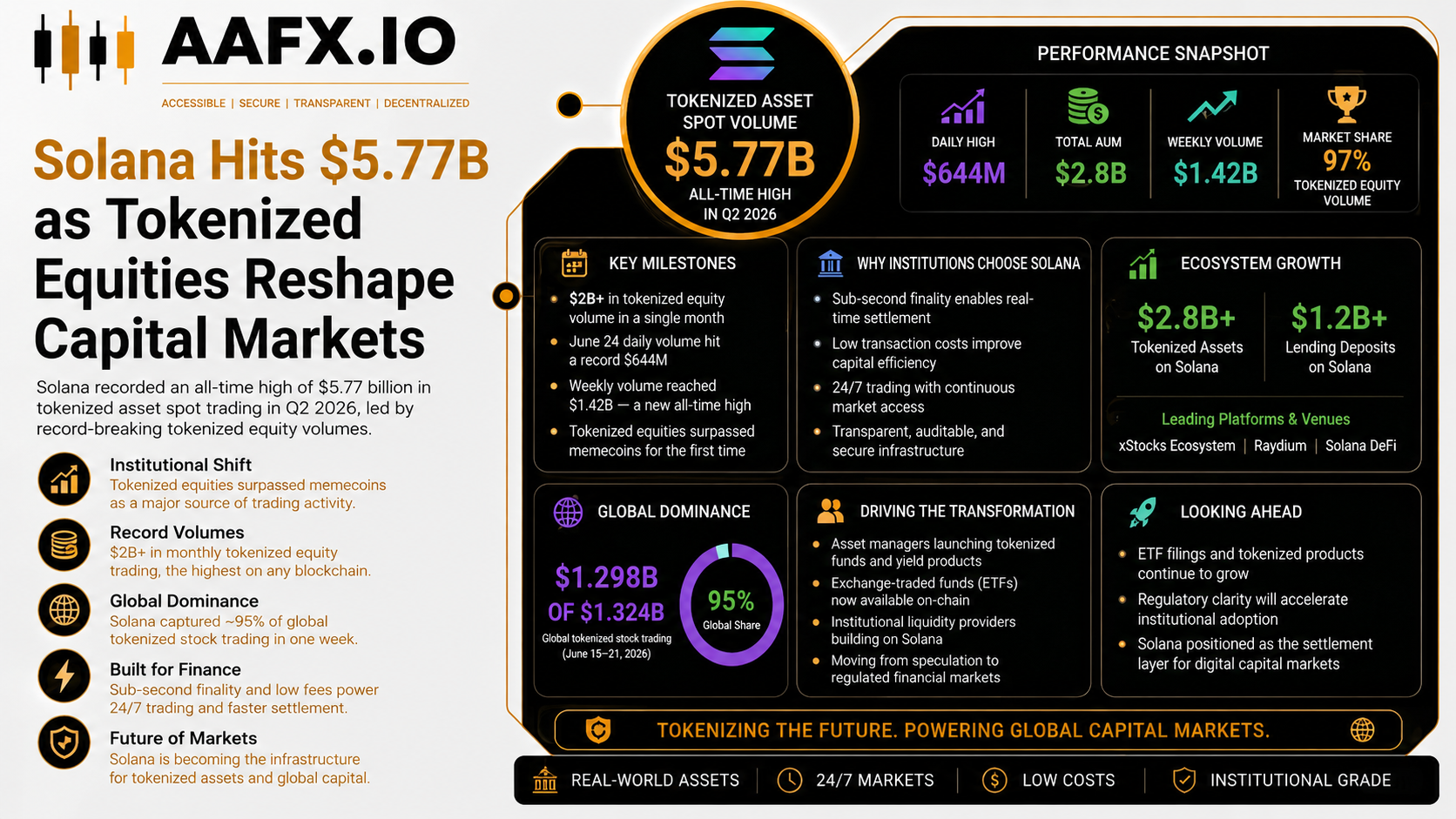
Solana recorded $5.77B in tokenized asset trading as tokenized equities surpassed memecoins, positioning the blockchain at the center of digital capital markets.
Solana’s Institutional Transformation
Solana is entering a new phase of growth that could redefine its role within the global financial system. Long recognized for hosting high-volume memecoin and NFT activity, the blockchain is increasingly becoming a preferred settlement layer for tokenized financial assets. This transition accelerated during the second quarter of 2026 when Solana recorded an all-time high of $5.77 billion in tokenized asset spot trading volume, marking a significant milestone in the network’s development.
The importance of this achievement extends beyond the headline figure. For the first time, tokenized equities emerged as a major driver of trading activity, challenging the dominance of speculative crypto assets that previously fueled the network’s expansion.
Earlier growth cycles were heavily dependent on retail-driven trading trends. While those periods generated substantial transaction volume, activity often declined when market sentiment weakened. The current wave of adoption is fundamentally different because it is tied to blockchain-based versions of regulated financial products, including stocks, exchange-traded funds (ETFs), and yield-generating investment instruments.
As a result, Solana is increasingly attracting institutional liquidity providers, professional traders, and asset managers seeking more efficient financial infrastructure.
Record Equity Trading on Solana
The scale of growth in tokenized equities has been remarkable. During the quarter, monthly tokenized equity trading volume surpassed $2 billion, setting a record for any public blockchain network.
On June 24, daily trading activity reached an unprecedented $644 million, while tokenized equities overtook memecoins as a share of total spot trading volume for the first time in Solana’s history.
Several figures highlight the network’s growing dominance:
- Solana processed approximately $1.298 billion of the world’s $1.324 billion tokenized stock trading volume during the week of June 15–21.
- The network captured roughly 95% of global tokenized equity trading activity during that period.
- Weekly trading volume later climbed to a new record of $1.42 billion.
- Solana now represents approximately 97% of cumulative on-chain tokenized equity spot trading worldwide.
These numbers indicate that Solana is increasingly competing with traditional market infrastructure rather than solely with other blockchain networks.
Building the Future of Digital Finance
A large portion of recent activity has been concentrated within the expanding xStocks ecosystem, where tokenized shares of publicly traded companies and major ETFs can be traded continuously on-chain. Platforms such as Raydium have become key venues for facilitating this activity through advanced liquidity mechanisms.
The appeal for institutions is clear. Blockchain-based settlement offers faster transaction processing, lower operational costs, and 24/7 market access compared with conventional financial systems. Solana’s combination of sub-second finality and low transaction fees has positioned it as a practical solution for these requirements.
The broader ecosystem is also expanding rapidly. More than $2.8 billion in tokenized assets and approximately $1.2 billion in lending deposits are now active on the network. Meanwhile, asset managers continue exploring Solana-based investment products, including proposed exchange-traded funds and tokenized liquidity solutions.
Although regulatory frameworks for digital assets remain under development, institutional adoption continues to advance. Financial firms are increasingly building products around tokenized securities rather than waiting for complete legislative clarity.
If this trend persists, Solana’s future may be defined less by speculative crypto trading and more by its ability to support stocks, bonds, funds, and other regulated assets. The network’s evolution suggests it is positioning itself as critical infrastructure for the next generation of global capital markets, where tokenization could fundamentally change how financial assets are issued, traded, and settled.
