

The euro held firm against the dollar on Thursday, with EUR/USD trading above 1.1650 during the American session. The move came despite stronger U.S. data, as dollar gains were capped by risk sentiment and investor caution.
Earlier in the week, the pair slipped to a three-week low below 1.1600, pressured by political turmoil in France. However, a rebound in risk appetite limited the dollar’s momentum, helping the euro stabilize.
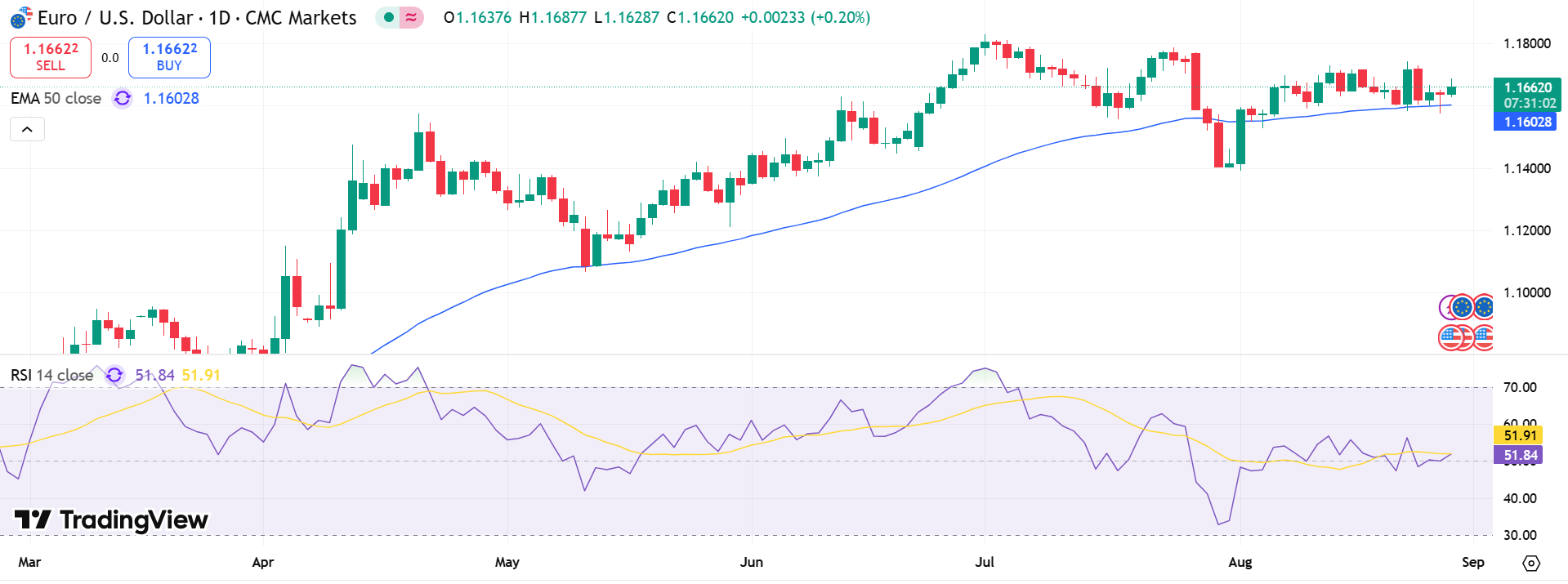
From a technical perspective, EUR/USD is hovering around the 200-period Simple Moving Average (SMA), with the Relative Strength Index (RSI) near 50, underscoring market indecision. Traders remain cautious, awaiting clearer signals from economic data.
U.S. Data Fails to Boost Dollar
The U.S. Bureau of Economic Analysis confirmed that Q2 GDP expanded at a 3% annualized rate, marking a solid pace of growth. Weekly jobless claims also improved, falling to 230,000, better than expected.
Yet, the dollar failed to capitalize on the upbeat numbers, weighed down by market focus on broader policy risks and global sentiment. Investors appear reluctant to build long positions in the greenback amid uncertainty around Federal Reserve actions in the months ahead.
Key market levels:
- Support: 1.1600, followed by 1.1540 and 1.1500.
- Resistance: 1.1660, 1.1700, and 1.1730.
While stronger economic data would typically lift the dollar, analysts suggest that mixed signals on monetary policy are muting its impact. Markets are awaiting the Fed’s preferred inflation gauge—the PCE Price Index—for fresh direction.
Political Risks Weigh on Euro
Although the euro has managed to hold ground, concerns about political instability in France continue to limit upside momentum.
French Prime Minister Francois Bayrou’s decision to face a parliamentary confidence vote has unsettled investors. Alexandre Bompard, CEO of Carrefour, warned the political uncertainty could dampen consumer spending, creating risks for domestic growth.
As markets balance U.S. data with European political challenges, EUR/USD is likely to remain range-bound in the near term. Traders will closely monitor:
- France’s confidence vote and political fallout.
- Friday’s U.S. PCE inflation figures.
- Eurozone growth signals in upcoming PMI data.
For now, the pair’s trajectory hinges on whether U.S. inflation cools enough to cement Fed easing bets—or if political turmoil in Europe overshadows modest economic resilience.

