


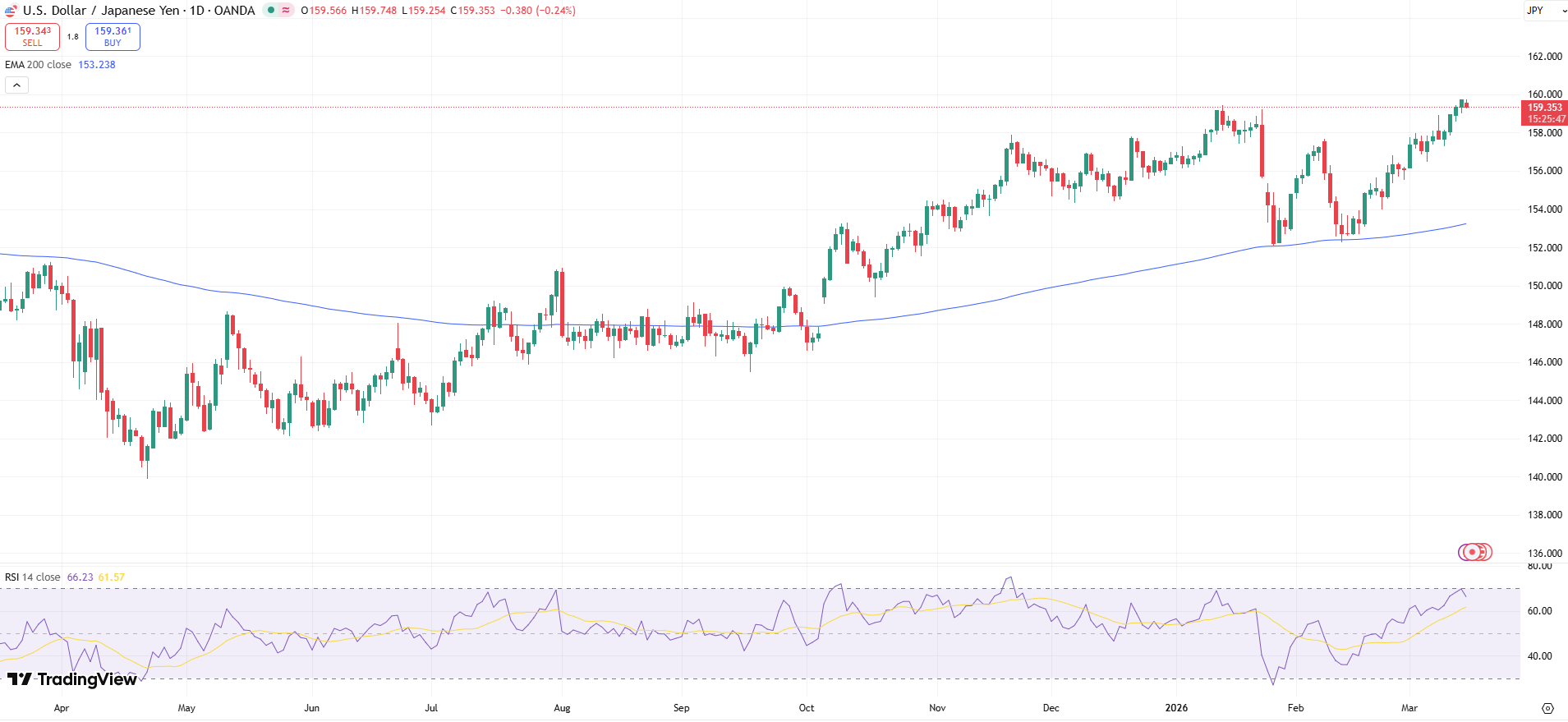
The USD/JPY remained under pressure near 159.50, as traders grew cautious about possible action from Japanese authorities to support the weakening yen. The currency pair held slight losses after government officials warned they are closely watching foreign-exchange markets.
Satsuki Katayama signaled that officials are prepared to respond if currency movements become too volatile. Her comments provided some support for the Japanese Yen, which has declined sharply in recent months against the United States Dollar.
Despite the warning, the broader trend still favors the dollar in the short term. The currency pair recently broke above 158.00, a key trading range resistance that had capped gains for about a week. That breakout suggests buyers remain active, even as authorities attempt to slow the yen’s slide.
Currency traders are especially sensitive when the exchange rate approaches 160, a level that previously triggered intervention from Japanese policymakers. Markets now believe authorities may tolerate some additional weakness but remain ready to act if the decline accelerates.
Technical Signals Point to Modest Strength
Market indicators show the dollar still holds a moderate advantage against the yen, though momentum is not extremely strong.
The Moving Average Convergence Divergence (MACD) indicator has turned slightly positive, signaling improving upward momentum. Meanwhile, the Relative Strength Index (RSI) sits around 64, which indicates buying pressure but still remains below the overbought threshold.
Key technical levels traders are monitoring include:
- 158.00: Immediate support after the breakout
- 157.30: Stronger support protecting the recent higher low
- 156.80: Next downside level if selling accelerates
- 158.90: First resistance level
- 159.50: Major barrier before the 160 intervention zone
A sustained move above 158.90 could open the path toward 159.50, reinforcing the bullish scenario for the dollar. However, a drop below 157.30 would weaken the current upward trend.
Traders are also waiting for important U.S. economic data, including the Personal Consumption Expenditures Price Index, which is the preferred inflation gauge of the Federal Reserve. Additional reports on U.S. fourth-quarter GDP growth and March consumer confidence could also influence currency markets.
Oil Risks Complicate Japan’s Policy
Japan’s economic outlook has become more complicated due to rising oil prices linked to geopolitical tensions in the Middle East.
Kazuo Ueda warned that a weaker yen increases the cost of imported goods, particularly energy. Higher oil prices could therefore push inflation higher and force the Bank of Japan to adjust its policies more quickly.
Japan relies heavily on imported energy, especially from the Middle East. The situation has become more challenging because shipping through the Strait of Hormuz has been disrupted by the ongoing conflict involving the United States, Israel, and Iran.
To stabilize energy supplies, Japan plans to release 80 million barrels of oil from its strategic reserves—equal to about 45 days of domestic supply.
Key energy facts shaping Japan’s response:
- 95% of Japan’s oil imports come from the Middle East
- Nearly 90% of shipments pass through the Strait of Hormuz
- 80 million barrels will be released from reserves
- Oil stock release begins March 16
Sanae Takaichi said the move will occur in coordination with the Group of Seven and the International Energy Agency.
At the same time, Ryosei Akazawa confirmed that Japanese companies are exploring alternative oil sources, including suppliers in the United States, Central Asia, and South America.

