

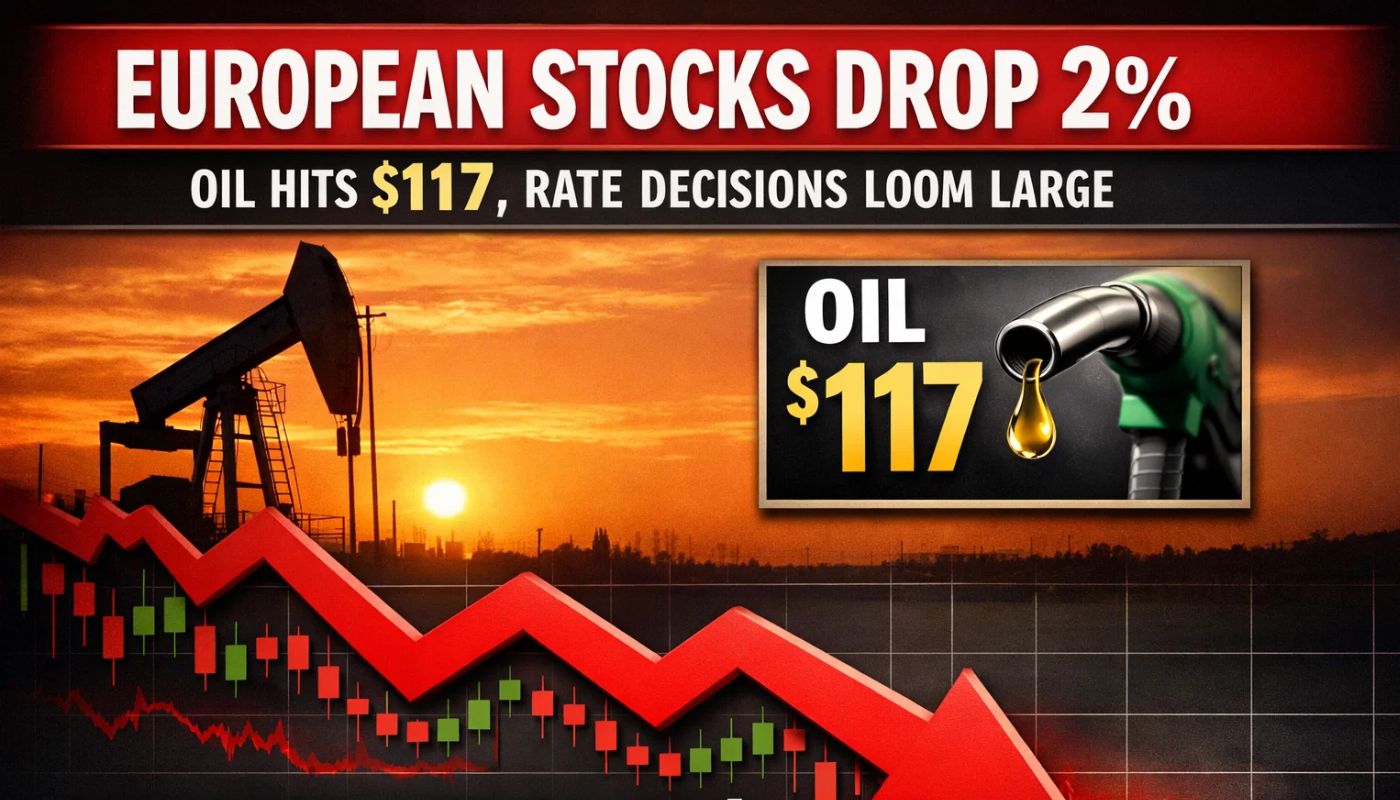
European stock markets moved lower on Thursday as investors waited for major central bank decisions and watched rising tensions in the Middle East. The region-wide Stoxx 600 index fell 2.04%, showing broad weakness across sectors.
Country-specific indexes also declined. Germany’s DAX dropped 2.5%, France’s CAC 40 slipped 1.7%, and the U.K.’s FTSE 100 lost 1.9%. These declines reflect growing caution among investors who are unsure about the next direction of the economy.
At the same time, oil prices surged above $117 per barrel, adding pressure on markets. Higher oil prices can increase costs for businesses and consumers, which slows economic growth.
In simple terms, investors are nervous. They are waiting for clear signals from central banks while also dealing with rising energy prices and global uncertainty.
Central Banks Signal Caution
Markets are focused on upcoming decisions from the European Central Bank (ECB) and the Bank of England (BoE). Both are expected to keep interest rates unchanged, following similar moves by other major central banks.
Just a day earlier, the Federal Reserve, Bank of Japan, and Bank of Canada all decided to hold rates steady. However, they warned that inflation could rise again if the conflict involving Iran continues.
Central banks now face a difficult challenge. They must control inflation without damaging economic growth. This situation is similar to 2022, when energy prices surged after the Russia-Ukraine conflict.
Key concerns shaping market sentiment:
- Rising inflation due to higher energy costs
- Delayed expectations for interest rate cuts
- Risk of stagflation (slow growth + high inflation)
- Investors shifting money into the U.S. dollar
Because of these risks, traders are becoming more cautious. Many are reducing exposure to stocks and waiting for clearer economic signals.
Oil Surge Adds Market Pressure
Oil prices have become a major driver of market movement. Brent crude, the global benchmark, jumped 9.4% to $117.47 per barrel, while U.S. West Texas Intermediate (WTI) rose 1.7% to $97.07 per barrel.
The sharp increase follows attacks on key energy infrastructure in the Middle East, including Iran’s South Pars gas field, the largest gas field in the world. These developments have raised fears of supply disruptions.
Another important factor is the growing gap between Brent and WTI prices. WTI is trading at its largest discount to Brent in over a decade, partly due to the release of U.S. strategic oil reserves.
Key oil market highlights:
- Brent crude above $117 per barrel
- WTI near $97 per barrel
- Brent up 9.4%, WTI up 1.7%
- Supply risks tied to Middle East conflict
In simple words, rising oil prices are making everything more expensive. This adds pressure on economies and keeps stock markets under stress.
Until energy prices stabilize and central banks provide clearer guidance, European markets are likely to remain cautious and volatile.

