


Gold prices strengthened in Asian trading on Wednesday as global investors shifted toward defensive assets amid renewed concerns over fiscal stability in major economies. The metal advanced after fresh signals that Japan’s government is considering a substantially larger spending package, raising questions over long-term debt sustainability and the country’s capacity to finance new obligations.
Spot gold increased 0.6% to $4,092.51 an ounce, while December futures gained 0.7% to $4,093.79, supported by steady U.S. dollar conditions following recent currency market volatility. With equities under pressure—particularly high-valuation technology stocks—traders sought refuge in safe-haven metals ahead of closely watched earnings from NVIDIA, a key barometer for AI-driven market sentiment.
Japan’s Fiscal Pressures Trigger Global Ripples
Market unease intensified after reports indicated that Prime Minister Sanae Takaichi plans to unveil a spending package of roughly ¥25 trillion ($163 billion)—significantly larger than early projections. The news sent shockwaves through Japan’s bond market, where 20- and 30-year yields surged to multi-decade highs. The benchmark 10-year yield notched its strongest level since the 2008 financial crisis, signaling investor discomfort with Tokyo’s mounting fiscal commitments.
Japan’s status as a major global creditor amplifies the global sensitivity to its debt dynamics. A disorderly adjustment in long-term Japanese yields risks spilling over into international fixed-income markets, particularly at a moment of fragile risk appetite.
Diplomatic tension between Tokyo and Beijing added another layer of geopolitical risk. Relations deteriorated this week after comments from Takaichi regarding Taiwan, prompting China to issue a formal protest despite Tokyo’s attempts to smooth communications.
Additional precious metals also benefited from the broader risk reset:
- Spot platinum rose 0.9% to $1,547.96/oz
- Spot silver climbed 1.3% to $51.3825/oz
US Rate Path and Fed Minutes in Focus
Investor attention also turned to the U.S. Federal Reserve’s December meeting, as recent labor market data offered fresh evidence of softening economic conditions. Weekly jobless claims suggested persistent weakness, prompting traders to raise expectations—modestly—for a rate cut next month.
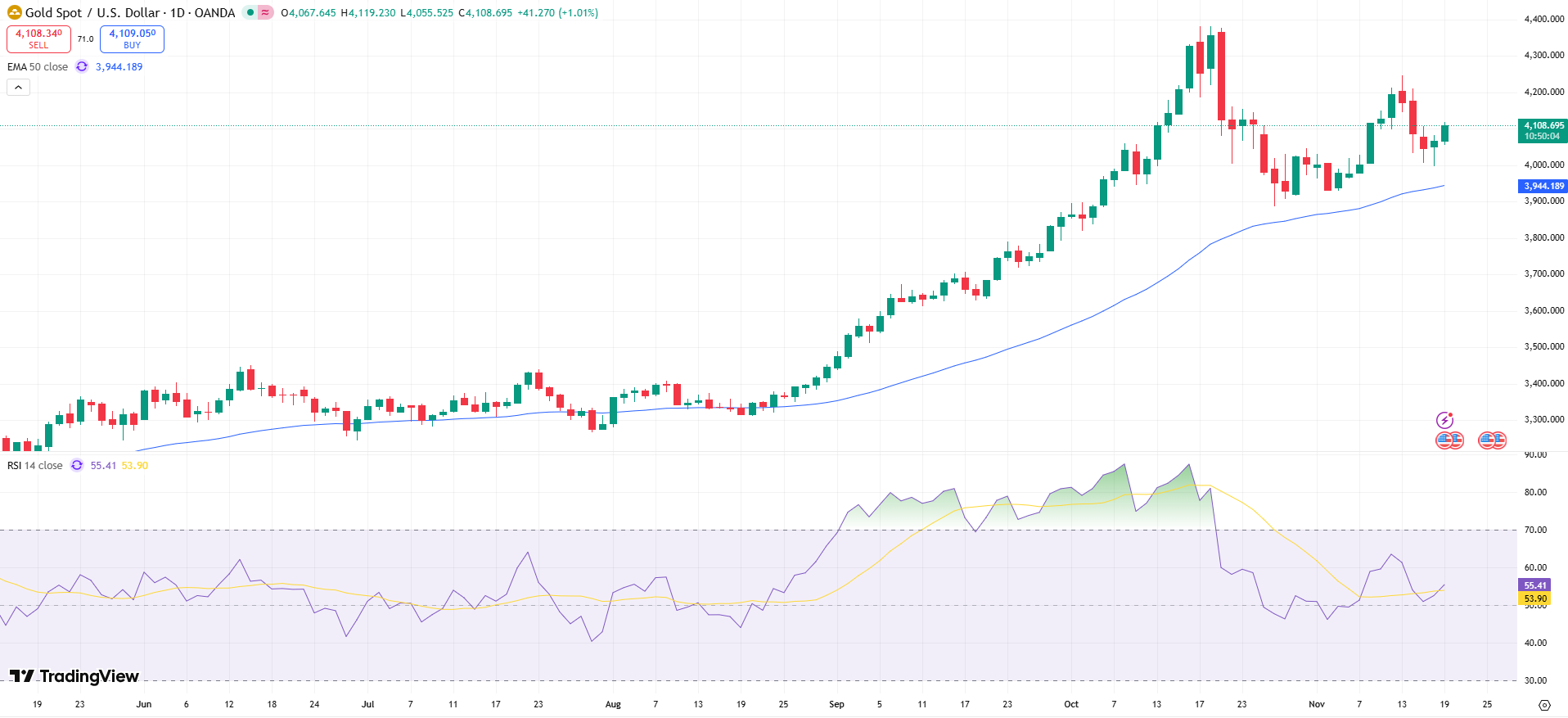
According to CME FedWatch, markets now assign a 42.4% probability to a 25-basis-point cut at the December 10–11 meeting, sharply lower than last week’s 62.4% reading. The decline signals growing skepticism that policymakers will ease further after delivering a broadly supported 25-basis-point cut in late October.
The upcoming release of the October meeting minutes is expected to clarify internal Fed divisions. With official U.S. data limited due to the prolonged federal shutdown, policymakers enter December with unusually limited visibility—strengthening the likelihood of a cautious pause.
Stable U.S. interest rates typically weigh on non-yielding assets such as gold, but ongoing fiscal and geopolitical risks continue to bolster safe-haven demand.

