

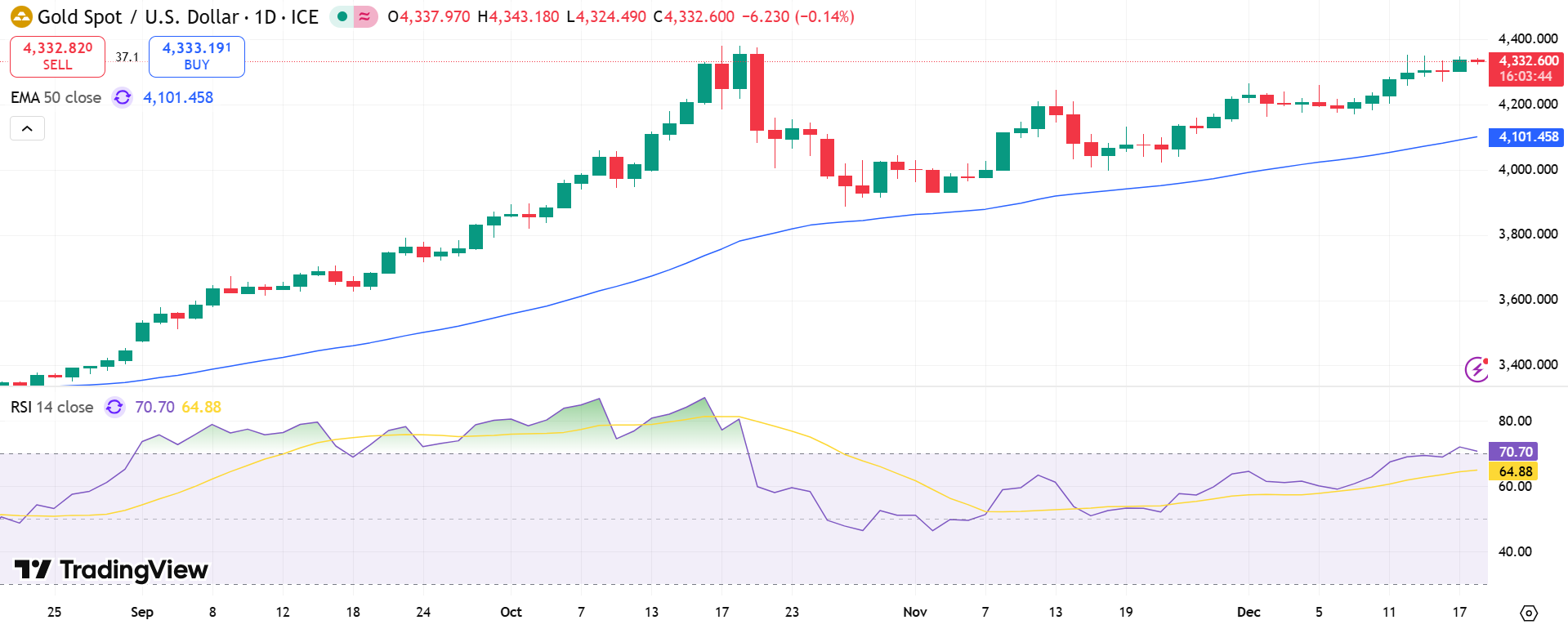
Gold prices were largely unchanged on Thursday as investors balanced supportive signals from the Federal Reserve against a firmer U.S. dollar, with attention firmly fixed on incoming inflation data. Spot gold edged down 0.1% to $4,334.70 an ounce by early Asian trading, after posting gains of more than 1% in the prior session. U.S. gold futures mirrored the move, easing 0.2% to $4,365.40.
The restraint reflects caution ahead of November’s U.S. Consumer Price Index, a report that could shape expectations for the pace of monetary easing. A resilient dollar index, hovering near a one-week high, has limited upside for bullion by making dollar-denominated assets more expensive for overseas buyers. Even so, gold remains well supported by expectations that U.S. interest rates will trend lower over time.
Silver’s 130% Rally Outpaces Gold
Silver continued to command attention, trading just below record territory. Spot prices rose 0.3% to $66.48 an ounce after touching an all-time high of $66.88 in the previous session. The metal has climbed an extraordinary 130% this year, far outpacing gold’s roughly 65% gain.
The rally reflects a rare convergence of forces: expanding industrial use, steady investor inflows, and tightening inventories. Analysts argue that silver’s dual role as both a precious and industrial metal leaves it especially sensitive to global manufacturing trends and monetary policy. Some market watchers now see prices testing $70 an ounce in 2026 if rate cuts continue to underpin demand.
Key drivers behind silver’s surge include:
- Robust demand from solar and electronics manufacturers
- Lower global inventories after years of underinvestment
- Increased investor interest amid falling real yields
Fed Signals Support Metals Outlook
Federal Reserve commentary has reinforced the constructive outlook for precious metals. Governor Christopher Waller said policymakers could continue cutting rates as the labor market cools, noting that the central bank must safeguard its independence. Recent data showed U.S. unemployment rose to 4.6% in November, the highest level since September 2021.
The Fed has already delivered three quarter-point cuts this year, and futures markets are pricing in two additional 25-basis-point reductions in 2026. Such an environment typically favors non-yielding assets like gold and silver by reducing the opportunity cost of holding them.
Beyond gold and silver, gains spread across the complex. Platinum jumped 2.9% to $1,952.90, its highest level in more than 17 years, while palladium advanced 1.1% to $1,666.44, a near three-year high. With inflation data and central-bank policy still in focus, precious metals remain firmly on investors’ radar.

