

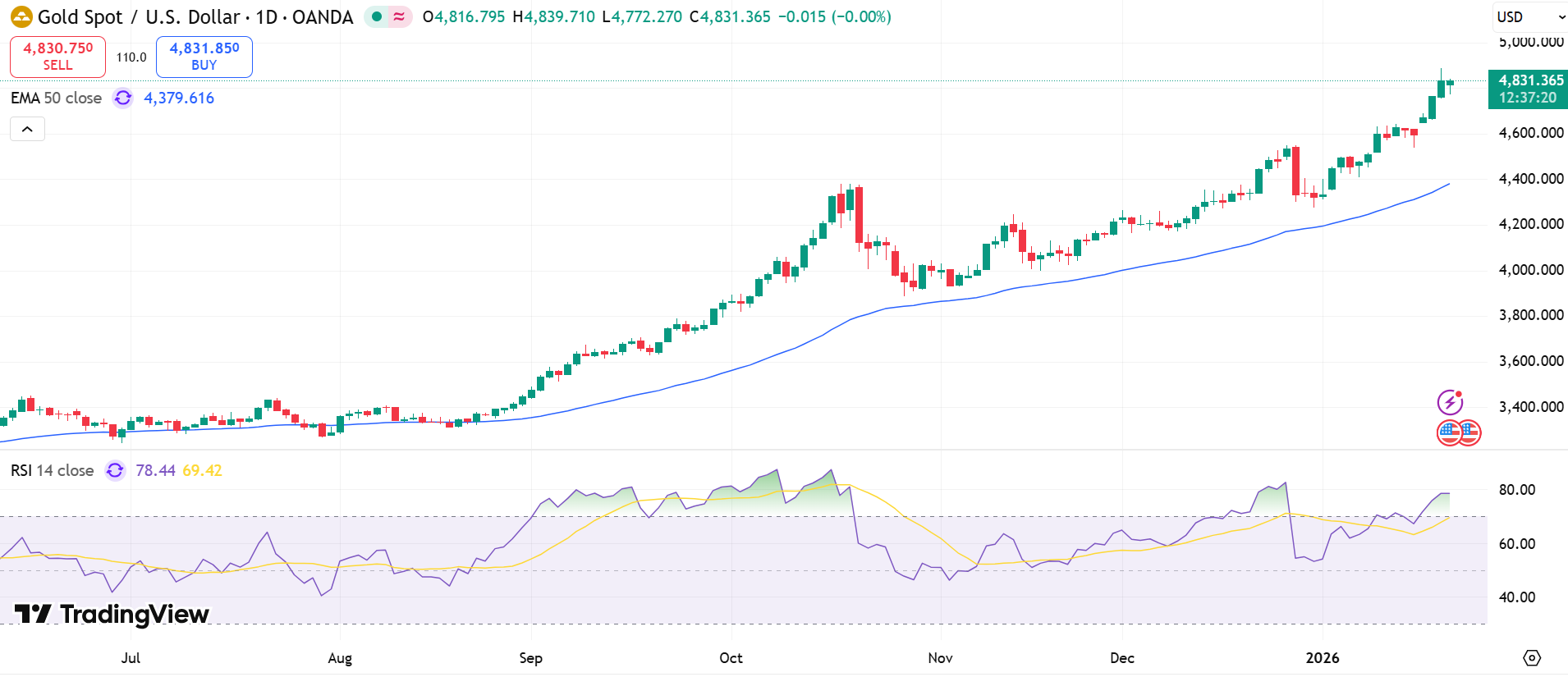
Gold prices paused near record territory in Asian trading on Thursday, consolidating after a sharp multi-day rally that pushed bullion within reach of the $5,000 psychological threshold. Spot gold slipped a modest 0.1% to $4,826 per ounce, easing from Wednesday’s all-time high of $4,888. U.S. gold futures for March followed a similar path, edging down 0.3% to $4,825.
The pullback came after investors reassessed geopolitical risks that had fueled a more than 6% surge over the past three sessions. That rally marked one of gold’s strongest short-term advances in recent years, underscoring the metal’s continued role as a hedge against political and economic uncertainty.
Despite the mild decline, prices remain elevated by historical standards. Gold is now trading nearly 35% higher year-to-date, supported by central-bank buying, persistent inflation concerns, and heightened sensitivity to geopolitical headlines.
Trump comments cool safe-haven demand
Momentum eased after U.S. President Donald Trump signaled a softer stance on potential tariffs linked to tensions over Greenland. Speaking at the World Economic Forum in Davos, Trump said he would not impose tariffs on European partners and ruled out the use of force in the dispute over the Danish territory.
He added that a long-term framework agreement was being discussed, particularly around security cooperation and access to strategic minerals. Markets interpreted the remarks as a de-escalation, prompting some investors to lock in profits after gold’s rapid ascent.
Additional pressure came from a modest rebound in the U.S. dollar. The Dollar Index rose slightly after a 0.1% gain in the previous session, making dollar-denominated gold marginally more expensive for overseas buyers.
Key forces influencing gold prices now include:
- Geopolitical risk tied to NATO and Arctic security
- Central-bank gold purchases at multi-year highs
- U.S. dollar movements and real interest rates
Silver, copper stay strong despite pullback
Elsewhere in metals markets, performance remained mixed but broadly constructive. Silver climbed 1% to $94.03 per ounce, hovering just below its recent record of $95.89, supported by strong industrial and renewable-energy demand.
Platinum prices slipped 0.8% to $2,465, reflecting weaker automotive sector demand. Meanwhile, copper extended its upward trend, with London Metal Exchange futures rising nearly 1% to $12,855 per ton, underpinned by supply tightness and expectations of long-term electrification demand.
In contrast, U.S. copper futures held steady at $5.81 per pound, suggesting near-term consolidation after recent gains.
While gold’s rally has paused, analysts say the broader uptrend remains intact, especially if geopolitical risks or inflation pressures resurface in the months ahead.

