

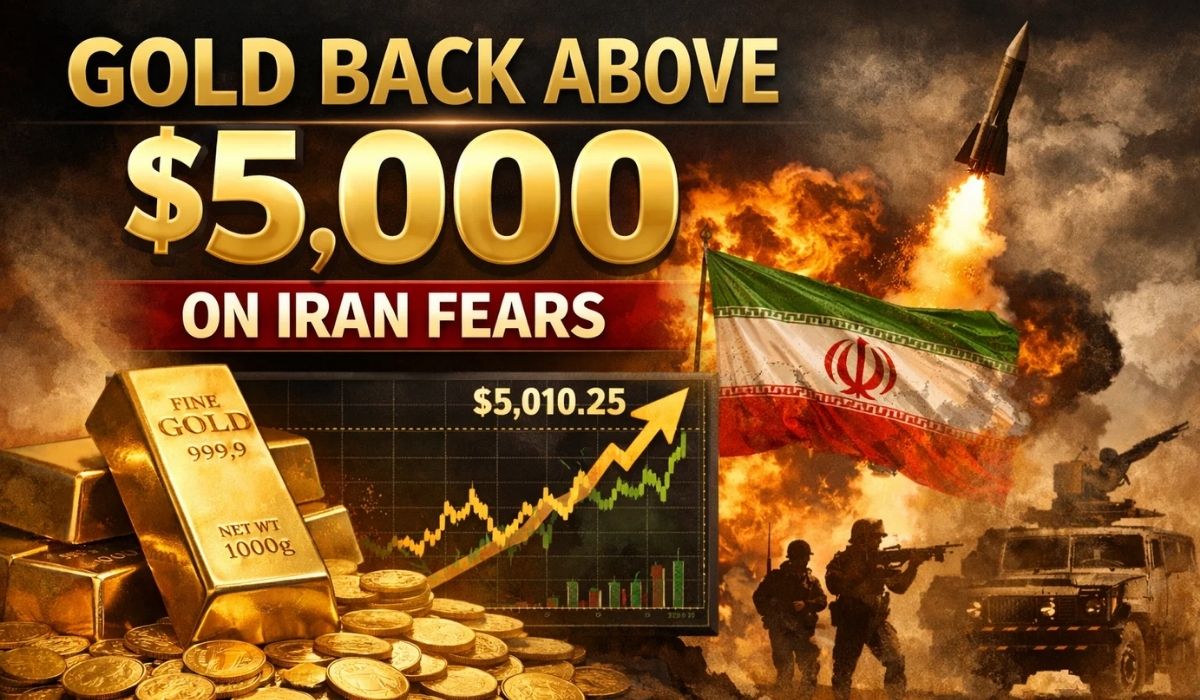
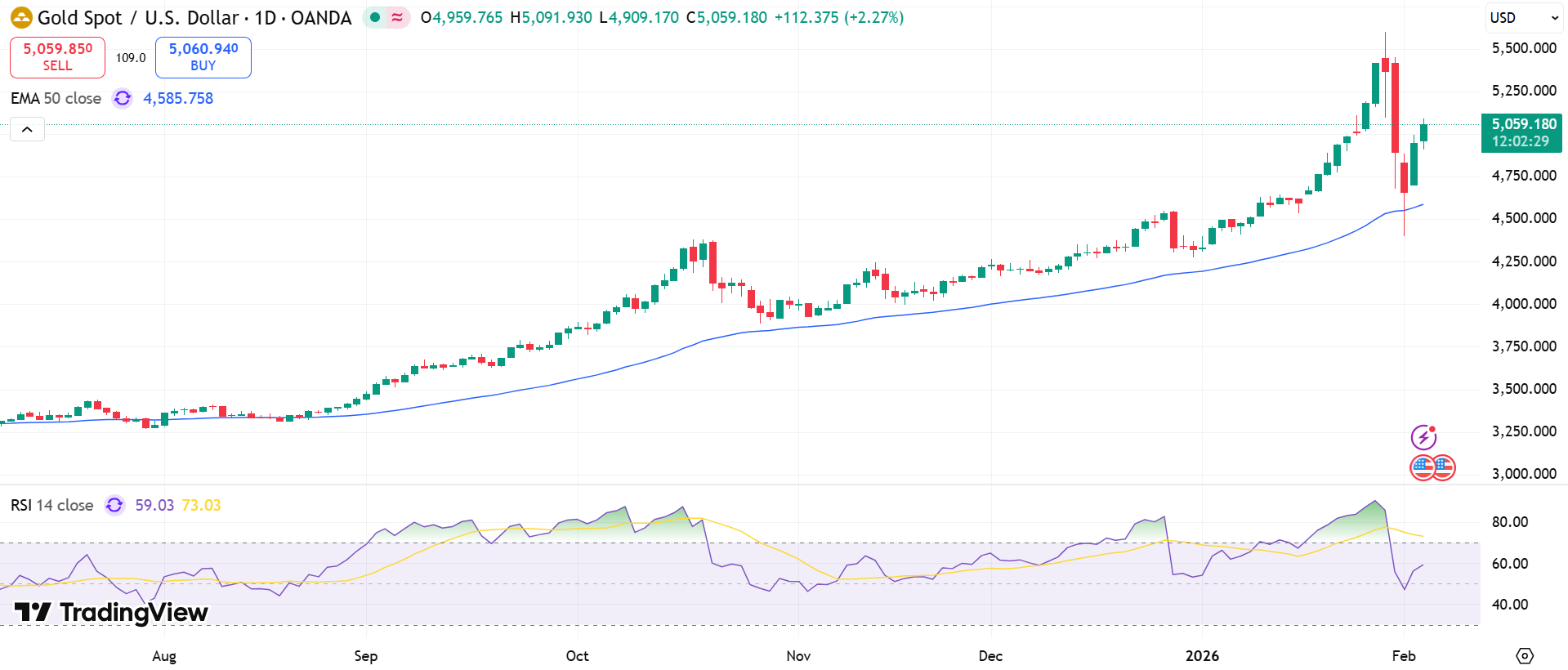
Gold powered higher in early Asian trading Wednesday, reclaiming the psychologically important $5,000-per-ounce threshold as renewed friction between Washington and Tehran jolted global markets. The move marked a sharp turnaround after last week’s $1,000 selloff, the steepest weekly drop in modern trading history, and underscored how quickly sentiment can swing when geopolitics flares.
Spot bullion climbed 2.3% to $5,060.28 an ounce by 01:17 ET, while April gold futures advanced 2.9% to $5,078.96. Traders described the action as a classic “risk-off” bid: investors rotated out of equities and into assets perceived as safe when headlines turned hostile.
The catalyst came overnight, when U.S. forces reportedly shot down an Iranian drone over the Arabian Sea. In a separate incident, Iranian gunboats were seen approaching a U.S.-linked tanker in the Strait of Hormuz, one of the world’s most strategically sensitive shipping lanes. Together, the episodes rekindled fears of broader confrontation even as both governments signaled plans to meet for nuclear talks later this week.
Markets had initially cheered the prospect of dialogue, which briefly cooled haven demand on Tuesday. Wednesday’s price action suggested that traders are no longer willing to take those assurances at face value.
Dollar, Fed bets and gold’s whipsaw
Recent turbulence in gold has been driven as much by macroeconomics as geopolitics. A sudden surge in the U.S. dollar last week, fueled by expectations that President Donald Trump’s Federal Reserve nominee Kevin Warsh would pursue a less dovish policy stance, pushed yields higher and pressured metals across the board.
That dynamic triggered forced liquidations and margin calls, amplifying losses after gold had touched an all-time high near $5,600/oz. Yet buyers quickly emerged on the dip, arguing that the fundamental case for bullion remains intact.
ANZ analysts noted that three core pillars of demand are still firmly in place: geopolitical hedging, strong physical buying in Asia, and sustained central-bank accumulation. Despite the rollercoaster, gold is still up nearly 15% year-to-date in 2026.
Key forces shaping prices now include:
- Fed uncertainty: Policy tone under new leadership remains the biggest wild card.
- Currency swings: A stronger dollar typically weighs on gold; any softening could reverse that.
- Geopolitical risk: Flashpoints in the Middle East continue to act as a price floor.
Broader metals rally and outlook
The rebound wasn’t limited to gold. Spot silver climbed 2.8% to $87.4955/oz, while platinum jumped 3% to $2,286.72/oz as investors reentered the complex after a bout of panic selling.
OCBC analysts said the recovery suggests that “forced selling and margin-related liquidation pressures may have faded, at least for now,” but warned that volatility is likely to persist. Metals remain highly sensitive to shifts in U.S. yields, dollar strength, and Fed messaging.
Still, OCBC characterized last week’s slump as a temporary normalization rather than a trend reversal. They expect gold to continue benefiting from central-bank purchases and fiscal uncertainty in major economies. Silver, with its dual role as both a precious and industrial metal, could gain additional support from any rebound in manufacturing activity.
The bank reaffirmed its end-2026 targets of $5,600/oz for gold and $133/oz for silver, a bullish stance that hinges on continued geopolitical risk and steady official-sector buying.

