


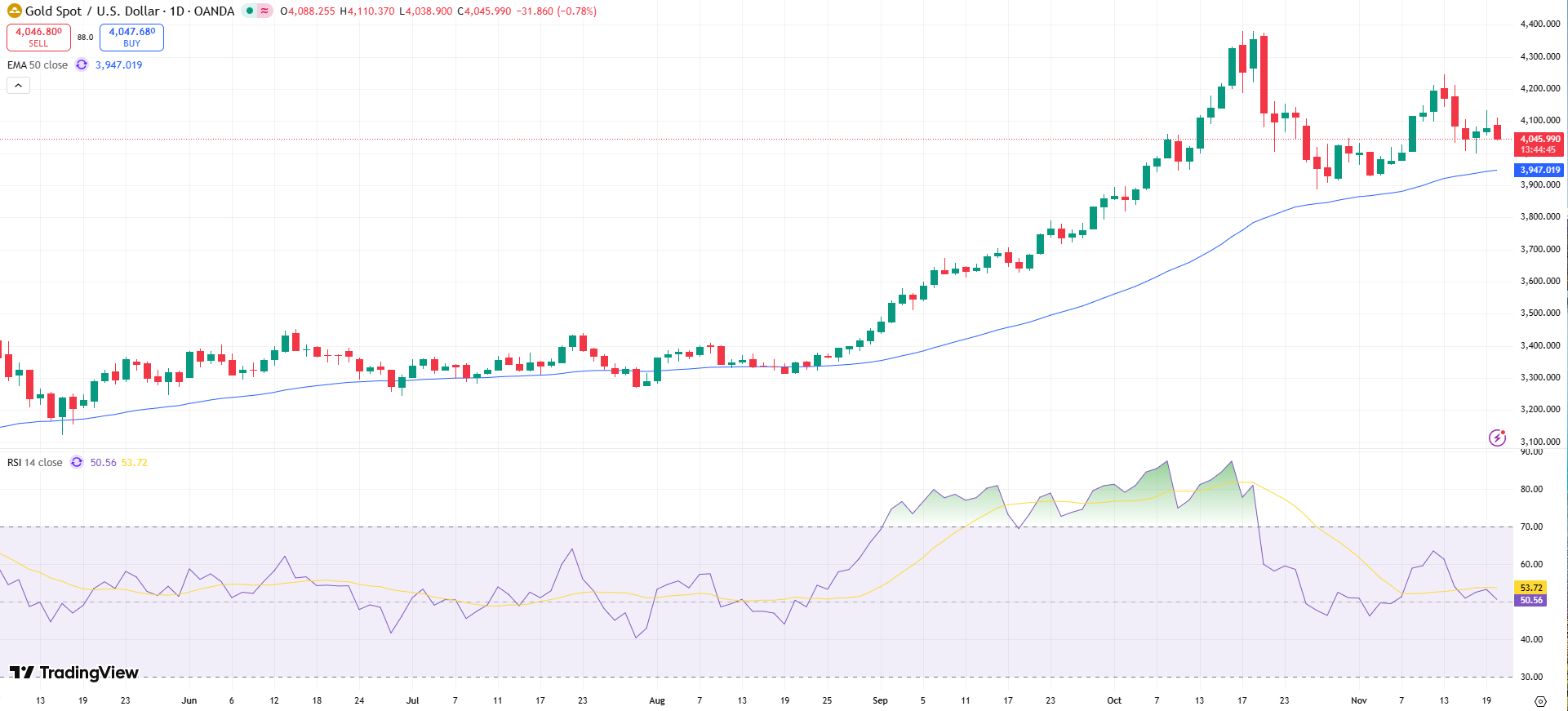
Gold prices edged lower in early Asian trading, ending a brief two-day rebound as investors reconsidered expectations for a December Federal Reserve rate cut. The shift followed a stronger tone in global equity markets, boosted by upbeat earnings from Nvidia Corp., which pulled capital away from traditional safe-haven assets.
Spot gold dipped 0.2% to $4,070.27 per ounce, while December gold futures slipped 0.3% to $4,069.09/oz by 00:15 ET (05:15 GMT). The pullback underscored how sensitive bullion remains to U.S. policy signals and broader market sentiment, despite persistent concerns around elevated fiscal spending across major economies.
Rising Japanese government bond yields—and a widening diplomatic rift between Japan and China—offered some offsetting support, though not enough to sustain gold’s earlier momentum.
Rate Cut Odds Fall Sharply
After gaining more than 1% across the previous two sessions, gold’s rally stalled as traders reassessed the likelihood of a near-term Fed pivot. Minutes from the central bank’s October meeting revealed growing divisions among policymakers, with no clear consensus on easing.
According to the CME FedWatch Tool, markets now assign only a 21.5% chance of a 25-basis-point rate cut at the Fed’s December 10–11 meeting—down sharply from 42.4% just one day earlier.
A prolonged U.S. government shutdown has delayed critical economic data, likely forcing the Fed into a cautious stance as it heads toward its final meeting of the year.
Higher-for-longer interest rates generally weigh on non-yielding assets like gold, although other precious metals found modest traction:
- Platinum: up 0.8% to $1,560.13/oz
- Silver: steady at $51.3415/oz
Markets Await U.S. Payrolls Data
All eyes now turn to the delayed release of U.S. nonfarm payrolls for September, expected later in the day. While the report is unlikely to influence the Fed’s December decision directly, it remains a critical gauge of labor market health.
A string of private-sector indicators and weekly jobless claims this week pointed to a gradual softening in the U.S. labor market. Such signs may strengthen the case for future rate cuts, given the Fed’s mandate to prevent persistent employment weakness.
Key considerations shaping investor sentiment include:
- Ongoing data delays due to the government shutdown
- Expectations that October payrolls may never be released
- Rising concern that sticky inflation could limit the Fed’s flexibility
Despite near-term uncertainty, markets broadly expect the Fed to eventually ease policy—just not in December.

