


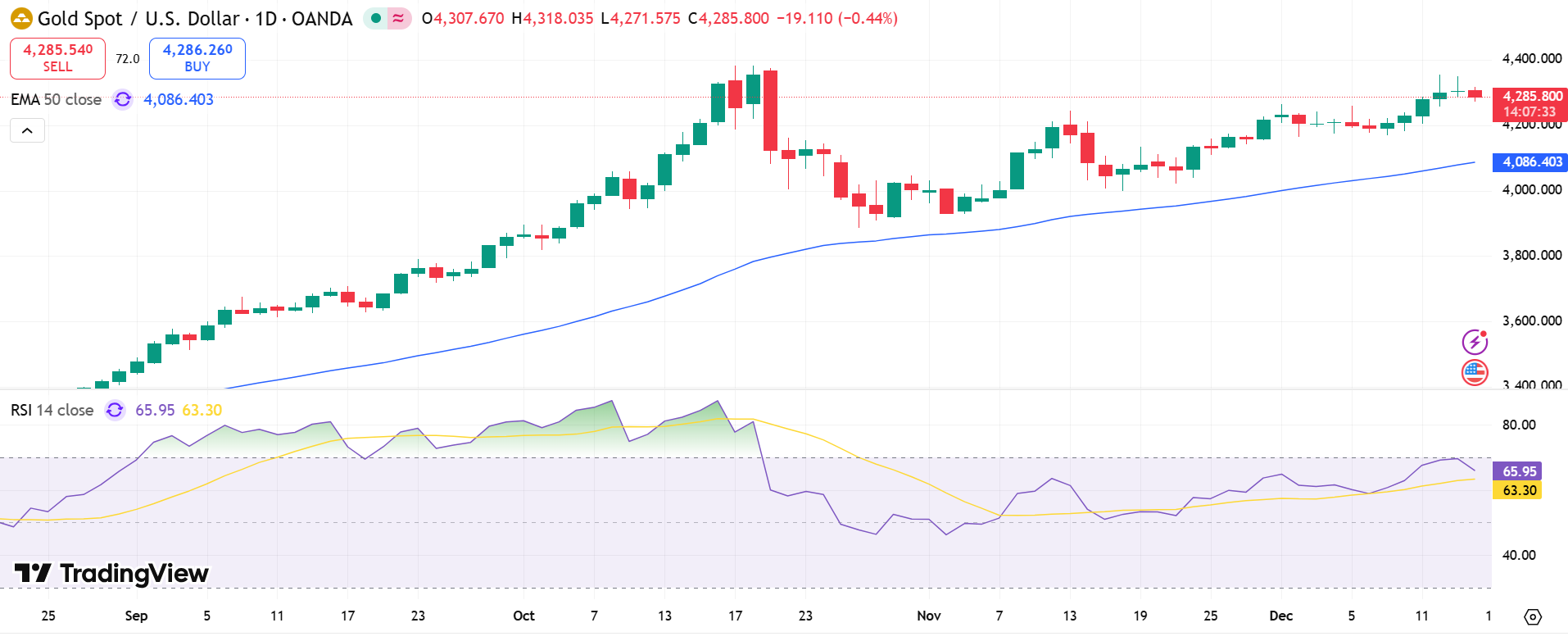
Gold and silver prices edged lower in Asian trading as investors locked in profits ahead of pivotal U.S. economic data, beginning with November nonfarm payrolls. The pullback follows a strong rally over the past week, fueled by a Federal Reserve rate cut and softer guidance that weakened the U.S. dollar and Treasury yields.
Spot gold slipped 0.4% to $4,289 an ounce, while February gold futures fell 0.5% to $4,315. Silver, which has been one of the strongest performers in the metals complex this year, saw sharper selling pressure. Spot silver declined 1.9% to $62.86, retreating from a string of record highs, while futures eased 1.2%.
The broader metals market delivered mixed signals. Platinum surged more than 1% to $1,810 an ounce, marking its highest level in over 14 years, supported by supply tightness. In contrast, London copper futures slipped 0.8% to $11,581 a ton, reflecting softer demand expectations linked to global growth concerns.
Payrolls, CPI Data Set the Tone
Markets are now focused on incoming U.S. macroeconomic data that could reshape expectations for interest rates. The nonfarm payrolls report, due later Tuesday, is expected to show continued cooling in labor-market momentum, a development that would reinforce the case for further policy easing.
That release will be followed by November consumer price index (CPI) data on Thursday, offering fresh insight into inflation trends after months of moderation. Together, labor and inflation metrics remain the Federal Reserve’s two primary inputs for policy decisions.
Key data points investors are watching include:
- Payroll growth and revisions to prior months
- Wage inflation trends and participation rates
- Core CPI momentum and services inflation
Lower interest rates tend to favor non-yielding assets such as gold and silver, reducing the opportunity cost of holding them. In 2025, falling U.S. rates and heightened uncertainty around liquidity conditions helped push precious metals sharply higher, reinforcing their role as portfolio hedges.
Gold Could Test $5,000 by 2026
Looking beyond near-term volatility, analysts remain constructive. ANZ forecasts gold prices could exceed $5,000 an ounce in 2026, driven by easing monetary policy, fiscal stress in developed economies, and persistent geopolitical risks.
The bank cited several structural tailwinds:
- Rising concerns over sovereign debt sustainability
- Waning confidence in U.S. assets
- Renewed global trade frictions and policy uncertainty
ANZ expects gold’s strong performance to continue into early 2026, though at a more measured pace. After outsized gains in 2025, analysts project annual increases of 12% to 15%, signaling consolidation rather than reversal.
For now, gold and silver appear to be resetting after a powerful run, with the next directional move likely hinging on how convincingly U.S. data confirms a slowing economy and a more accommodative Fed path.

