


Oil prices edged higher at the start of 2026, stabilizing after suffering their largest annual decline since 2020, as fresh geopolitical risks briefly offset persistent concerns about global oversupply. Brent crude rose 35 cents to $61.20 a barrel, while U.S. West Texas Intermediate (WTI) gained 34 cents to $57.76, according to early Asian trading data.
The modest rebound followed a turbulent 2025 in which both benchmarks fell nearly 20%, marking Brent’s third consecutive annual loss, the longest such streak on record. Prices were weighed down last year by rising supply, slowing global demand growth, and the threat of new trade barriers, even as geopolitical flashpoints periodically lifted risk premiums.
Early support in 2026 came from escalating tensions involving key energy producers. Ukraine intensified drone strikes on Russian energy facilities, while Washington tightened pressure on Venezuela’s oil sector through new sanctions. These developments revived concerns about short-term supply disruptions, even as structural oversupply remains the dominant theme.
Geopolitical Risks Offer Short-Term Support
Energy markets are once again navigating a fragile balance between politics and fundamentals. Kyiv has expanded its campaign targeting Russian oil infrastructure, aiming to weaken Moscow’s wartime revenues. At the same time, Russia and Ukraine have exchanged accusations of civilian attacks despite renewed diplomatic efforts overseen by U.S. President Donald Trump to end the nearly four-year conflict.
Meanwhile, the United States has moved to further isolate Venezuela’s oil trade. New sanctions imposed on four companies and several oil tankers are designed to block sanctioned vessels from entering or leaving Venezuelan ports. The measures are forcing state-run PDVSA to adopt emergency workarounds as residual fuel inventories accumulate, raising operational risks.
Key geopolitical drivers influencing prices include:
- Drone attacks on Russian energy infrastructure
- Expanded U.S. sanctions targeting Venezuelan oil logistics
- Ongoing Russia–Ukraine negotiations with uncertain outcomes
- Supply disruptions that remain localized rather than global
Despite these risks, markets have been reluctant to price in sustained upside, reflecting confidence that global supply remains ample.
Oversupply and OPEC+ Decisions in Focus
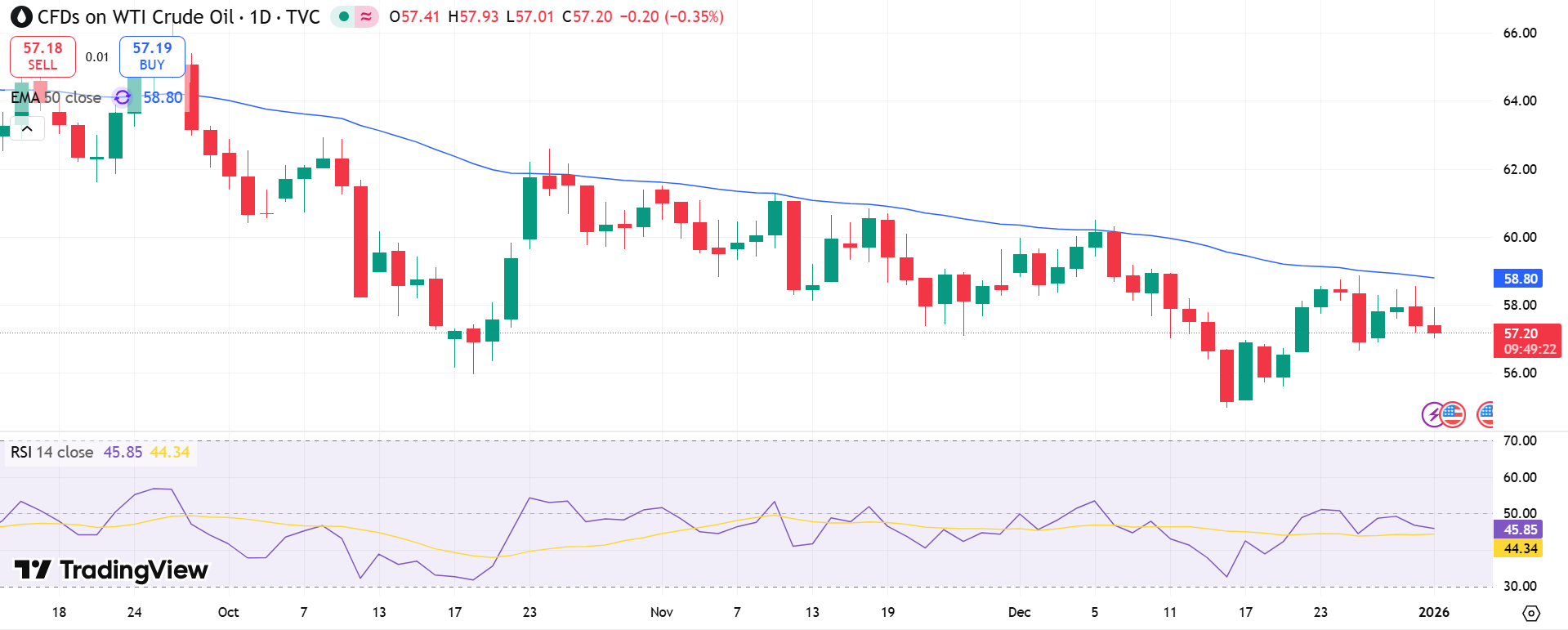
Analysts say the muted price response highlights a broader struggle between short-term shocks and longer-term fundamentals. According to market estimates, crude balances point to oversupply heading into early 2026, keeping prices range-bound.
WTI is widely expected to trade between $55 and $65 per barrel in the first quarter, as investors await clarity from the OPEC+ meeting scheduled for January 4. The group is expected to maintain its pause on output increases, extending a cautious approach adopted late last year.
China is also expected to play a stabilizing role. Analysts note that Beijing is likely to continue building crude stockpiles in the first half of 2026, helping to set a soft floor under prices.
In the United States, supply remains abundant. The Energy Information Administration reported record crude production of 13.87 million barrels per day in October. While crude inventories declined last week, gasoline and distillate stocks rose, reflecting strong refinery activity rather than tight supply.
Together, these forces suggest oil’s early-2026 rebound is more a pause after a historic decline than the start of a sustained rally.

