


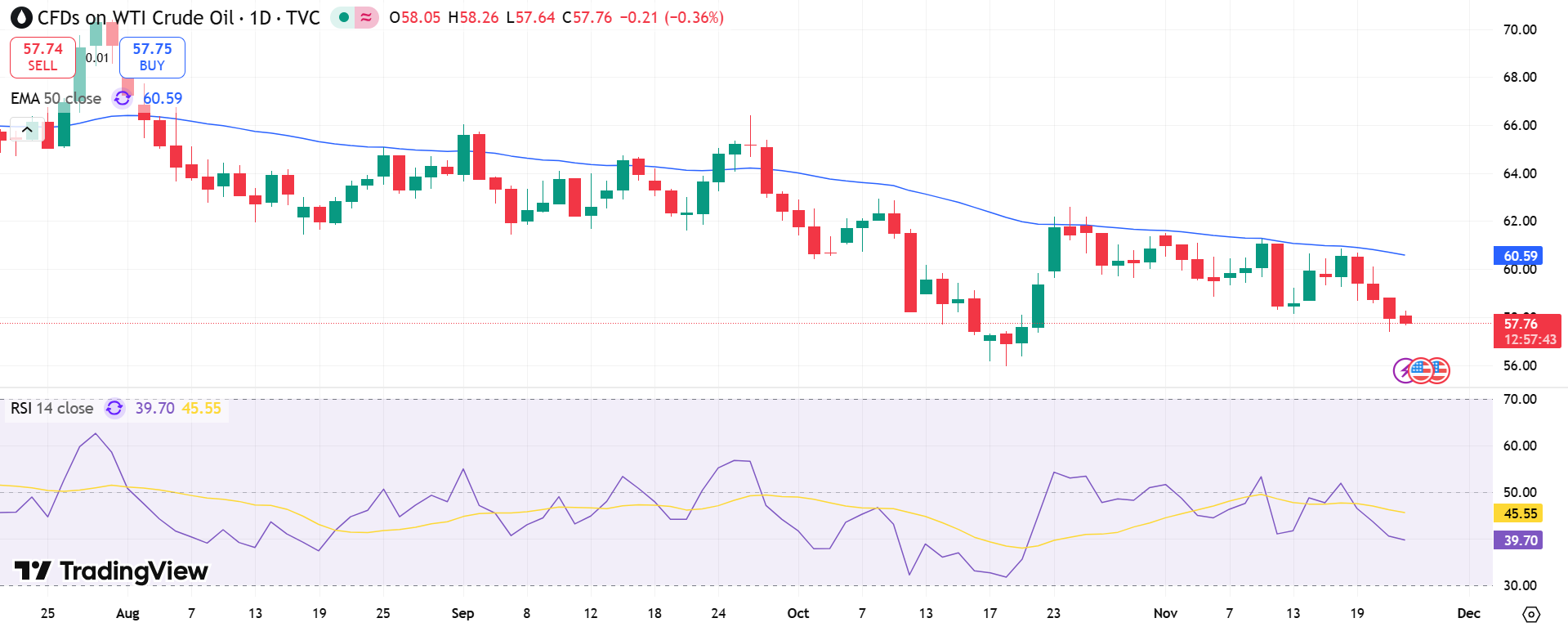
Oil prices weakened on Monday, adding to last week’s declines, as progress in Russia-Ukraine peace negotiations signaled the potential return of significant Russian supply to the global market. A stronger U.S. dollar compounded the downward pressure, making crude more expensive for international buyers and limiting near-term demand.
By early Asian trade, Brent crude slipped 14 cents, or 0.22%, to $62.42 per barrel, while West Texas Intermediate fell 15 cents, or 0.26%, to $57.91. Both benchmarks lost nearly 3% last week, marking their lowest close since October 21.
Traders grew increasingly concerned that a peace agreement could prompt the rollback of sanctions on Moscow—sanctions that have kept millions of barrels off the market. Analysts warned that the prospect of fresh supplies overshadowed the short-term effects of newly imposed U.S. penalties on Rosneft and Lukoil.
Key forces pressuring crude prices today include:
- Advancing Russia-Ukraine peace negotiations
- A stronger U.S. dollar hitting multi-week highs
- Market fears of sanctioned Russian oil returning to global supply
Supply Risks Rise as 48M Barrels Remain Stranded
The United States intensified sanctions on Rosneft and Lukoil last Friday, leaving nearly 48 million barrels of Russian crude stranded at sea. Yet analysts argue these disruptions may be temporary if peace efforts gain momentum.
Tony Sycamore of IG noted that President Trump’s aggressive push for a settlement was the primary catalyst behind the recent sell-off. Markets view a rapid agreement as a clear pathway to unlocking Russian exports, which could quickly reshape global supply dynamics.
Talks over the weekend produced what negotiators described as “meaningful progress.” The proposed framework would require Ukraine to cede contested territory and halt its NATO ambitions. While the U.S. has set a Thursday deadline, European leaders continue advocating for broader guarantees before endorsing any deal.
Russia, the world’s second-largest oil producer in 2024, could significantly expand exports if sanctions ease, according to the U.S. Energy Information Administration.
Dollar Strength and Rate Cut Hopes Shape Outlook
A resurgent dollar added pressure to crude prices, with the dollar index hitting its strongest level since late May. The currency is poised for its largest weekly rise in six weeks, raising the cost of oil for buyers using other currencies.
Meanwhile, monetary policy expectations injected fresh complexity into the market. New York Federal Reserve President John Williams signaled that a rate cut may be possible “in the near term,” lifting hopes for softer financial conditions in December.
Even so, the combined effect of a stronger dollar and looming Russian supply continues to weigh heavily on the oil market. Traders now await further clarity from peace negotiations and the Federal Reserve’s upcoming communications—both pivotal drivers for energy markets in the weeks ahead.

