
The New Zealand Dollar (NZD) weakened below 0.5500 against the US Dollar (USD) on Wednesday, with NZD/USD trading near 0.5490 during European hours. A stronger Greenback, supported by persistent US inflation and increasingly hawkish Federal Reserve (Fed) commentary, is weighing on the currency pair. Political uncertainty following New Zealand’s November 7 election is adding another source of pressure. Traders are now watching the Federal Open Market Committee (FOMC) minutes for clues about the Fed’s next policy decision.
Fed hawkishness supports the US Dollar
Comments from Federal Reserve officials have strengthened expectations that US interest rates could rise further. St. Louis Fed President Alberto Musalem said on Tuesday that several additional rate increases may be needed before spring 2027 to bring inflation under control. He warned that inflation remains above the Fed’s 2% target and that the current policy rate may be insufficiently restrictive.
Cleveland Fed President Beth Hammack also supported a gradual tightening approach, while leaving the door open to larger increases if inflation accelerates. Such remarks can support the Dollar by raising the expected return on US assets relative to currencies whose central banks are less likely to tighten.
The Fed’s October 27-28 meeting minutes are scheduled for release on Wednesday at 2:00 p.m. Eastern time, according to the Federal Reserve calendar. Investors will examine the discussion for evidence of how strongly policymakers are leaning toward another increase.
Strategists at Brown Brothers Harriman have cautioned that the Dollar’s recent advance may be stretched in the near term. However, resilient US growth, relatively firm employment conditions and persistent inflation continue to support the broader bullish Dollar outlook.
New Zealand election adds Kiwi uncertainty
New Zealand’s November 7 general election has left the political outlook unsettled while officials complete the count. Preliminary results give the National Party 42 seats, ACT New Zealand 13 and New Zealand First 12, leaving the National-led bloc with a narrow one-seat parliamentary majority.
The Electoral Commission expects to publish the official results on November 27. Until then, uncertainty over the composition and priorities of the next government could influence investor sentiment.
Labour’s potential return to government has also drawn attention because of proposals to restore employment to the Reserve Bank of New Zealand’s (RBNZ) policy considerations. A greater emphasis on employment could complicate the outlook for monetary policy.
Meanwhile, New Zealand’s unemployment rate increased to 5.7% in the September quarter from 5.6% previously, according to Stats NZ. A softer labour market may reduce pressure for further monetary tightening and weigh on the Kiwi.
NZD/USD forecast: 0.5470 support
The daily technical setup supplied for NZD/USD shows the pair trading below its 20-day Bollinger Band midpoint and the 100-day simple moving average (SMA), preserving a bearish near-term structure. The Relative Strength Index (RSI) near 32 indicates weakening momentum and approaches oversold territory, although that alone does not confirm a reversal.
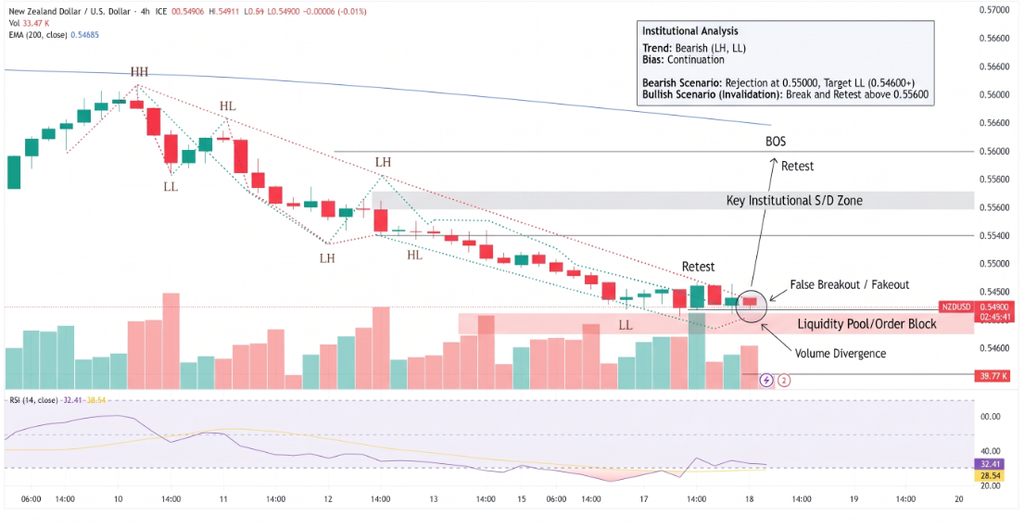
Key chart levels include:
- 0.5470: Lower Bollinger Band and immediate support.
- 0.5527: November 6 low and initial resistance.
- 0.5600: Bollinger Band midpoint and recovery threshold.
- 0.5725–0.5745: Upper Bollinger Band and 100-day SMA resistance zone in the supplied chart.
A decisive break below 0.5470 could expose fresh lows and extend the decline. Conversely, a recovery above 0.5527 would ease immediate selling pressure, with 0.5600 the next upside reference.
Conclusion
NZD/USD remains vulnerable below 0.5500 as hawkish Fed signals support the US Dollar and New Zealand faces political and labour-market uncertainty. A sustained break under 0.5470 would strengthen the bearish outlook, while a move above 0.5527 would offer an early indication of stabilisation.
Sources & Methodology
Primary-source standard: Market-moving facts should link to original data releases, regulator notices, company filings or official project announcements whenever available. Secondary reporting is used for additional context, not as a substitute for original evidence.
Page last reviewed: