Oil prices fall for a third day as U.S., Iran, and Oman near an interim deal to reopen the Strait of Hormuz. Brent at $79, WTI at $75 after Tuesday’s 5%+ drop; API shows 2.69M-barrel inventory build.
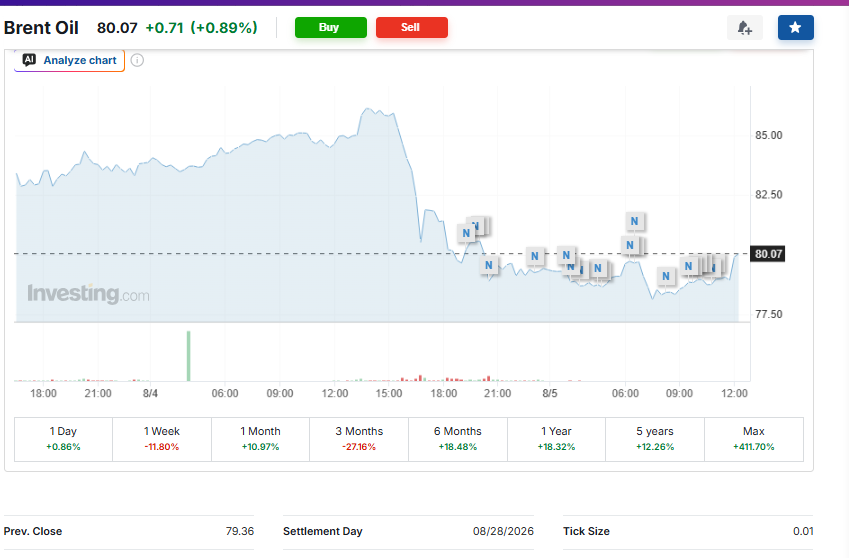
Oil prices edged lower on Wednesday, extending losses for a third straight session as optimism grew that an interim U.S.-Iran-Oman agreement could restore shipping through the Strait of Hormuz. Brent crude futures fell 0.5% to $79.00 per barrel and WTI slipped 0.7% to $75.27 as of early trading, following Tuesday’s more than 5% plunge that pushed both benchmarks to three-week lows, according to market data.
Brent Falls to $79, WTI to $75.27 as U.S.-Iran-Oman Near 60-Day Hormuz Deal; API Shows 2.69M-Barrel Build
As of 02:56 ET (06:56 GMT) on Wednesday, Brent Oil Futures (October contract) were down 0.5% at $79.00 per barrel, while West Texas Intermediate (WTI) crude futures for September fell 0.7% to $75.27 per barrel. Both benchmarks had tumbled more than 5% on Tuesday — Brent closed around $79.33 (down 5.3%) and WTI near $75.82 (down 5.6%) — extending sharp losses from Monday and marking the lowest levels since mid-July. Week-to-date losses exceeded 11–12% for both contracts.
Axios reported late Tuesday that the U.S., Iran, and Oman are nearing an interim agreement to reopen the Strait of Hormuz, with Washington aiming for a possible Wednesday announcement. The emerging deal, according to regional sources and a U.S. official, would establish a 60-day temporary arrangement: inbound traffic via a northern lane through Iranian waters, outbound traffic via a southern lane through Omani waters, no tolls or fees during the period, and mine-clearing of the median lane within 30 days. Iranian media, however, indicated any agreement could be delayed amid ongoing U.S. threats. Qatar confirmed that an interim proposal had been drafted as mediators worked to bridge differences.
U.S. President Donald Trump discussed de-escalation efforts with Qatar’s Emir Sheikh Tamim bin Hamad Al-Thani in a phone call on Tuesday. Trump has described the talks as a “last chance” for Iran. Tehran has publicly denied that formal direct negotiations with Washington are underway, though it is engaged with Oman on safe shipping corridors. Another commercial vessel came under attack near the Strait on Tuesday, underscoring persistent security risks.
Separately, the American Petroleum Institute (API) reported late Tuesday that U.S. crude oil inventories rose by 2.69 million barrels in the week ended July 31, against analysts’ expectations for a draw of about 2 million barrels. Cushing, Oklahoma inventories also built by approximately 2.36 million barrels. Official U.S. Energy Information Administration (EIA) data is due later Wednesday.
Oil Drops as Hormuz Deal Hopes Cut Risk Premium; Strait Handles ~20% of Global Supply
Prices fell as traders priced in a potential reduction in the geopolitical risk premium that has supported oil since the U.S.-Iran conflict disrupted Hormuz flows. The Strait normally handles about one-fifth (roughly 20%) of global oil and LNG shipments — historically around 15–20 million barrels per day of crude and products. A credible reopening deal would ease supply fears that previously drove sharp price spikes (including a 50% surge in March). The unexpected API inventory build added to bearish pressure by signaling softer near-term U.S. demand or higher supply. Ongoing mixed signals from Iran and residual security incidents limited deeper selling.
Hormuz Traffic Far Below Pre-War 130–140 Ships/Day; Carries ~20M bpd, Bypass Only 3.5–5.5M
The Strait of Hormuz has been heavily disrupted since the U.S.-Iran conflict intensified around late February 2026, with traffic far below the pre-crisis average of roughly 130–140 vessels per day. Pre-war, the waterway carried nearly 20 million barrels per day of oil and products, making it one of the world’s most critical energy chokepoints. Bypass options (Saudi and UAE pipelines) offer only limited alternative capacity of roughly 3.5–5.5 million barrels per day. Diplomatic efforts have involved Qatar as a key mediator, with Oman also central to any Hormuz traffic arrangement. U.S. Treasury Secretary Scott Bessent had earlier signaled a possible deal “today or tomorrow,” while Secretary of State Marco Rubio noted progress but no finality. Oil had already dropped sharply on Monday after Trump paused further military action to allow diplomacy.
Key Watch: Hormuz Deal Announcement, EIA Inventory Data, and Shipping Traffic
Markets will closely monitor any official announcement of a Hormuz deal on Wednesday or shortly thereafter, as well as the official EIA inventory report later Wednesday for confirmation of the API build. Further statements from Washington, Tehran, Oman, or Qatar, along with shipping traffic data through the Strait, will be critical. Persistent vessel attacks or Iranian insistence on greater control could reverse the current price decline. Broader factors include OPEC+ supply decisions and global demand signals.
Sources & Methodology
Primary-source standard: Market-moving facts should link to original data releases, regulator notices, company filings or official project announcements whenever available. Secondary reporting is used for additional context, not as a substitute for original evidence.
Page last reviewed: