
Brent slips to $83.56 and WTI to $79.68 after erasing gains, as Qatar pushes de-escalation while Iran denies U.S. talks and Trump warns of last chance. Key facts on Strait of Hormuz flows, July U.S. exports, and market risks.
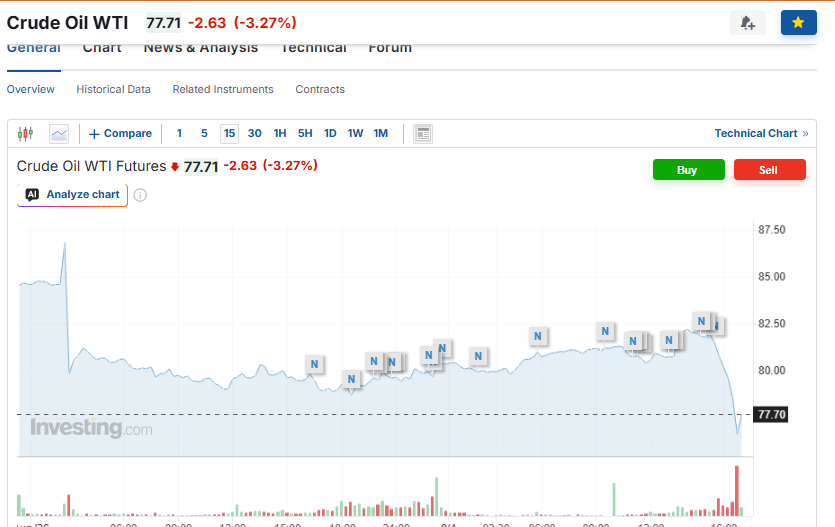
Oil prices turned lower on Tuesday, erasing earlier gains of more than 2.5%, after a string of potentially positive but conflicting headlines on Middle East peace talks. As of 07:29 ET (11:29 GMT), Brent crude futures, the global benchmark, ticked down 0.3% to $83.56 per barrel while U.S. West Texas Intermediate (WTI) dropped 0.9% to $79.68. Investors weighed Qatar-mediated efforts focused on de-escalation and reopening the Strait of Hormuz against denials from Tehran and warnings from Washington.
Qatar Pushes Hormuz Deal as Trump Issues ‘Last Chance’ Warning; US Crude Exports Drop to 3.66M bpd
Qatar, a key regional mediator between Iran and the United States, said a push for a diplomatic resolution to the Iran conflict remains ongoing, with efforts centered on de-escalation and restoring traffic through the Strait of Hormuz. Language on a possible deal has been drafted and is circulating among negotiators, according to media reports. While no agreement exists yet for direct talks, a short-term resolution is Qatar’s focus.
U.S. President Donald Trump said on Monday that discussions with Iran were underway and warned Tehran it faced its “last chance” to reach a deal. Iranian foreign ministry spokesperson Esmaeil Baqaei countered that Iran was not currently in negotiations with the U.S. and was instead working with Oman on a route for vessel traffic through the strait.
The conflicting statements left the status of the on-again, off-again conflict unclear. This murkiness threatened to dampen hopes for a breakthrough that had been temporarily bolstered after Trump called off planned U.S. strikes on Iran over the weekend.
Separately, data showed U.S. crude exports fell to 3.66 million barrels per day in July—the lowest level in eight months—as increased Middle Eastern supply following June’s short-lived ceasefire reduced demand for American crude. Shipments to Asia dropped sharply (Japan down 67% to 324,000 bpd; South Korea down 39% to 474,000 bpd), while high U.S. refinery utilization (about 96.3%, the highest since 2018) kept more barrels at home.
Oil Prices Reverse Gains on Hormuz Uncertainty; Brent Dropped 7% Monday
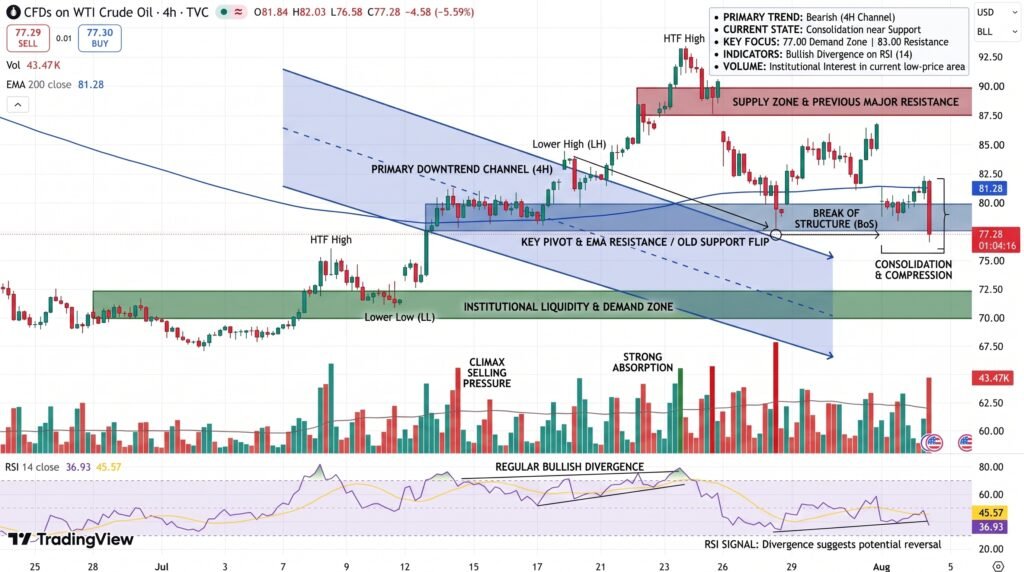
Prices had surged more than 2.5% earlier on optimism over diplomatic progress but reversed as traders digested the mixed signals. The Strait of Hormuz is a vital conduit for roughly one-fifth of the world’s oil and liquefied natural gas (approximately 20 million barrels per day of crude and products, or about 20–25% of global seaborne oil trade, according to IEA and EIA data). Persistent uncertainty over its full reopening revived concerns about ongoing crude supply disruptions.
ING analysts noted: “We’ve been in this situation multiple times before, only to see things unravel. And with Iran denying that any talks are underway and Trump issuing warnings if no deal materialises, the backdrop clearly leaves ample room for a renewed escalation.” Markets remain highly sensitive to headlines, having already absorbed sharp swings—including a roughly 7% drop in Brent to a three-week low near $83.77 and a more than 5% fall in WTI to around $80.34 on Monday after Trump paused strikes in hopes of a quick deal.
Hormuz Crisis: June MoU Falters, Just 3.5–5.5M bpd Bypass Capacity
The conflict, which intensified after U.S. and Israeli actions earlier in 2026, has repeatedly disrupted shipping through the narrow waterway (only about 29 nautical miles wide at its narrowest). An interim memorandum of understanding in mid-June aimed to halt hostilities, reopen the strait without fees for a limited period, and set a framework for broader talks, including on Iran’s nuclear program. Implementation has proven fragile, with disputes over routes, potential transit fees, sovereignty claims involving Oman, and intermittent strikes.
Alternative export routes exist but are limited: Saudi Arabia and the UAE can divert only a portion of volumes via pipelines (roughly 3.5–5.5 million bpd combined capacity outside the strait). Most Gulf producers, including Iran, Iraq, Kuwait, Qatar, and Bahrain, rely heavily on Hormuz. The waterway also handles significant LNG volumes from Qatar and the UAE (nearly 20% of global LNG exports in some periods).
U.S. export data underscores the knock-on effects: the July drop to 3.66 million bpd reflected temporary relief from Middle Eastern barrels returning after the June ceasefire, though high domestic refining rates constrained further overseas shipments. Global oil markets have seen extreme volatility throughout 2026, with Brent previously trading well above $100 amid peak disruption fears before retreating on de-escalation hopes.
What’s Next: Qatar-Iran-Oman Talks Face Trump ‘Last Chance’ Deadline Amid Escalation Risk
Attention will focus on whether Qatar-mediated efforts or Iran-Oman talks produce a tangible short-term arrangement for safer vessel traffic, and whether any language on a deal advances to formal negotiations. Trump’s “last chance” framing and Iran’s denials raise the risk of renewed military action if progress stalls. Traders will also monitor shipping data for actual transit volumes through Hormuz, further U.S. export figures, and any shifts in refinery runs or Asian demand. Analysts continue to flag the possibility of rapid re-escalation given the history of false starts.
Sources & Methodology
Primary-source standard: Market-moving facts should link to original data releases, regulator notices, company filings or official project announcements whenever available. Secondary reporting is used for additional context, not as a substitute for original evidence.
Page last reviewed: