Pi Network (PI) attracted fresh buying interest on Wednesday, holding above the $0.0600 level as its first-ever Pi Ecosystem Summit showcased new development tools and plans to expand the network. Co-founders Nicolas Kokkalis and Chengdiao Fan presented updates covering AI-assisted development, ecosystem growth funding and payment infrastructure. Despite the announcements, PI remains under pressure from weak cryptocurrency sentiment. Its technical indicators also point to a fragile recovery, leaving the $0.0600 support area important for near-term price direction.
Market pressure limits PI recovery
PI traded around $0.0622 in the market snapshot accompanying Wednesday’s report, while broader cryptocurrency sentiment remained deeply bearish. Bitcoin’s 12% weekly decline, uncertainty over US interest rates and the resignation of Nvidia chief executive Jensen Huang have contributed to risk aversion across financial markets.
The CoinMarketCap Fear and Greed Index fell to 13, indicating extreme fear among cryptocurrency investors. Such conditions can weigh particularly heavily on speculative tokens, as traders become less willing to take risks.
Derivatives activity also suggests that confidence remains limited. According to Blockworks, PI’s open interest declined to $6.21 million from $6.80 million the previous week. Open interest measures the value of outstanding futures and perpetual contracts. A decline can indicate that traders are closing positions or reducing exposure, although it does not independently establish whether the market is turning bearish.
Pi Ecosystem Summit unveils major upgrades
The first day of the Pi Ecosystem Summit introduced several initiatives intended to make the network more attractive to developers and businesses.
The announcements included a new Developer Web Console and Model Context Protocol (MCP) tools that allow compatible AI agents to assist with application creation, registration and integration. The network also outlined an App Growth Initiative with a marketing allocation of up to 20 million PI.
Other developments focused on practical payment and application features. Pi demonstrated on-chain subscription smart contracts and an integration with OpenMind’s RoboPay system to showcase x402 payments on its Testnet.
The founders also confirmed plans to bring additional financial infrastructure to the Mainnet in the first quarter of 2027:
- Pi Launchpad: Infrastructure for ecosystem token launches.
- Decentralized exchange (DEX): A platform for trading supported tokens.
- Automated market maker (AMM): Liquidity pools designed to facilitate token swaps.
These features could expand Pi’s ecosystem, although their eventual impact will depend on adoption, liquidity and successful implementation.
PI price forecast: $0.0516 in focus
PI remains below its 50-day and 200-day Exponential Moving Averages, positioned at $0.0758 and $0.1076, respectively. Both averages remain well above the current price, reinforcing the broader bearish structure.
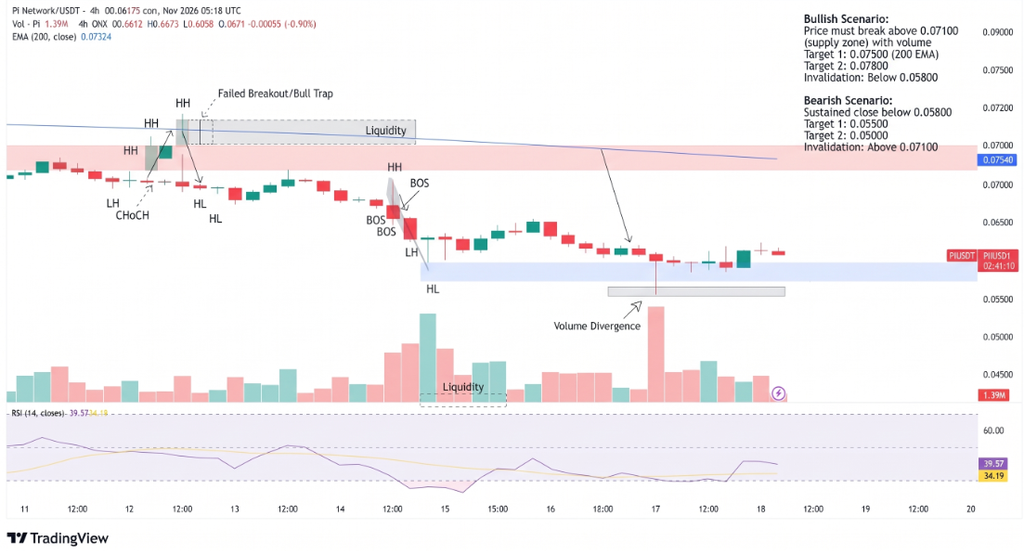
The descending resistance trendline near $0.0727 is another important barrier. A sustained move above it could improve the technical outlook and bring the 50-day EMA at $0.0758 into focus. The Relative Strength Index near 31 is close to oversold territory, while the negative MACD reading indicates that bearish momentum remains present.
On the downside, the 127.2% Fibonacci extension at $0.0516 represents a potential support area if selling pressure accelerates.
Conclusion
Pi Network’s summit announcements provide a potential foundation for stronger developer activity and broader token utility, but they have yet to reverse PI’s bearish price structure. Holding above $0.0600 would give buyers an opportunity to build a recovery, while a break lower could expose the $0.0516 Fibonacci level. A sustained move above $0.0727 would offer a stronger indication that market momentum is beginning to improve. For now, weak sentiment and declining open interest remain obstacles to a durable rebound.
Sources & Methodology
Primary-source standard: Market-moving facts should link to original data releases, regulator notices, company filings or official project announcements whenever available. Secondary reporting is used for additional context, not as a substitute for original evidence.
Page last reviewed: