
Pi Network’s PI token is hovering around $0.0870 after five consecutive daily declines, with the latest weakness occurring as the network prepares for its next major protocol upgrade. Protocol 28 is already running on the Pi Testnet, following the completion of Protocol 27 on Mainnet. The upgrade is designed to improve transaction-data handling and make it easier for developers to manage groups of smart contracts and stored application data. Despite the network development, PI’s technical structure remains bearish.
Protocol 28 Moves Toward Mainnet
Pi Network has upgraded its Testnet to Protocol 28 after completing the Protocol 27 upgrade on Mainnet. According to the network’s latest announcement, Protocol 28 improves how the blockchain handles delays in transaction data and allows developers to upgrade groups of smart contracts together. It also introduces safer ways to modify stored data as applications evolve.
The upgrade is particularly relevant to developers building applications on Pi because Testnet provides an environment for testing network performance, security and scalability before changes reach the live blockchain. Pi’s documentation also distinguishes Test-Pi from real PI, with Test-Pi having no monetary value.
Pi Node operators must upgrade to Protocol 28 by October 13 ahead of the scheduled Mainnet transition on October 16. The upgrade therefore represents an important infrastructure milestone, although the announcement does not imply a direct change to PI’s token supply or guarantee a price reaction.
PI Price Tests Key Support
PI trades around $0.0874 and remains below its 50-day, 100-day and 200-day exponential moving averages at $0.0909, $0.0988 and $0.1215, respectively. The descending EMA structure indicates that sellers retain control and that rebounds could encounter resistance from overhead supply.
Momentum indicators also remain cautious. The daily Relative Strength Index is near 45 and has slipped below its midpoint, showing that buying pressure has weakened. Meanwhile, the MACD remains below both zero and its signal line, reinforcing the bearish technical setup.
The immediate downside level is the 23.6% Fibonacci retracement at $0.0866, calculated from $0.1341 to $0.0704.
- Immediate support: $0.0866
- Major downside floor: $0.0704
- First resistance: $0.0909
- Next resistance: $0.0988
A decisive break below $0.0866 could expose the $0.0704 swing low if selling accelerates.
Bulls Need Break Above $0.0909
For PI to establish a meaningful recovery, buyers first need to reclaim the 50-day EMA at $0.0909. A sustained move above that level would bring the 100-day EMA at $0.0988 into focus and begin to weaken the current bearish structure.
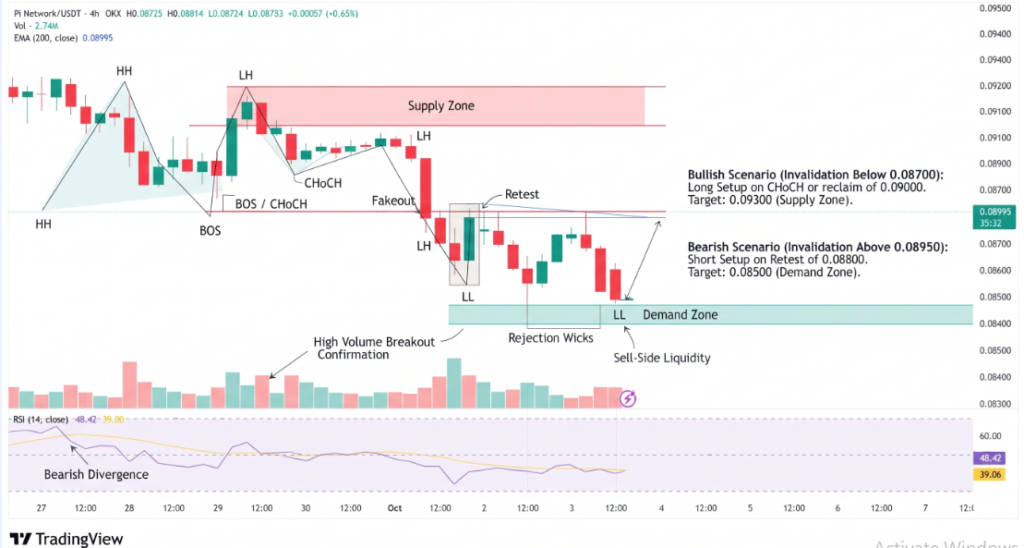
A stronger breakout through the $0.0988 resistance would open the path toward the 50% Fibonacci retracement at $0.1049. Such a move would also signal that the recent decline is losing momentum rather than simply pausing near support.
However, the Protocol 28 upgrade alone does not remove the technical pressure. Pi’s official documentation describes Testnet as an environment for testing and development, meaning successful deployment should be separated from assumptions about immediate token-price gains.
Conclusion
PI remains under pressure near $0.0870 despite the rollout of Protocol 28 on Testnet. The October 13 Pi Node deadline and October 16 Mainnet target mark important network milestones, while the token’s technical structure remains tilted lower. The $0.0866 Fibonacci support is the immediate test for sellers. Holding that level could allow a rebound toward $0.0909 and $0.0988, but a break lower would expose the $0.0704 swing low.
Sources & Methodology
Primary-source standard: Market-moving facts should link to original data releases, regulator notices, company filings or official project announcements whenever available. Secondary reporting is used for additional context, not as a substitute for original evidence.
Page last reviewed: