Pi Network (PI) remained under significant selling pressure on Monday, trading near $0.062 after reaching a new all-time low around $0.0600 over the weekend. Weak derivatives positioning and deteriorating technical indicators suggest that bearish sentiment continues to dominate the market. PI’s negative funding rate and declining risk-adjusted returns point to limited investor confidence, while its position below all major moving averages leaves the token vulnerable to another decline. Although oversold conditions could encourage a temporary rebound, buyers have yet to demonstrate sufficient strength to reverse the prevailing downward trend.
PI Derivatives Signal Strong Bearish Sentiment
Derivatives market indicators suggest that traders remain cautious about Pi Network’s near-term prospects. According to Blockworks data, PI’s Open Interest (OI)-weighted funding rate turned negative, falling to -0.00014% on Monday.
Funding rates represent periodic payments exchanged between traders holding long and short perpetual futures positions. A negative reading generally means short sellers are paying long-position holders, indicating that bearish positioning is relatively stronger in the derivatives market.
Another concerning indicator is Pi Network’s 30-day Sharpe ratio, which declined to -4.462. The metric has remained below zero since October, highlighting increasingly weak risk-adjusted performance.
The Sharpe ratio measures investment returns relative to the volatility investors experience. A deeply negative reading suggests that the asset has delivered poor returns relative to its level of risk.
Together, these indicators highlight several challenges for PI:
- Funding rate: -0.00014%, reflecting bearish derivatives positioning.
- 30-day Sharpe ratio: -4.462, indicating deteriorating risk-adjusted performance.
- Market sentiment: Negative funding and prolonged weakness suggest limited confidence among traders.
Pi Network Price Forecast: Key Levels
PI traded around $0.062 on Monday after recording a weekend low near $0.0600. The token remains below its three major daily Exponential Moving Averages (EMAs), keeping the broader technical outlook negative.
The 50-day EMA stands at $0.077, while the 100-day and 200-day EMAs are positioned at $0.085 and $0.112, respectively. These indicators measure average prices over different periods, helping traders identify prevailing market trends.
Momentum indicators also reflect persistent weakness. The daily Relative Strength Index (RSI) stands near 28, placing PI in oversold territory. Meanwhile, the Moving Average Convergence Divergence (MACD) histogram remains negative, suggesting that bearish momentum has not yet reversed.
The following levels are important for traders:
- Immediate resistance: $0.073.
- Additional resistance: $0.074.
- 50-day EMA: $0.077.
- 100-day EMA: $0.085.
- Major resistance: $0.098 and $0.112.
- Recent all-time low: Approximately $0.0600.
Can PI Avoid Another Record Low?
Pi Network faces considerable downside risks while trading close to its recent record low. A sustained break below $0.0600 could expose the token to additional losses, particularly if bearish derivatives positioning persists.
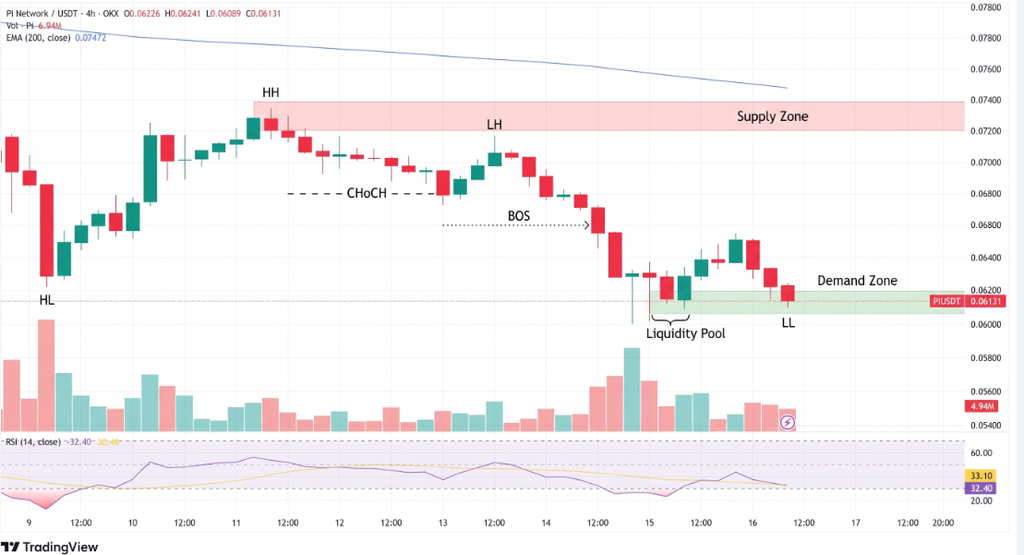
On the upside, reclaiming the $0.073–$0.074 resistance zone would provide an initial indication that buying interest is improving. A subsequent move above the 50-day EMA at $0.077 could strengthen the recovery attempt.
However, overcoming the 100-day EMA at $0.085 would represent a more meaningful improvement in market structure. The $0.098 level and 200-day EMA at $0.112 remain longer-term recovery obstacles.
Conclusion
Pi Network’s near-term outlook remains bearish as negative funding rates, a deeply negative Sharpe ratio and weak technical momentum reinforce selling pressure. Although the RSI suggests that PI is oversold, a temporary rebound alone would not confirm a trend reversal. Buyers must reclaim nearby resistance levels and establish stronger demand to prevent another test of the $0.0600 record low.
Sources & Methodology
Primary-source standard: Market-moving facts should link to original data releases, regulator notices, company filings or official project announcements whenever available. Secondary reporting is used for additional context, not as a substitute for original evidence.
Page last reviewed: