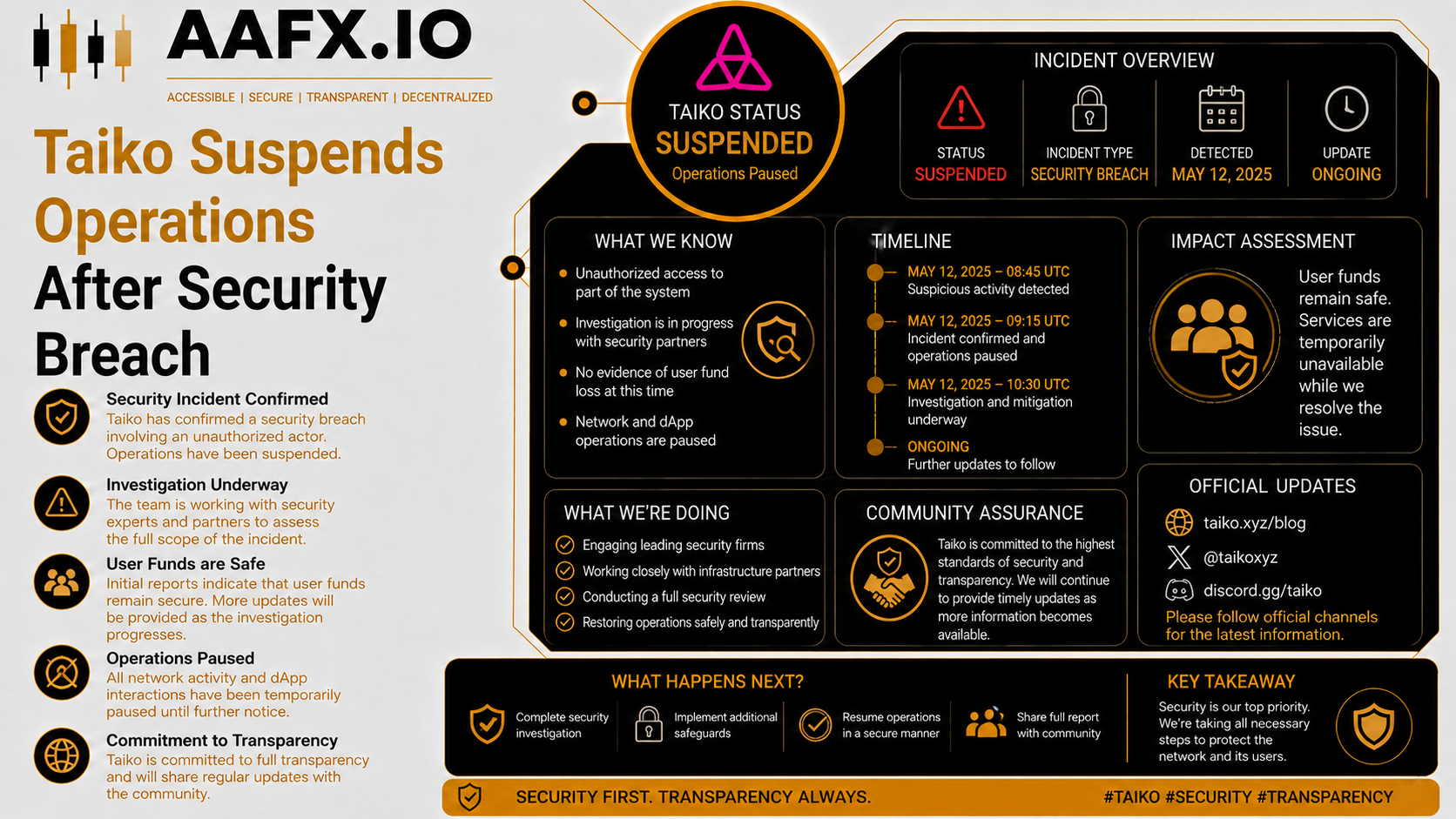
Ethereum Layer 2 network Taiko has halted block production and urged users to withdraw assets after confirming a significant compromise of its chain-state verification system. The incident has raised concerns across the Ethereum ecosystem, highlighting the security challenges facing emerging scaling solutions.
In an official statement, Taiko disclosed that the vulnerability affected its verification mechanism, a core component responsible for validating information between networks. As a result, the protocol warned that all bridges deployed on the network should currently be considered unsafe.
The development prompted immediate emergency measures, including coordination with security partners, ecosystem participants, and the protocol’s Security Council. Taiko also requested centralized cryptocurrency exchanges to suspend deposits of its native token until further notice.
Exploit Targets Bridge Validation
The breach was initially identified by blockchain security firm Blockaid, which traced the issue to a flaw in Taiko’s source-signal proof validation process.
According to the investigation, attackers successfully submitted fabricated message proofs that were incorrectly recognized as legitimate on Ethereum’s main network. These forged messages allowed unauthorized withdrawals from the protocol’s ERC-20 asset vault, enabling the release of funds without valid transactions occurring on the Taiko chain.
Security researchers highlighted several key findings:
- Fraudulent bridge messages bypassed verification checks.
- Unauthorized assets were released from the ERC-20 vault.
- Attackers exploited proof validation logic rather than smart-contract ownership.
- Emergency response efforts were launched immediately after detection.
The exploit demonstrates how vulnerabilities within cross-chain communication systems can become attractive targets for attackers. As blockchain ecosystems increasingly rely on bridges to transfer assets, the security of verification mechanisms has become a critical area of focus.
Losses Reach $1.7 Million
Initial estimates from Blockaid suggested that approximately $1 million had been stolen. However, subsequent analysis from blockchain security platform PeckShield revised the losses upward to roughly $1.7 million.
Investigators also reported that the attacker transferred nearly 1.99 million Taiko tokens, valued at approximately $170,000, to an address associated with the MEXC cryptocurrency exchange.
While the financial impact remains relatively modest compared with some of the industry’s largest exploits, the incident carries broader implications because it directly affected a core infrastructure component rather than an isolated application.
Future of the Ethereum Rollup
Taiko operates as a “based rollup,” a Layer 2 architecture that leverages Ethereum validators to help sequence and secure transactions. The project launched its mainnet in May 2024 after more than two years of development and quickly gained attention as part of Ethereum’s expanding scaling ecosystem.
The immediate priority for the Taiko team is restoring confidence and ensuring no additional vulnerabilities remain. Key areas under review include:
- Bridge security architecture.
- Proof verification mechanisms.
- Asset recovery options.
- Exchange and ecosystem coordination.
Until investigations conclude, block production remains suspended, and users are being encouraged to remove assets from affected bridges. The incident serves as another reminder that while Layer 2 networks improve scalability and reduce transaction costs, robust security remains essential for long-term adoption across the decentralized finance sector.