
The U.S. dollar recovered from early losses on Thursday as investors shifted their attention from the midterm election results to stronger-than-expected economic indicators. The U.S. Dollar Index (DXY) traded near 101.50 after rebounding from an Asian-session low of 101.20, leaving it almost unchanged on the day. October employment and business activity figures reinforced expectations that the Federal Reserve could raise interest rates again in December. However, lower Treasury yields and softer oil prices continued to restrict the dollar’s recovery.
Strong US Data Supports Dollar Recovery
Recent economic releases have provided evidence that the U.S. economy entered the fourth quarter with considerable momentum. The ADP National Employment Report showed that private employers added 86,000 jobs in October, exceeding economists’ forecast of 69,000.
The report indicated that hiring remained relatively firm, although employment gains varied across industries. Trade, transportation and utilities added 39,000 positions, while education and health services contributed another 28,000. Professional and business services, by contrast, lost 27,000 jobs.
The ISM Services Purchasing Managers’ Index eased to 54.5 in October from 54.9 in September. Despite the modest decline, the reading remained above 50, the threshold separating expansion from contraction. Its employment component also improved, while prices remained elevated.
Manufacturing activity offered another positive signal. The ISM Manufacturing PMI increased to 55.5 in October from 54.5 in September, marking the sector’s tenth consecutive month of expansion.
Together, the figures suggest that economic activity remains resilient, giving the Federal Reserve less immediate reason to ease monetary policy.
December Fed Rate Hike Expectations Rise
Stronger employment and business surveys have reinforced expectations that the Federal Reserve could deliver another 25-basis-point increase in December. Market pricing in the supplied CME FedWatch snapshot indicated an 81% probability of a quarter-point hike.
A higher interest rate can support the dollar by increasing the relative return available on U.S. assets. However, the Fed’s decision will depend on incoming inflation, employment and growth data rather than one report alone.
Friday’s Nonfarm Payrolls report is therefore a major event for currency traders. A stronger-than-expected result could reinforce expectations of further tightening, while a substantial employment slowdown could challenge the dollar’s recovery.
DXY Outlook: Election Risks and Yields
The dollar remains exposed to political and financial-market developments. The Democratic sweep in the U.S. midterm elections raised concerns about potential fiscal gridlock and slower government spending. At the same time, declining oil prices amid hopes for progress toward ending the Iran conflict have eased some inflation concerns.
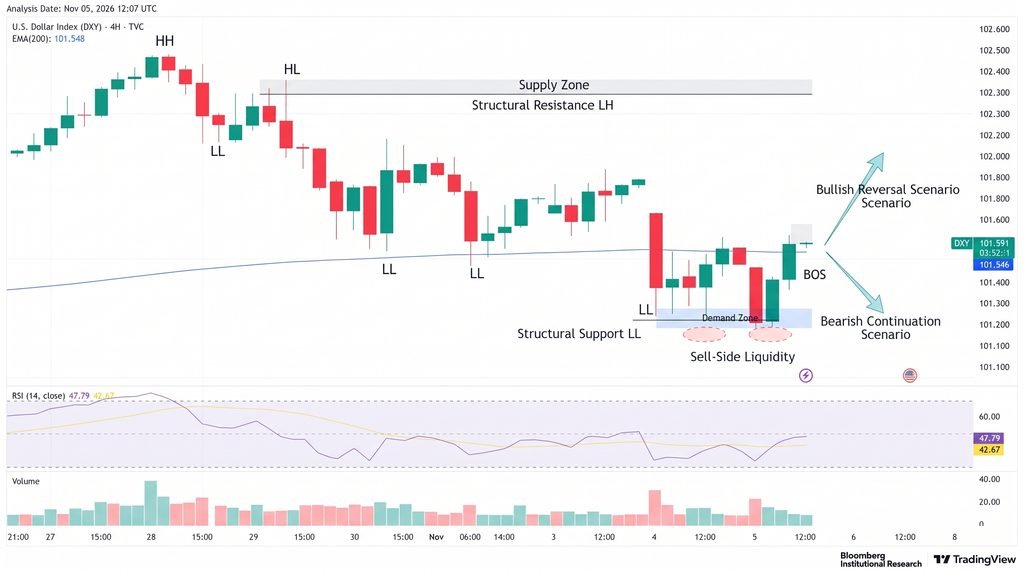
Lower Treasury yields can reduce the dollar’s appeal by narrowing its yield advantage over other currencies. This has limited the impact of otherwise supportive economic data.
Analysts at MUFG and ING have emphasized the resilience of U.S. economic fundamentals as a potential source of support for the currency.
Conclusion
The DXY’s recovery toward 101.50 reflects stronger U.S. employment and business activity, alongside expectations of another Federal Reserve rate increase. The 81% December hike probability in the supplied market snapshot highlights how firmly traders are positioning around tighter policy. Nevertheless, softer Treasury yields and election-related uncertainty remain obstacles. Friday’s Nonfarm Payrolls report could determine whether the dollar extends its rebound or resumes its recent decline.
Sources & Methodology
Primary-source standard: Market-moving facts should link to original data releases, regulator notices, company filings or official project announcements whenever available. Secondary reporting is used for additional context, not as a substitute for original evidence.
Page last reviewed: