
The Bank for International Settlements has published a working paper describing a blockchain-based system for verifying the origin and integrity of official economic data. The research team implemented the proof of concept on the XRP Ledger, using the network as a public record for cryptographic fingerprints of datasets. The paper was published on September 2, 2026.
The problem addressed by the project involves SDMX, the international standard used by organizations including the BIS to exchange statistical data. SDMX standardizes how information is distributed, but it does not by itself allow a recipient to independently confirm that a downloaded dataset came from the original publisher and remained unchanged.
The BIS researchers proposed a separate verification layer. Each dataset receives a cryptographic fingerprint, while multiple fingerprints can be grouped into a Merkle tree. A single Merkle root representing the batch is then recorded on XRPL. A user can compare the dataset with that recorded value to determine whether the information has been modified.
The underlying economic data is not placed on the blockchain. Only the fingerprints are recorded, preserving the confidentiality of the source material while providing a method to check its integrity.
Prototype verifies data in seconds
The BIS prototype produced measurable results. Median publication latency was 3–5 seconds, while verification took 1–2 seconds under controlled test conditions. The paper says the results are fast enough for interactive applications and automated systems that consume data in near real time.
The system was also designed around batching. Instead of creating a separate ledger transaction for every dataset, many datasets can be represented by a single summary value. According to the BIS, this makes on-chain fees negligible once modest batches are used, although larger batches can introduce additional delay before a data release is anchored.
The verification process also incorporates digital identity. The published SDMX file can contain a W3C Verifiable Credential identifying the publisher, with that identity cryptographically linked to an XRPL address through an on-chain attestation registry. This allows users to establish both the source of the data and whether its contents have changed.
The core architecture can be summarized through four components:
- Hashing: Generates a digital fingerprint for the dataset.
- Merkle aggregation: Compresses multiple fingerprints into one root.
- XRPL anchoring: Records and timestamps the root.
- Verifiable Credential: Connects the dataset to its publisher.
The BIS also released an open-source reference implementation, providing a basis for further testing and development.
XRPL research is not BIS adoption
The distinction between research and production deployment is critical. The BIS project was tested on XRPL DevNet, and the paper explicitly characterizes the implementation as a proof of concept rather than a hardened production system.
That means the research should not be interpreted as an announcement that the BIS has adopted XRPL as official infrastructure or that central banks will use XRP for settlement. The paper examines whether a public blockchain can provide an independent integrity layer for official statistics; it does not establish a production commitment from the BIS.
The research nevertheless adds a documented institutional use case for XRPL beyond payments. The paper says the same approach can be extended to other structured reporting formats, including XBRL, and notes potential future applications involving automated verification and zero-knowledge proofs.
The broader institutional case for XRPL is also developing. In May, Ondo Finance, JPMorgan’s Kinexys, Mastercard and Ripple completed a cross-border redemption of a tokenized U.S. Treasury fund on XRPL, with the transaction settling in under five seconds. That project was separate from the BIS research, but it provides another example of institutions testing XRPL for financial infrastructure.
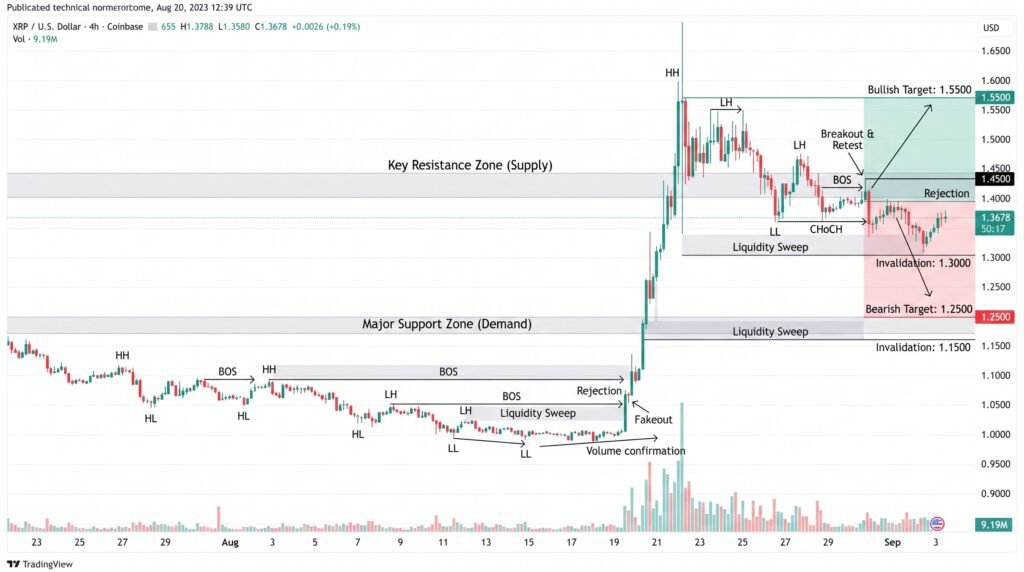
Meanwhile, XRP itself is trading around $1.36, with a market capitalization of about $85.6 billion and roughly $2.43 billion in 24-hour trading volume in the latest CoinGecko data. XRP was down about 5% over seven days despite gaining roughly 3.3% over the previous 24 hours.
For investors, the BIS paper is therefore best viewed as evidence of additional institutional experimentation with XRPL, not as a direct valuation catalyst for XRP.
Conclusion
The BIS research gives XRPL a credible institutional proof of concept for verifying official economic data, with median publication times of 3–5 seconds and verification in 1–2 seconds. The system uses cryptographic hashes, Merkle roots and publisher credentials while keeping the underlying data off-chain. However, the testing occurred on XRPL DevNet and remains research rather than a BIS production deployment. For XRP investors, the significance lies in expanding institutional use cases for the ledger, while the immediate impact on XRP’s price remains uncertain.
Sources & Methodology
Primary-source standard: Market-moving facts should link to original data releases, regulator notices, company filings or official project announcements whenever available. Secondary reporting is used for additional context, not as a substitute for original evidence.
Page last reviewed: