Zcash co-founder Sean Bowe has proposed ending automatic funding for the Zcash Community Grants (ZCG) program, arguing that its existing assets could support years of spending without additional token allocations. The draft, published on October 26, would redirect the program’s 8% share of newly issued ZEC into a reserve for future mining rewards. The proposal does not immediately change the network’s rules: it remains a draft that would require community review and protocol changes before taking effect.
$125 Million Treasury Drives Proposal
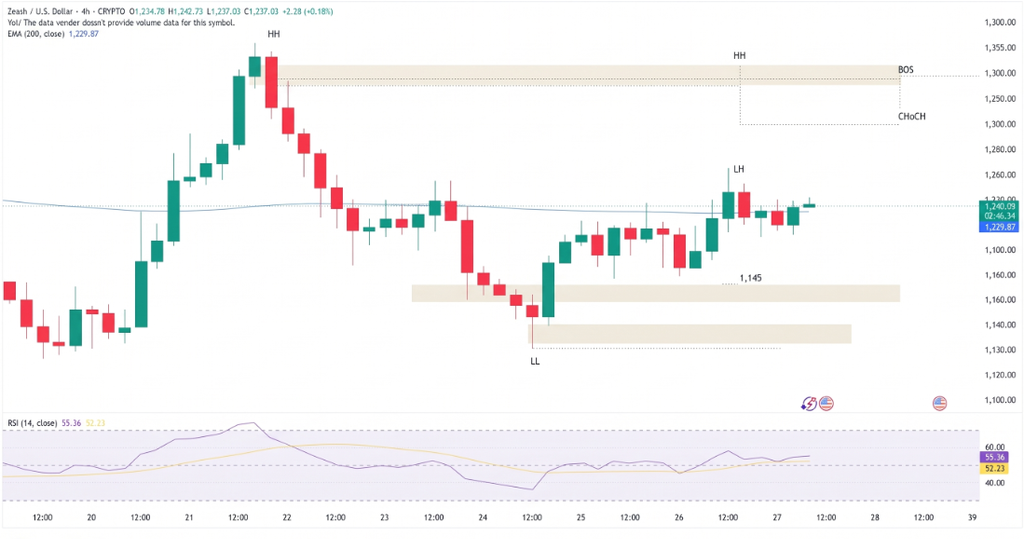
Bowe’s proposal argues that ZCG’s funding stream has become larger than necessary given the program’s accumulated resources. His estimated $125.3 million treasury valuation is based on an illustrative ZEC price of $1,300, not a statement of the fund’s current market value.
The committee’s funding dashboard reportedly listed about 91,453 ZEC and $8.8 million in other assets, with approximately $2.4 million committed to grants. The valuation changes substantially with ZEC’s market price.
Under the proposal, the existing treasury would remain available for approved grants, while future allocations would stop flowing automatically to the committee. Bowe estimates that the current reserve could cover years of expenditure, including under lower ZEC-price assumptions, if annual spending remains controlled.
The funding stream currently directs roughly 144 ZEC per day to ZCG. At the proposal’s illustrative price of $1,300 per coin, that amounts to approximately $68 million annually. This estimate is highly price-sensitive and should not be read as the program’s guaranteed dollar income.
Zcash Funding Model Would Change
Zcash’s development funding system includes separate allocations with different governance arrangements. ZCG’s 8% share supports grants selected by a five-member committee, while a separate 12% allocation is controlled through coinholder voting. Bowe’s proposal would preserve the larger, coinholder-directed stream rather than eliminate community funding altogether.
The redirected 8% allocation would instead enter the Network Sustainability Mechanism, a protocol-level reserve designed to support future mining rewards. The proposal would keep those funds in reserve for the remaining term of the existing grants stream.
Key implications include:
- ZCG: Keeps its existing assets and continues awarding grants.
- New allocations: The automatic 8% stream would be redirected.
- Coinholder fund: Its separate 12% allocation would remain in place.
- Network rules: Implementation requires an approved protocol change.
The Zcash Improvement Proposal process provides the framework for reviewing protocol changes, gathering feedback and building consensus. The draft has no activation date.
Grant Debate Adds Governance Pressure
The proposal follows scrutiny of ZECsy, a Zcash-funded outreach initiative seeking to promote private payments among people who face banking restrictions. Its revised grant request was $550,000, covering adult-industry events, crypto conferences and workshops. The program drew online criticism after images from an event booth circulated on social media.
Bowe’s draft, however, focuses on the size of ZCG’s reserves and the ongoing issuance of new funds; it does not cite the ZECsy grant as its rationale. The debate therefore raises broader questions about grant budgets, oversight and how much capital a community funding program should accumulate.
Conclusion
Bowe’s proposal would shift Zcash’s funding policy from continuous grants inflows toward preserving reserves for future network needs. Whether it advances will depend on community review and the protocol approval process. Until a change takes effect, the existing funding stream remains in place.
Sources & Methodology
Primary-source standard: Market-moving facts should link to original data releases, regulator notices, company filings or official project announcements whenever available. Secondary reporting is used for additional context, not as a substitute for original evidence.
Page last reviewed: