Zcash (ZEC) approached the $1,000 level on Wednesday after losing more than 20% over five consecutive sessions. Stronger-than-expected US inflation and rising Federal Reserve rate-hike expectations have intensified selling across cryptocurrencies, outweighing the positive headlines surrounding Grayscale’s major Zcash marketing campaign and financial support for the network. With bearish derivatives signals and weakening technical indicators, investors are watching whether ZEC can defend the psychologically important $1,000 threshold or extend its decline toward $880.
Hot US Inflation Pressures Zcash
The latest US Consumer Price Index (CPI) report showed that consumer prices increased 0.4% in October, exceeding economists’ forecast of 0.3%. Core inflation, which excludes food and energy, also rose 0.3%, above expectations of 0.2%, according to the Bureau of Labor Statistics.
The stronger figures increased expectations of further monetary tightening. The CME FedWatch Tool indicated roughly a 90% probability of a 25-basis-point Federal Reserve rate increase in December.
Higher borrowing costs can reduce demand for speculative investments, including digital assets, as investors reassess the attractiveness of riskier positions. The broader crypto market experienced more than $700 million in liquidations over 24 hours, with approximately $580 million coming from leveraged long positions, according to the market figures reported by FXStreet.
Bitcoin also fell below $74,000, while ZEC declined sharply. The downturn came despite Grayscale launching a prominent advertising campaign for its Zcash investment product, including a front-page advertisement in The Wall Street Journal.
Grayscale Campaign Fails to Lift Sentiment
Grayscale has expanded its support for the Zcash ecosystem, pledging to reinvest 100% of its Zcash Trust ETF sponsor fees into network development, marketing, community initiatives and education for up to one year.
The asset manager also announced a $1 million commitment to Zcash-related initiatives. It had already distributed $400,000 in grants among four organizations supporting the network.
The campaign highlights growing institutional efforts to promote Zcash and its privacy-focused technology. However, positive developments surrounding the project have not been enough to counter broader market weakness and investor concerns about interest rates.
Derivatives indicators also point to deteriorating sentiment. The Crypto Fear and Greed Index fell to 26 from 42 a week earlier, indicating increased caution across the market.
Meanwhile, CoinGlass data showed Zcash’s futures taker buy-to-sell ratio falling to 0.95. A reading below 1 indicates that aggressive selling orders exceed buying activity, reflecting weak immediate demand.
ZEC Technical Outlook Points to $880
Zcash has fallen below its 50-day Exponential Moving Average (EMA) near $1,202 and is approaching its 200-day EMA around $880. The decline also broke below the $1,050 horizontal support and the previous consolidation range between $1,112 and $1,340.
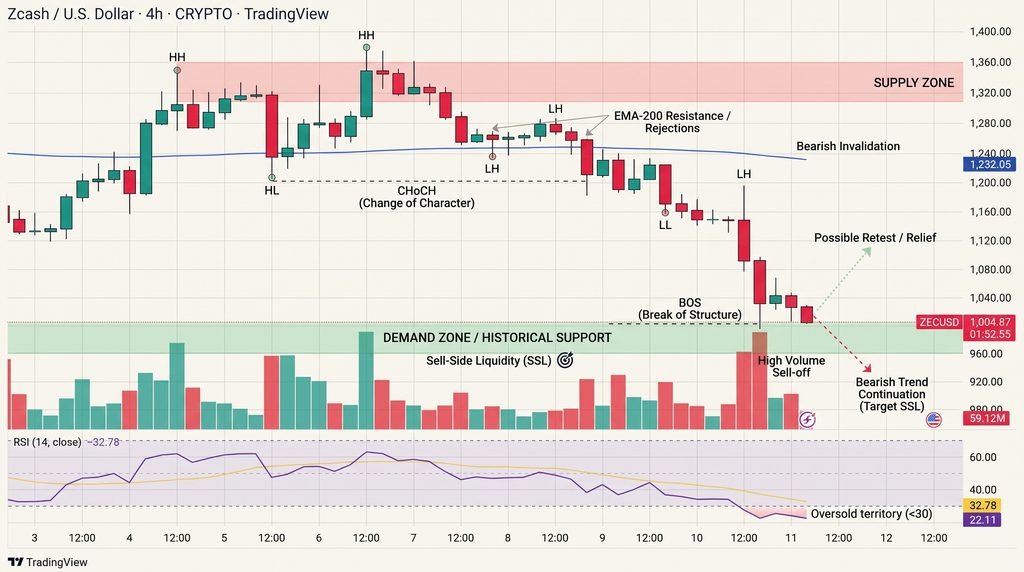
The daily Relative Strength Index (RSI) has dropped to 36, while the Moving Average Convergence Divergence (MACD) remains below zero, indicating persistent bearish momentum.
Key technical levels include:
- Immediate support: $1,000, followed by $880.
- Initial resistance: $1,050 and $1,112.
- Major resistance: $1,202, near the 50-day EMA.
Conclusion
Zcash faces continued downside risks as inflation concerns, leveraged selling and weak derivatives demand outweigh Grayscale’s promotional efforts. A sustained break below $1,000 could expose the $880 moving-average support. However, reclaiming $1,050 and $1,112 would provide an early indication that selling pressure is easing. The near-term recovery outlook depends heavily on broader cryptocurrency sentiment and expectations for Federal Reserve policy.
Sources & Methodology
Primary-source standard: Market-moving facts should link to original data releases, regulator notices, company filings or official project announcements whenever available. Secondary reporting is used for additional context, not as a substitute for original evidence.
Page last reviewed: