
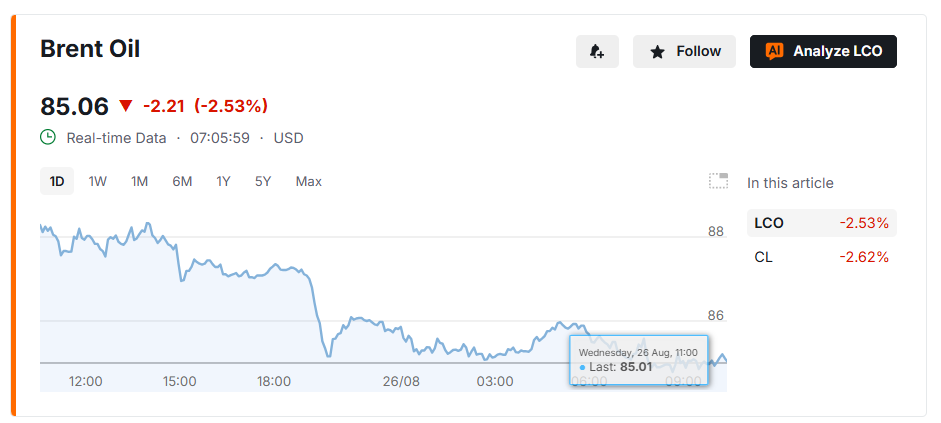
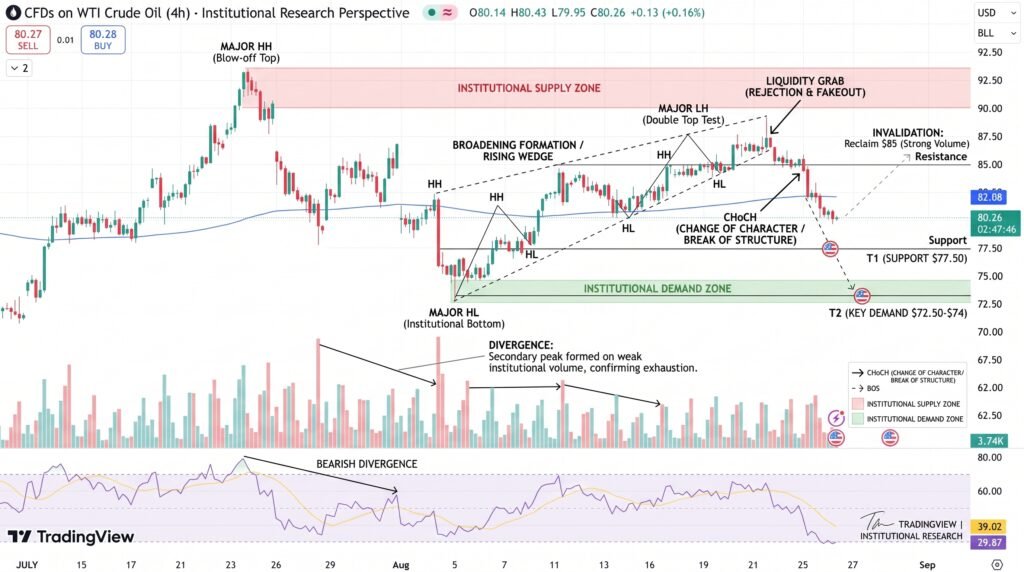
Oil prices fell for a second straight session Wednesday after reports pointed to progress in U.S.-Iran diplomacy and a possible reopening of the Strait of Hormuz. Brent crude futures dropped 2.6% to $86.30 a barrel by 04:17 ET, while U.S. West Texas Intermediate fell 2.7% to $80.18, extending Tuesday’s 5% slide. Russian state agency RIA Novosti reported the U.S. and Iran are close to a new ceasefire that would restore free navigation through the strait, though Investing.com could not independently confirm the report.
A Reported Hormuz Deal Takes Shape
RIA Novosti’s report, citing Pakistani and Iranian sources, said the arrangement would guarantee free passage through the Strait of Hormuz and could be announced within days. Pakistan has served as the primary mediator between Washington and Tehran throughout the conflict, having helped broker a ceasefire in June. Separately, a senior Iranian official told Al Jazeera that Iran and Oman agreed on a temporary route through the strait following talks in Tehran. The official was clear that full reopening will not happen until the U.S. fulfills the commitments it made in June’s framework ceasefire — a condition Washington has not yet met.
Shipping Traffic Still a Trickle
Physical traffic through the strait shows how far the market remains from normal. Preliminary data from Kpler, cited by CNBC, showed just five commodity vessels transited the strait on Tuesday, well below the 10-day average of 15. Before the conflict began in late February, roughly a fifth of the world’s oil and liquefied natural gas passed through the channel.
Analysts are pricing in a lasting risk premium rather than a full return to pre-war conditions:
- Vital Knowledge said a geopolitical risk factor will likely stay permanently embedded in oil prices, given how quickly fighting has resumed before.
- ING said the Iran-Oman arrangement does not equal normalized flows, noting the U.S. would first need to lift its blockade on Iranian ports and ease sanctions on Tehran.
The diplomatic movement also follows, by one day, tighter U.S. economic sanctions on Iran — a signal that Washington currently favors economic pressure over military action.
A Discount That May Not Fully Fade
Wednesday’s decline reflects real progress: two separate reports of eased restrictions, plus a mediator with a track record of successful ceasefires. But the underlying math hasn’t changed. Vessel counts remain a third of normal, the U.S. blockade is still active, and Tehran’s own official said reopening depends on American commitments not yet fulfilled. Until shipping volumes recover toward pre-war levels and both sides hold to their terms, oil prices are likely to keep carrying a risk premium tied directly to the strait’s uncertain status — even as each new report of progress triggers short-term selling.
Sources & Methodology
Primary-source standard: Market-moving facts should link to original data releases, regulator notices, company filings or official project announcements whenever available. Secondary reporting is used for additional context, not as a substitute for original evidence.
Page last reviewed: