
The EUR/USD exchange rate climbed for a second consecutive session on Friday, trading around 1.1225–1.1230 as the US dollar weakened alongside a pullback in Treasury yields. The recovery offers some relief after the pair recently touched 1.1160, its lowest level since May 2025. However, the euro’s gains remain vulnerable: persistent geopolitical uncertainty, expectations for a hawkish Federal Reserve and mounting French fiscal concerns continue to weigh on the outlook.
Softer Dollar Supports a Modest Rebound
The dollar came under pressure after US Treasury yields retreated and investors took profits on recent gains. Comments from President Donald Trump that Washington would avoid resuming military strikes against Iran before the November 3 midterm elections also helped ease some immediate market concerns.
Still, the risk premium surrounding the US-Iran standoff has not disappeared. Uncertainty over Tehran’s nuclear program could quickly revive demand for defensive assets and support the dollar if tensions intensify.
Monetary policy presents another obstacle for the euro. The Federal Reserve raised its benchmark interest-rate range by 25 basis points in September to 3.75%–4.00%. Recent hawkish comments from some policymakers have reinforced expectations that borrowing costs could remain restrictive or rise further. Higher expected US rates can support the dollar by making dollar-denominated assets more attractive.
France’s fiscal position is another source of pressure on the shared currency. The European Commission’s economic forecast projects French public debt to reach around 120.2% of GDP in 2027, while political divisions complicate efforts to reduce the deficit. These concerns may limit investor appetite for the euro even when the dollar temporarily weakens.
Key EUR/USD Levels to Watch
The pair remains within a trading range established earlier this month. Although momentum has improved, the technical picture does not yet confirm a sustained bullish reversal.
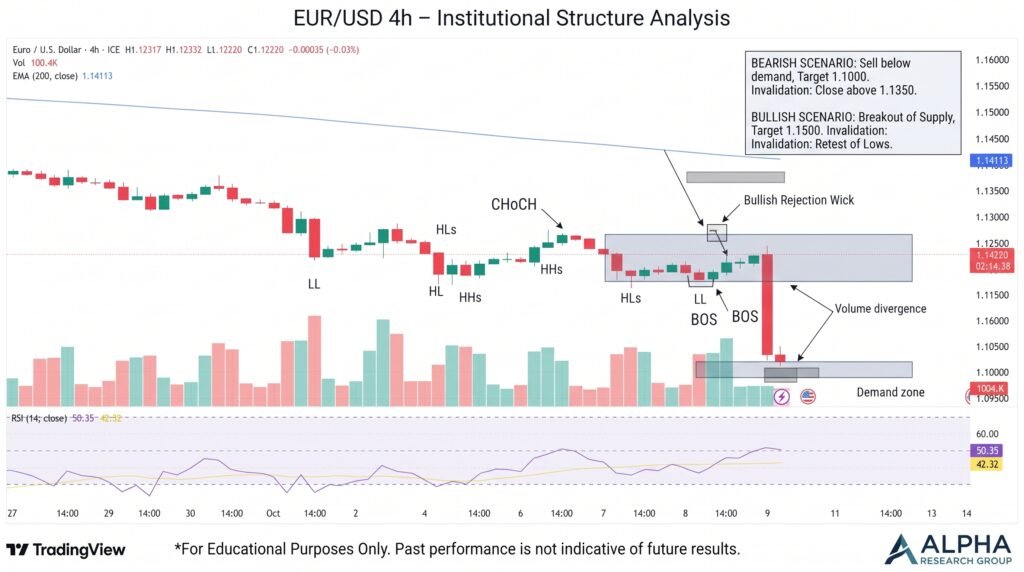
The Relative Strength Index (RSI) stands near 50.4, indicating broadly neutral momentum after recovering from oversold conditions. Meanwhile, the Moving Average Convergence Divergence (MACD) has turned modestly positive, suggesting selling pressure may be easing.
Traders are watching these levels:
- Resistance at 1.1280: The upper boundary of the current range and the first significant hurdle for buyers.
- 1.1300: A break above this psychological level could encourage short-covering.
- 1.1355–1.1360: The next potential upside target if bullish momentum strengthens.
- Support at 1.1200: A break below this level would weaken the recovery.
- 1.1160: The recent low and key downside level; a decisive breach could extend losses.
A move above resistance would improve the near-term outlook, but it would not automatically overturn the broader bearish structure.
Conclusion
EUR/USD is attempting to stabilize near 1.1230 as softer US yields ease pressure on the euro. Yet the recovery remains fragile, with Fed policy expectations, geopolitical risks and France’s fiscal challenges limiting upside potential. A sustained move above 1.1300 would strengthen the bullish case, while a fall below 1.1200 could expose the 1.1160 low again. Until resistance is cleared convincingly, the rebound may prove corrective rather than the start of a lasting uptrend.
Sources & Methodology
Primary-source standard: Market-moving facts should link to original data releases, regulator notices, company filings or official project announcements whenever available. Secondary reporting is used for additional context, not as a substitute for original evidence.
Page last reviewed: