Gold prices edged lower for a third consecutive session on Tuesday as rising oil prices intensified inflation concerns and strengthened expectations that the Federal Reserve could maintain restrictive monetary policy. Spot gold fell 0.1% to $4,137.84 an ounce, while December U.S. gold futures declined 0.1% to $4,165.34. Investors are assessing whether higher energy costs will delay monetary easing or encourage another rate increase, potentially raising the opportunity cost of holding non-yielding bullion.
Oil-Driven Inflation Weighs on Gold
Brent crude oil remained above $109 a barrel after reaching $110.70 in the previous session, its highest level in five months. Geopolitical tensions involving the Middle East have increased concerns about supply disruptions, offsetting some relief from the possibility of easing U.S. restrictions on Russian energy exports.
Yemen’s Iran-aligned Houthi group reported attacks on Saudi energy, airport and military targets on Monday, including an Aramco facility. The developments have heightened concerns about regional energy security and the potential for prolonged increases in oil prices.
Higher crude prices can push up transportation, manufacturing and household energy costs, making inflation harder to control. For gold investors, the concern is that persistent price pressures could keep interest rates elevated for longer.
The latest U.S. inflation figures reinforce that risk. According to the Bureau of Labor Statistics, consumer prices increased 3.7% year over year in September, while gasoline prices jumped 9.1% during the month. These figures complicate the Federal Reserve’s effort to return inflation to its 2% target.
Fed Rate Outlook Takes Center Stage
The Federal Reserve is scheduled to meet on October 27–28, with traders closely monitoring signals about its next policy decisions. The central bank raised its benchmark interest rate by 25 basis points in September, bringing the target range to 3.75%–4.00%.
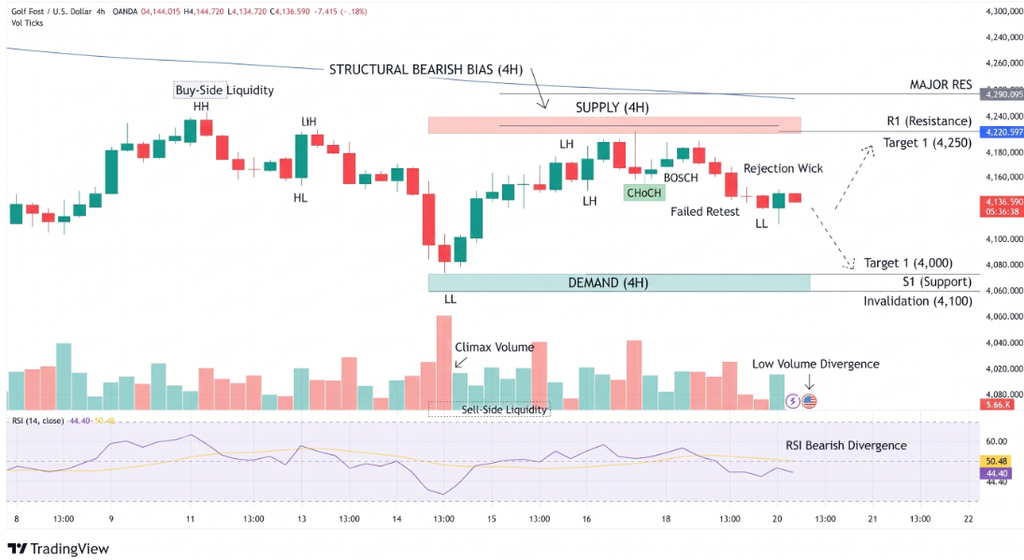
According to the supplied market snapshot, traders assigned an 83% probability to an unchanged rate next week and a 94% probability of a December increase, based on the CME FedWatch Tool. These probabilities reflect market pricing rather than a confirmed policy decision.
Higher interest rates and Treasury yields generally weigh on gold because bullion generates no interest income. Conversely, falling yields or a weaker U.S. dollar could improve gold’s appeal by reducing the relative cost of holding the metal.
Investors are also watching the upcoming Personal Consumption Expenditures (PCE) price index, the Federal Reserve’s preferred inflation measure, for evidence of whether price pressures remain persistent.
Other precious metals showed mixed performance on Tuesday:
- Silver: Rose 0.1% to $57.1325 an ounce.
- Platinum: Advanced 0.5% to $1,650.65 an ounce.
Conclusion
Gold’s near-term direction will depend on energy prices, inflation data and the Federal Reserve’s policy signals. Sustained oil-price increases could reinforce expectations of higher interest rates, limiting bullion’s recovery. However, easing inflation, lower Treasury yields or renewed geopolitical uncertainty could support demand. Traders will focus on the October policy meeting and upcoming PCE data for clearer signals about gold’s next move.
Sources & Methodology
Primary-source standard: Market-moving facts should link to original data releases, regulator notices, company filings or official project announcements whenever available. Secondary reporting is used for additional context, not as a substitute for original evidence.
Page last reviewed: